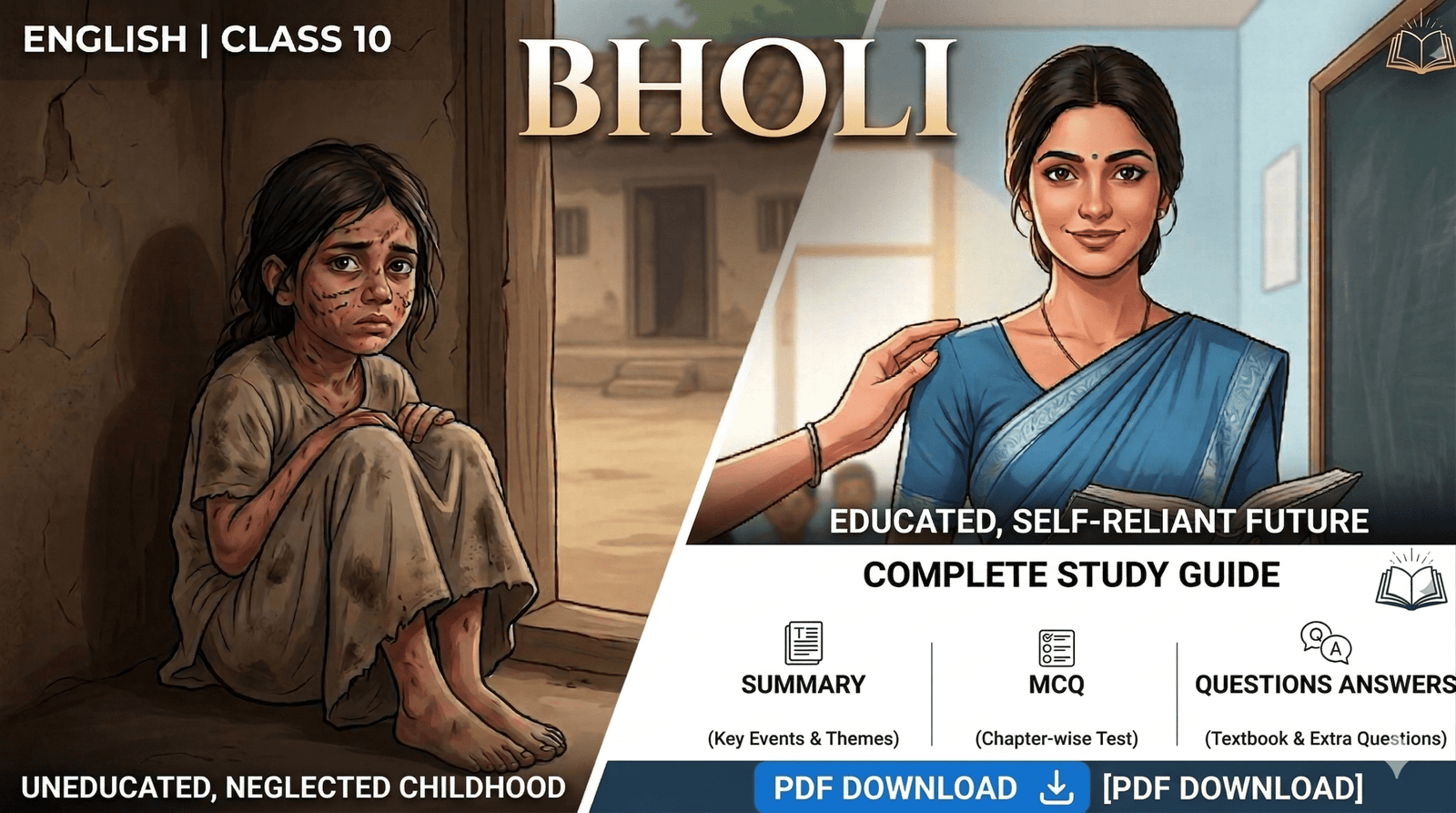
1. Chapter Introduction
“Bholi” is a heart-touching story written by K.A. Abbas. It revolves around a girl named Sulekha, who is nicknamed ‘Bholi’ (simpleton) because of her slow mental development and stammering. Neglected by her parents due to her looks and lack of intelligence, Bholi’s life takes a complete turn when she starts going to school. The story highlights the importance of education and how a supportive teacher can transform a shy, fearful child into a confident and independent woman who stands up for her rights.
2. Characters Detail
- Bholi (Sulekha): The protagonist of the story. She is a neglected child who suffers from the after-effects of an accident and smallpox. She transforms from a fearful child into a courageous woman through education.
- Ramlal: Bholi’s father and a Numberdar of the village. He is a traditional man who worries about his daughters’ marriages and social status.
- The Teacher: A kind, patient, and encouraging woman. She is the real architect of Bholi’s new personality, giving her the strength to speak clearly and think independently.
- Bishamber Nath: A wealthy but greedy grocer who is much older than Bholi. He tries to exploit Ramlal’s helplessness by demanding a dowry of 5,000 rupees.
3. Full Summary
A Troubled Childhood
Sulekha was the fourth daughter of Numberdar Ramlal. At ten months old, she fell off her cot and damaged a part of her brain, making her a slow learner. At two, she had an attack of smallpox, which left her entire body covered with deep black pockmarks. To make matters worse, she began to stammer when she started speaking. Because of these reasons, everyone called her ‘Bholi’. She was neglected even by her own family, wearing the old, unwashed clothes of her sisters.
The Turning Point: Going to School
When a primary school for girls opened in the village, the Tehsildar asked Ramlal to send his daughters to school to set an example. Ramlal’s wife argued that sending girls to school would make it difficult to marry them off, but she agreed to send Bholi because she thought Bholi had “little chance of getting married” anyway. Bholi was terrified of going to school, but after being washed and given a clean dress for the first time, she felt she was going to a better place than home.
The Kind Teacher
At school, Bholi sat in a corner, afraid and crying. When the teacher asked for her name, Bholi stammered and could not speak. Instead of scolding her, the teacher spoke to her with a voice so soft and kind that Bholi had never heard before. With patient encouragement, Bholi finally managed to say her full name. The teacher promised her that if she came to school every day, she would soon be the most learned person in the village. This gave Bholi a new ray of hope.
The Marriage Proposal
Years passed, and the village became a small town. A marriage proposal came for Bholi from Bishamber Nath, a wealthy grocer who was about the same age as Bholi’s father and had grown-up children from his first wife. Ramlal and his wife accepted the proposal, thinking it was the best chance for Bholi. On the wedding day, Bishamber arrived with great pomp. However, when he saw Bholi’s pockmarked face during the garland ceremony, he refused to marry her unless Ramlal paid him 5,000 rupees as dowry.
Bholi’s Courageous Decision
Ramlal was humiliated and placed his turban at Bishamber’s feet, eventually giving him the money. But when Bishamber raised the garland to put it around Bholi’s neck, she struck it away. Her voice was clear and she did not stammer. She told her father that she would not marry this “greedy and cowardly” man. She decided she would not get married and instead would serve her parents in their old age and teach in the same school where she had learned so much. Her teacher, who was watching from a corner, felt proud of her student’s transformation.
4. Multiple Choice Questions (10 MCQs)
Q1. What was Bholi’s real name?
(a) Sulekha | (b) Radha | (c) Mangla | (d) Champa
Answer: (a) Sulekha
Q2. What damaged a part of Bholi’s brain when she was ten months old?
(a) Smallpox | (b) Falling off her cot | (c) A high fever | (d) An accident in the street
Answer: (b) Falling off her cot
Q3. Why did Bholi have deep black marks on her body?
(a) Burn marks | (b) Smallpox | (c) Birthmarks | (d) Injuries from a fall
Answer: (b) Smallpox
Q4. What was Ramlal’s profession/status in the village?
(a) Tehsildar | (b) Teacher | (c) Numberdar | (d) Doctor
Answer: (c) Numberdar
Q5. Who insisted that Ramlal should send his daughters to school?
(a) His wife | (b) The Tehsildar | (c) Bholi’s teacher | (d) Bishamber
Answer: (b) The Tehsildar
Q6. How did Bholi feel on her first day of school after getting a clean dress?
(a) Angry | (b) Terrified | (c) She felt she was going to a better place than home | (d) Bored
Answer: (c) She felt she was going to a better place than home
Q7. What was the name of the man who came to marry Bholi?
(a) Ram Nath | (b) Bishamber Nath | (c) Shanti Lal | (d) Hari Singh
Answer: (b) Bishamber Nath
Q8. How much dowry did Bishamber demand?
(a) 2,000 rupees | (b) 5,000 rupees | (c) 10,000 rupees | (d) 1,000 rupees
Answer: (b) 5,000 rupees
Q9. Why did Bholi refuse to marry Bishamber?
(a) He was old | (b) He was lame | (c) He was greedy and heartless | (d) All of the above
Answer: (d) All of the above
Q10. What did Bholi decide to do at the end of the story?
(a) Run away | (b) Commit suicide | (c) Serve her parents and teach in the school | (d) Marry another man
Answer: (c) Serve her parents and teach in the school
5. Short Answer Questions (35 Words)
Q1. Why was Sulekha nicknamed ‘Bholi’?
Ans. Sulekha was called ‘Bholi’ because she had fallen off her cot as a baby, which damaged a part of her brain. This made her a slow learner and a simpleton compared to other children.
Q2. Why did Bholi’s parents decide to send her to school?
Ans. The Tehsildar pressured Ramlal to send his daughters to school. His wife thought sending healthy daughters would ruin their marriage prospects, but Bholi had “no looks and no sense,” so they sent her.
Q3. How did the teacher help Bholi on her first day?
Ans. The teacher was extremely kind and patient. She didn’t laugh at Bholi’s stammering. Instead, she encouraged her with love, which gave Bholi the confidence to speak her name and feel safe in school.
Q4. Why did Bishamber demand a dowry of five thousand rupees?
Ans. During the wedding, Bishamber saw the pockmarks on Bholi’s face. Being greedy, he decided to exploit the situation and demanded 5,000 rupees from Ramlal as a condition to marry a “disfigured” girl.
Q5. Why was the teacher happy and satisfied at the end of the story?
Ans. The teacher was happy because she saw her “masterpiece” (Bholi) standing up for herself. Bholi’s courage to refuse a greedy husband proved that the teacher’s hard work and education had successfully transformed her.
6. Long Answer Questions (60-70 Words)
Q1. Give a character sketch of Bholi.
Ans. Bholi, originally Sulekha, is a symbol of resilience and transformation. In childhood, she was a neglected, stammering girl with a pockmarked face. However, education and her teacher’s support changed her completely. She evolved from a submissive “cow” into a confident, self-respecting woman. Her decision to reject a greedy groom and serve her parents shows her high moral character, intelligence, and immense inner strength.
Q2. Role of the teacher is crucial in Bholi’s life. Elaborate.
Ans. The teacher acted as a second mother and a mentor to Bholi. She was the first person to treat Bholi with dignity and affection. By encouraging her to speak and study, she replaced Bholi’s fear with hope and her stammering with clear speech. The teacher’s constant support gave Bholi the education that eventually allowed her to stand up against social evils like dowry and greedy marriages.
Q3. Why did Bholi refuse to marry Bishamber? Was her decision right?
Ans. Bholi refused to marry Bishamber because he was a greedy, heartless, and cowardly man who tried to humiliate her father for money. Despite his age and limp, Bholi was ready to marry him for her family’s sake, but his demand for dowry was the last straw. Her decision was absolutely right because marriage should be based on mutual respect, not on exploitation and greed.
Q4. How did Bholi’s family treat her? Compare it with her teacher’s treatment.
Ans. Bholi’s family treated her as a burden. She was never given new clothes, her hair was never oiled, and her parents considered her a “witless” child. They sent her to school only to get rid of her. In contrast, her teacher treated her with immense love, patience, and equality. While her family saw her flaws, her teacher saw her potential, proving that empathy is more powerful than blood relations.
Q5. What social evils are highlighted in the story ‘Bholi’?
Ans. The story highlights several social evils: gender discrimination, the dowry system, and the neglect of children with disabilities. It shows how daughters are often considered burdens and how society values looks over character. However, the story also provides a solution—education. Through Bholi’s victory, the author shows that education can empower individuals to fight these traditional evils and live a life of dignity.