
Table of Contents
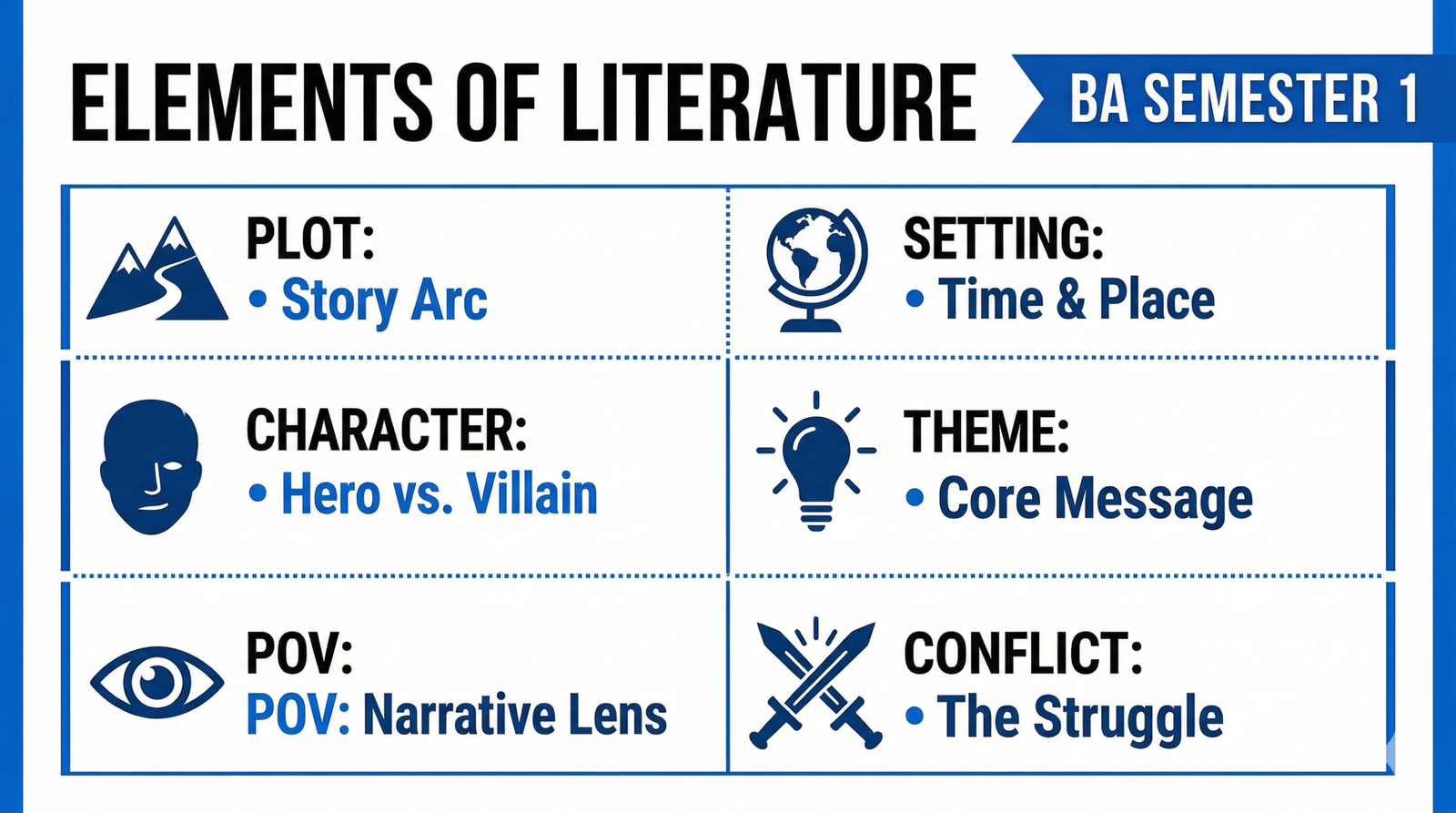
The 6 Essential Elements of Literature: A Simple Guide
Have you ever read a book you just couldn’t put down? Or maybe watched a movie that stayed in your head for days? That magic doesn’t happen by accident. Behind every great story—whether it’s a classic novel you are reading for class or a weekend thriller—there is a specific recipe. The ingredients in that recipe are what we call the elements of literature.
Many people think analyzing literature is just about finding hidden, complicated meanings. But honestly, it’s much simpler than that. Understanding the elements of literature is really just learning how a story is built from the ground up. Think of it like taking apart an engine to see how it makes a car move. When you know how the pieces fit together, reading becomes a lot more fun, and writing your own essays (or even your own stories!) becomes incredibly easy.
In this guide, we are going to break down the core components that make up any good piece of fiction. Let’s dive in!
1. Plot: The Backbone of the Story
If a story were a house, the plot would be the floor plan. It is the sequence of events that make up the narrative. Simply put, the plot is exactly what happens in the story. It is the chain of cause and effect that keeps you turning the pages, asking, “And then what?”
But a good plot isn’t just a random list of events happening one after another. It usually follows a very specific emotional rollercoaster, which looks a bit like climbing a mountain:
- The Setup (Exposition): This is the beginning. We meet the main characters and see their normal, everyday world before everything gets flipped upside down.
- The Spark (Inciting Incident): Something unexpected happens that kicks off the adventure. A mysterious letter arrives, a crime is committed, or the protagonist gets fired from their job.
- The Climb (Rising Action): The tension starts to build. The characters face obstacles, make mistakes, meet allies, and try to solve the main problem. This takes up the majority of the story.
- The Peak (Climax): This is the ultimate showdown. It’s the most exciting, nail-biting part of the story where the main character has to face their biggest fear or enemy head-on. There is no turning back.
- The Cool Down (Falling Action & Resolution): The dust settles. We see the aftermath of the climax, loose ends are tied up, and we get to see what the characters’ “new normal” looks like.
Let’s look at an example: Think about The Lion King. The plot isn’t just “animals living in Africa.” The plot is: A young lion cub loses his father (Inciting Incident), runs away out of guilt (Rising Action), eventually realizes he must return to save his family (Climax), and takes his rightful place as king (Resolution).
2. Setting: The ‘Where’ and ‘When’
Imagine watching a horror movie, but instead of taking place in an abandoned, dark mansion during a thunderstorm, it happens in a brightly lit, colorful candy store at noon. It completely ruins the scary vibe, right? That is the power of setting.
If the plot is what happens in a story, the setting is where and when it happens. It acts as the stage for your characters to move around on. But setting is actually a lot more than just a backdrop; it is a crucial tool that writers use to create a specific feeling or atmosphere.
When we talk about setting, we are looking at two main things:
- Time: This isn’t just the time of day (like midnight or early morning). It also includes the historical period (like the 1920s or the distant future), the season (a harsh winter or a blooming spring), and even the duration of the story (does it happen over one single day, or across ten years?).
- Place: This is the physical location. It could be as broad as an entire planet or a specific country, or as small as a single, claustrophobic elevator where two characters are trapped.
Why it matters: The setting dictates what is possible in the story. If your story is set in a small village in 1850, your characters can’t just pull out a smartphone to solve a problem.
Beyond practical rules, setting creates the mood. Think about the Harry Potter series. The magical, cozy, and sometimes dangerous halls of Hogwarts castle make the story feel completely different than if Harry had stayed locked in the boring, completely normal cupboard under the stairs at the Dursleys’ house. The environment shapes the whole experience for the reader!
3. Characters: The Heart of the Story
What would a story be without anyone in it? Probably just an empty landscape. Characters are the people, animals, or sometimes even robots that drive the plot forward. They are the ones making decisions, messing up, falling in love, and saving the day. Ultimately, characters are the reason we actually care about what happens in the story.
When you look closely, characters usually fall into a few specific roles:
- The Protagonist: This is your main character. The story revolves around them. Keep in mind, the protagonist isn’t always a flawless “good guy” or a superhero in a cape. Sometimes they are deeply flawed or make terrible choices, but they are still the person whose journey we are following.
- The Antagonist: This is the person, group, or force standing in the protagonist’s way. It is easy to just call them the “villain,” but an antagonist doesn’t have to be evil. Sometimes, it is just a rival in a sports tournament, a strict boss, or even nature itself (like a massive hurricane they have to survive).
- Dynamic vs. Static Characters: The best stories feature characters that change over time. A dynamic character learns a hard lesson, grows up, or completely shifts their perspective by the end of the story. A static character, on the other hand, stays exactly the same from page one to the very end.
Let’s look at an example: Think of Tony Stark (Iron Man). He starts his first movie as a selfish, arrogant billionaire, but over time, he learns to sacrifice himself for others. That makes him a highly dynamic character. On the flip side, someone like Captain America is much more static; his core morals and desire to do the right thing remain rock-solid from his very first scene to his last.
4. Theme: The Deeper Meaning
If the plot is what the characters do, the theme is what the story means. It is the big idea, the underlying message, or the life lesson that the author is trying to share with the reader. It is the invisible thread that holds the whole story together and gives it a soul.
A lot of students confuse a story’s “subject” with its “theme,” but there is a big difference.
- The Subject is just the topic. It can usually be described in one word: Love, War, Revenge, Friendship, or Survival.
- The Theme is what the author is specifically saying about that subject. It is usually a complete sentence.
For example, if a book’s subject is “Revenge,” the theme isn’t just “revenge.” The theme might be, “Revenge ultimately destroys the person seeking it,” or on the flip side, “Sometimes revenge is the only path to true justice.”
Why it matters: Themes are what make literature relatable. You might never fight a dragon or travel through space, but you definitely know what it feels like to experience love, betrayal, fear, or hope. Themes connect the fictional world to our real, everyday lives.
Let’s look at an example: Think about Spider-Man. The plot is about a teenager who gets bitten by a radioactive spider and fights bad guys. The subject is gaining superpowers. But the theme is famously summed up in one line: “With great power comes great responsibility.” That is the core message the audience takes home!
5. Point of View (POV): The Camera Angle of the Story
Imagine you and your friend both witness a minor car accident on the street. If you tell the story, it will sound completely different than if your friend tells it, because you both saw it from different angles and noticed different details. That is exactly what Point of View (POV) is.
POV is the “lens” or the “camera angle” through which the author lets you experience the story. It determines who is telling the story and how much information the reader is allowed to know.
There are three main types of POV you will see in literature:
- First-Person POV (“I”, “Me”, “We”): The narrator is a character inside the story. You are directly inside their head, hearing their personal thoughts and feelings. It feels very intimate, almost like reading someone’s private diary.
- Drawback: You only know what this character knows. If they are being lied to, you are being lied to as well!
- Third-Person Limited (“He”, “She”, “They”): The narrator is outside the story, like a camera following one specific character around. You get to see the world through their eyes and know their thoughts, but you don’t know what the other characters are thinking.
- Third-Person Omniscient (The “God” View): The narrator is outside the story but knows everything. This narrator can jump into the minds of any character, see things happening miles away, and even tell the reader things that the characters haven’t figured out yet.
Why it matters: The POV completely changes how you connect with the story. A mystery novel written in the first-person is thrilling because you have to solve the clues right alongside the detective. If it were written in omniscient POV, you would already know who the killer is from page one, which ruins the fun!
Let’s look at an example: The Hunger Games is famous for its First-Person POV. You experience the fear and adrenaline exactly as Katniss Everdeen feels it, using “I”. On the other hand, Harry Potter uses Third-Person Limited; the story focuses heavily on Harry’s experiences (“Harry walked down the hall…”), but the narrator isn’t Harry himself.
6. Conflict: The Engine of the Story
If you have a great setting, interesting characters, and a beautiful theme, but absolutely nothing goes wrong… you don’t have a story. You just have a description of a really nice day. Conflict is the engine that drives the entire plot forward. It is the problem, the struggle, or the obstacle that the main character has to overcome.
Without conflict, characters have no reason to make choices, and without choices, they never grow or change.
Conflicts generally fall into two main categories:
- Internal Conflict (Character vs. Self): This happens entirely inside the character’s mind. They might be struggling with a tough moral decision, trying to overcome a phobia, dealing with guilt from their past, or battling their own insecurities. It is a war of emotions.
- External Conflict: This happens when a character is fighting against an outside force. There are a few common types:
- Character vs. Character: The classic hero versus villain setup. Two people have opposing goals and clash with each other. (e.g., Batman vs. The Joker).
- Character vs. Nature: The protagonist is trying to survive in a harsh environment, battling a natural disaster, or fighting a wild animal. (e.g., surviving a plane crash on a deserted island or trying to outrun a massive tornado).
- Character vs. Society: The main character rebels against the unfair rules of their government, fights an oppressive system, or stands up against the expectations of their culture. (e.g., Katniss Everdeen fighting the Capitol in The Hunger Games).
Why it matters: Conflict creates tension. It is the exact thing that makes the reader hold their breath and keep reading late into the night because they simply have to know how the problem gets solved. If the problem is too easy to solve, the story feels boring. The harder the conflict, the more satisfying the resolution!