Father to Son Class 11: Summary, MCQs & Important Questions

Father to Son Class 11: Poem, Summary, MCQs & Important Questions

Father to Son Class 11: Full Notes, Poem & MCQs

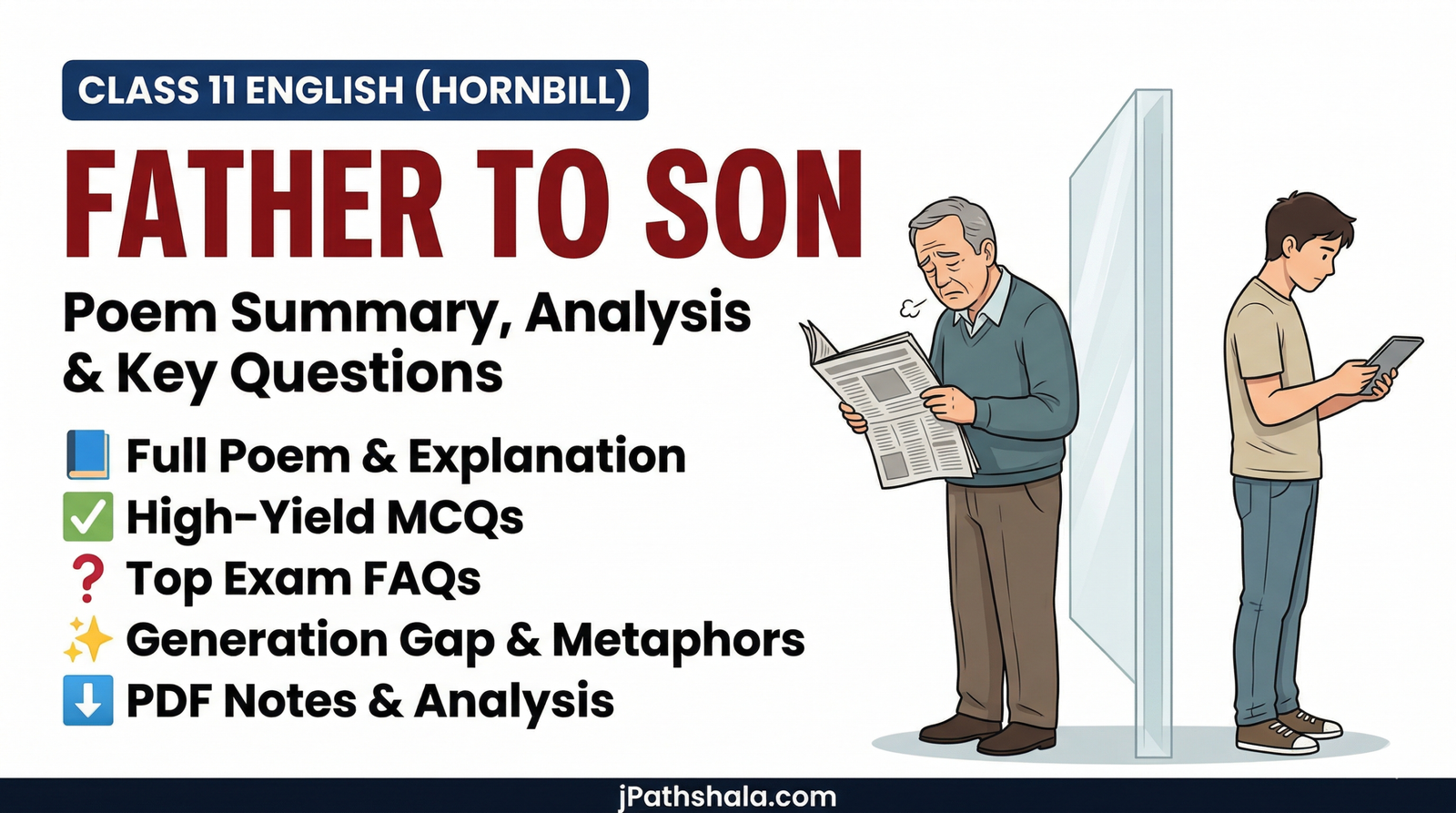
Welcome to the complete study guide for Class 11 English Hornbill chapter, “Father to Son”. Written by Elizabeth Jennings, this emotional poem highlights the universal problem of the generation gap and the painful lack of communication between a father and his grown-up son.

The Poem: “Father to Son” by Elizabeth Jennings

I do not understand this child
Though we have lived together now
In the same house for years. I know
Nothing of him, so try to build
Up a relationship from how
He was when small. Yet have I killed

The seed I spent or sown it where
The land is his and none of mine?
We speak like strangers, there’s no sign
Of understanding in the air.
This child is built to my design
Yet what he loves I cannot share.

Silence surrounds us. I would have
Him prodigal, returning to
His father’s house, the home he knew,
Rather than see him make and move
His world. I would forgive him too,
Shaping from sorrow a new love.

Father and son, we both must live
On the same globe and the same land,
He speaks: I cannot understand
Myself, why anger grows from grief.
We each put out an empty hand,
Longing for something to forgive.

Complete Summary of Father to Son

The poem is a direct confession of a father who is deeply unhappy about the broken relationship with his son. The summary can be divided into four key parts:

Phase 1: Strangers in the Same House

The father complains that even though he and his son have lived in the same house for years, he does not understand his child at all. He knows nothing about his son’s likes or dislikes. In a desperate attempt, the father tries to rebuild their relationship by remembering the time when his son was a small child, but he feels he has failed.

Phase 2: The Generation Gap

The father uses a metaphor of a seed and land. He feels that although he gave birth to the son (“the seed”), the son has grown up with a completely different mindset (“the land is his”). Physically, the son looks like his father (“built to my design”), but mentally, they are completely different. They speak to each other like strangers, and they do not share the same interests.

Phase 3: The Father’s Desire (The Prodigal Son)

Absolute silence surrounds their relationship. The father wishes for his son to be “prodigal” (wasteful but returning, referring to a Biblical story). He wants his son to come back to his father’s house instead of moving away and creating a separate world. The father is ready to forgive all his son’s mistakes to start a new bond of love shaped out of their current sorrow.

Phase 4: Mutual Helplessness

In the final stanza, the son’s perspective is briefly introduced. The son also admits that he doesn’t understand himself and realizes that his anger is born out of his sadness (grief) over their broken relationship. Both the father and the son want to reconcile. They both extend an “empty hand” towards each other, wanting to forgive, but neither knows how to bridge the gap.

Important Word Meanings

Word/Phrase Meaning in English
Sown Planted a seed (Here, giving birth to and raising the child).
Prodigal Spending money wastefully. (Refers to the Biblical story of the prodigal son who returns home after wasting his wealth and is forgiven by his father).
Grief Deep sorrow or sadness.
Empty hand A symbol of helplessness and the desire to make peace without knowing how.

Important Multiple Choice Questions (MCQs)

Practice these highly important exam-oriented MCQs based on the poem.

1. Who is the poet of the poem ‘Father to Son’?
  • A) Shirley Toulson
  • B) Ted Hughes
  • C) Elizabeth Jennings
  • D) Walt Whitman
Answer: C) Elizabeth Jennings
2. What is the central theme of the poem?
  • A) Love for nature
  • B) Generation gap and lack of communication
  • C) Childhood memories
  • D) Importance of education
Answer: B) Generation gap and lack of communication
3. Despite living in the same house for years, how do the father and son speak to each other?
  • A) Like best friends
  • B) Like strangers
  • C) Like teacher and student
  • D) They don’t speak at all
Answer: B) Like strangers
4. What does the word ‘prodigal’ refer to in the poem?
  • A) A very intelligent son
  • B) A son who is lost forever
  • C) A wasteful son who returns home seeking forgiveness
  • D) A son who hates his father
Answer: C) A wasteful son who returns home seeking forgiveness
5. “The seed I spent or sown it where / The land is his and none of mine”. What is the poetic device here?
  • A) Metaphor
  • B) Simile
  • C) Personification
  • D) Hyperbole
Answer: A) Metaphor (Seed = son, Land = the son’s mind/world)
6. What does the father want his son to do?
  • A) Move to a new city
  • B) Find a good job
  • C) Return to his father’s house
  • D) Never speak to him again
Answer: C) Return to his father’s house
7. Identify the poetic device in “Silence surrounds us”.
  • A) Simile
  • B) Alliteration
  • C) Oxymoron
  • D) Metaphor
Answer: B) Alliteration (Repetition of the ‘s’ sound)
8. According to the son, what grows from his grief?
  • A) Love
  • B) Silence
  • C) Anger
  • D) Happiness
Answer: C) Anger
9. What does the phrase “We each put out an empty hand” symbolize?
  • A) They are begging for money
  • B) They both want to reconcile but don’t know how
  • C) They are saying goodbye
  • D) They are fighting
Answer: B) They both want to reconcile but don’t know how
10. “This child is built to my design” means:
  • A) The father bought clothes for the son
  • B) The son is an architect
  • C) Physically, the son looks like the father
  • D) The son follows all the father’s rules
Answer: C) Physically, the son looks like the father

Top Exam Questions and Answers (FAQs)

Q1: Does the poem talk of an exclusively personal experience or is it fairly universal?
Answer: The poem highlights a fairly universal experience. It talks about the “Generation Gap” which is a common problem in many households. As children grow up, they develop their own independent thoughts, lifestyles, and priorities, which often clash with their parents’ traditional views, leading to a lack of communication and understanding.
Q2: How is the father’s helplessness brought out in the poem?
Answer: The father’s helplessness is highly evident. He laments that despite living in the same house for years, he and his son speak like strangers. He desperately wants to rebuild their relationship and is even willing to forgive his son’s mistakes (wishing him to be like the prodigal son). In the end, he extends an “empty hand,” showing his deep desire for peace but complete inability to fix the bond.
Q3: Explain the reference to the “Prodigal” son.
Answer: The word ‘prodigal’ refers to a famous Biblical parable. In the story, a son takes his inheritance, leaves home, and wastes all his money. When he returns empty-handed and repentant, his father forgives him and welcomes him back with open arms. The father in this poem wishes for the same; he wants his son to return to his roots, even if he has made mistakes, so they can start fresh.

Leave a Comment