
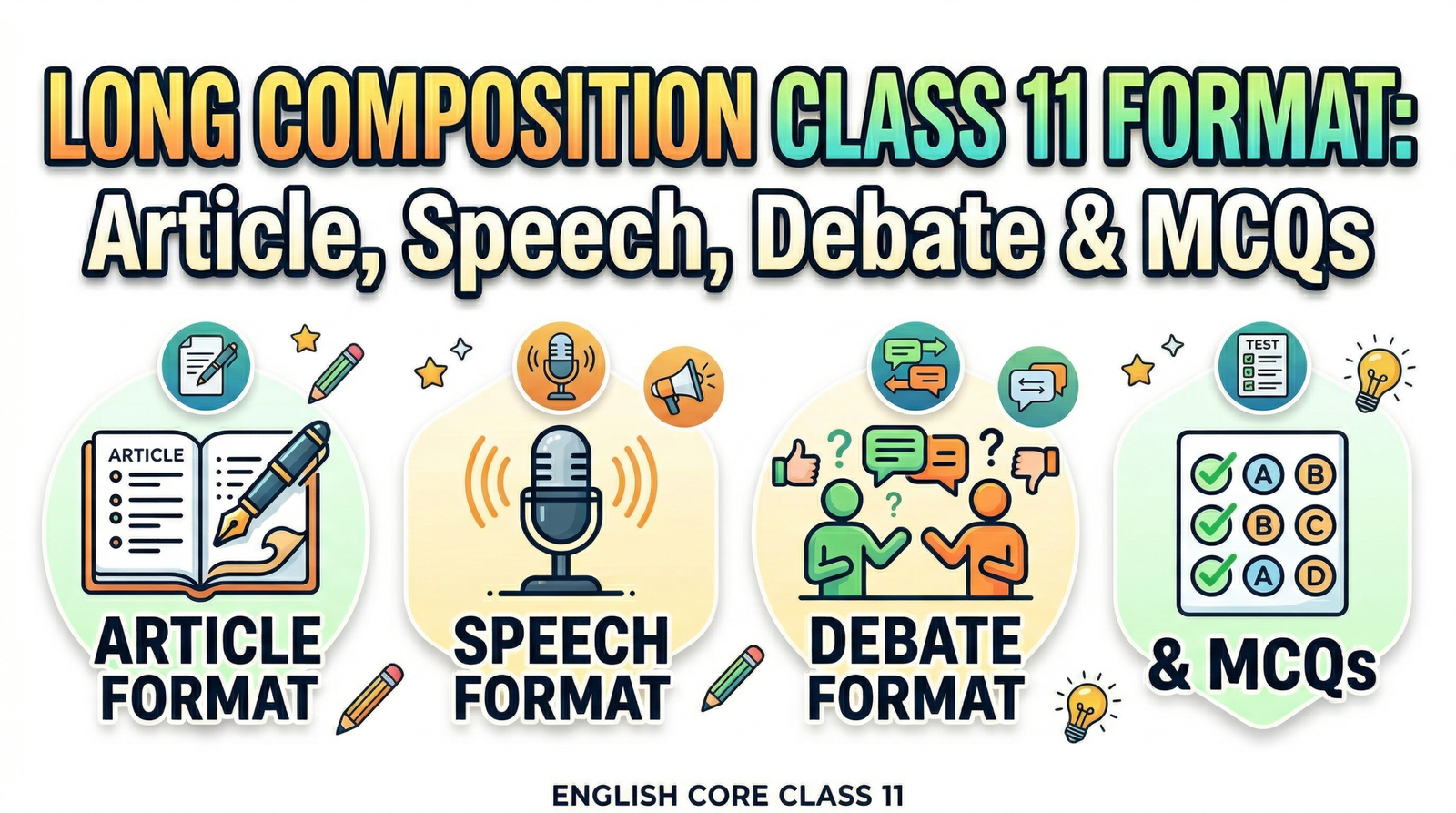
Long Composition
Article, Speech & Debate Writing – Class 11 English
Welcome to the ultimate guide on Long Compositions for CBSE Class 11 English. This section tests your ability to express ideas, arguments, and facts coherently over 120-150 words. Let’s master the exact formats for Article, Speech, and Debate Writing!
📝 Part 1: Article Writing
An article is written for a large audience, usually for publication in a newspaper, magazine, or journal. It should be informative, analytical, and structured.
✨ Format of an Article
- Heading/Title: Catchy and relevant (Center-aligned).
- Byline: The writer’s name (Placed just below the heading).
- Paragraph 1 (Introduction): Briefly introduce the topic and grab the reader’s attention.
- Paragraph 2 & 3 (Body): Discuss causes, effects, advantages, disadvantages, and current status.
- Paragraph 4 (Conclusion): Give suggestions, solutions, and a concluding thought.
💡 Solved Example: Article
Q. Write an article in 120-150 words on the topic “The Importance of Reading in the Digital Age”. You are Aman/Aditi.
While the internet provides quick information, it often leads to a shorter attention span. Books, on the other hand, demand focus and patience. They transport us to different worlds, broaden our perspectives, and enhance our vocabulary. Reading stimulates imagination and critical thinking, skills that 30-second videos cannot teach.
Moreover, reading is a great stress buster. It allows us to disconnect from the constant digital noise. To preserve this enriching habit, parents and schools must encourage children to read physical books. Let us not allow the screen to replace the profound joy of flipping through the pages of a good book.
🎤 Part 2: Speech Writing
A speech is a formal address delivered to an audience. It should be engaging, conversational, and persuasive.
✨ Format of a Speech
- Salutation: Greet the Chief Guest, Principal, Teachers, and Students.
- Opening: Introduce yourself and the topic.
- Body: Develop the topic with facts, examples, and rhetorical questions to engage the audience.
- Conclusion: Summarize the main points, give a call to action, and end with “Thank You”.
💡 Solved Example: Speech
Q. You are Rohan/Riya. Write a speech to be delivered in the morning assembly on “The Role of Youth in Nation Building”.
The youth are the backbone and the future of any country. India is blessed to have one of the largest youth populations in the world. This demographic dividend can be our biggest asset if channeled in the right direction. Youth means energy, innovation, and courage.
It is the youth who bring fresh ideas in technology, education, and social reforms. However, to build a strong nation, the youth must first educate themselves and stay away from destructive habits like drug abuse. We must actively participate in social campaigns and exercise our voting rights responsibly.
Let us pledge today to use our energy not in forwarding fake news, but in lifting the weaker sections of society. Remember, the progress of our nation rests on our shoulders.
Thank you!
⚖️ Part 3: Debate Writing
A debate is a formal contest of argumentation. You must strictly speak EITHER ‘For’ or ‘Against’ the given motion (topic).
✨ Format of a Debate
- Salutation: Address the jury/judges, teachers, and opponents.
- Stance: Clearly state whether you are speaking FOR or AGAINST the motion.
- Argumentative Body: Present strong, logical points. You can contradict the opposing side’s possible points (rebuttal).
- Conclusion: Reiterate your strong belief in your stance and end with “Thank You”.
💡 Solved Example: Debate
Q. Write a debate in 120-150 words either for or against the motion: “Online Classes are better than Traditional Classrooms”.
Honorable judges, respected teachers, and my worthy opponents. Good morning. I am Amit, and I strongly oppose the motion that “Online Classes are better than Traditional Classrooms.”
My worthy opponents might argue that online classes offer comfort and save travel time. But at what cost? Education is not just about staring at a screen and memorizing PDFs; it is about human interaction, discipline, and overall personality development. Traditional classrooms provide a competitive and structured environment that is impossible to replicate on a laptop.
In online classes, students face constant network issues, eye strain, and endless distractions from social media. Furthermore, school teaches us how to interact with peers, share lunch, and resolve conflicts. How can a child learn teamwork sitting alone in a room?
Therefore, I firmly believe that the holistic development provided by physical classrooms can never be replaced by the isolation of online learning.
Thank you.
🎯 Test Your Knowledge: Top 10 MCQs
1. What is the standard word limit for a Long Composition (Article/Speech/Debate) in Class 11 CBSE?
A) 50-80 words
B) 120-150 words
C) 200-250 words
D) 300 words
Answer: B) 120-150 words
2. Which of the following is MANDATORY at the top of an Article?
A) Date and Place
B) Salutation (Respected Sir)
C) Heading/Title and Byline
D) “Thank You”
Answer: C) Heading/Title and Byline
3. How should a Speech generally begin?
A) By writing a catchy title
B) By directly giving statistics
C) By greeting the audience (e.g., Respected Principal, teachers…)
D) By stating “Yours sincerely”
Answer: C) By greeting the audience (e.g., Respected Principal, teachers…)
4. What is the most crucial requirement of a Debate?
A) Using colorful pens
B) Clearly stating your stance (For or Against the motion)
C) Writing the sender’s address
D) Drawing a box around the text
Answer: B) Clearly stating your stance (For or Against the motion)
5. In an Article, where is the ‘Byline’ usually written?
A) At the very end of the article
B) Just below the heading/title
C) Inside the first paragraph
D) Outside the margin
Answer: B) Just below the heading/title
6. Which writing format frequently uses phrases like “My worthy opponents” or “I strongly oppose”?
A) Notice Writing
B) Article Writing
C) Speech Writing
D) Debate Writing
Answer: D) Debate Writing
7. What must you write at the end of both a Speech and a Debate?
A) Yours faithfully
B) Thank You
C) Signature
D) The Date
Answer: B) Thank You
8. Can you use first-person pronouns like ‘I’, ‘Me’, and ‘We’ in a Speech?
A) Yes, to make it conversational and personal
B) No, it is strictly prohibited
C) Only in the last line
D) Only if the principal asks you to
Answer: A) Yes, to make it conversational and personal
9. What should ideally be avoided while writing an Article?
A) Giving facts and examples
B) Writing in paragraphs
C) Addressing the readers directly like “Good morning everyone”
D) Giving a conclusion
Answer: C) Addressing the readers directly like “Good morning everyone”
10. The concluding paragraph of an Article should generally contain:
A) An introduction to a new topic
B) Suggestions, solutions, or a final thought
C) A complaint to the editor
D) The writer’s address
Answer: B) Suggestions, solutions, or a final thought