
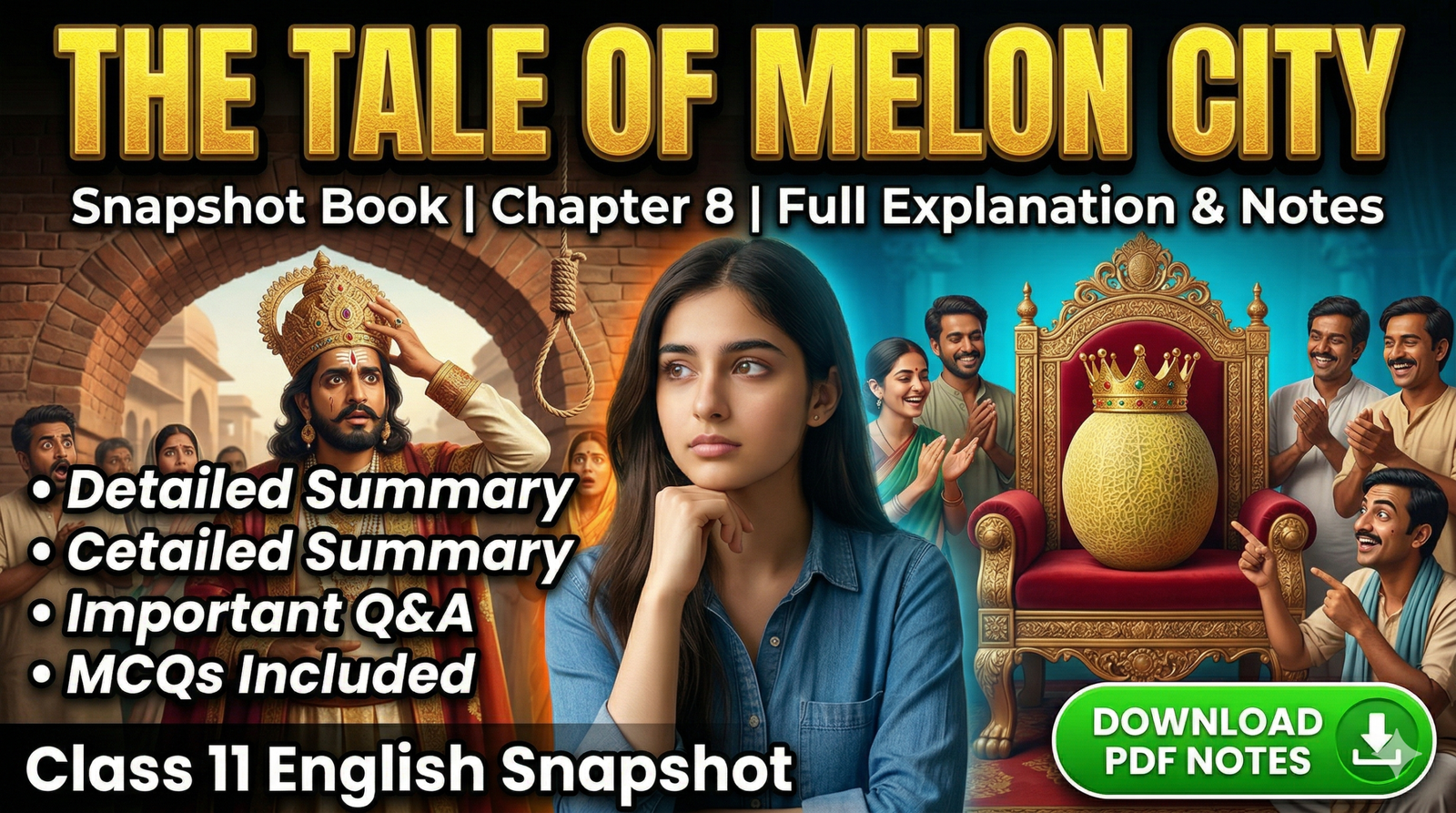
The Tale of Melon City Class 11 Notes
Class 11 English Snapshot Chapter 8 | Complete Notes, Summary & Q&A
Welcome to the complete The Tale of Melon City Class 11 Notes. In this post, we will cover the detailed summary, character sketches, 10 highly important multiple-choice questions (MCQs), and subjective Q&A for the humorous poem written by Vikram Seth. These notes will help you understand the sharp satire on governance and foolishness, making it a perfect resource for your exam preparation.
✍️ About the Author
Vikram Seth is a highly celebrated Indian poet and novelist, known for his witty, humorous, and deeply satirical writing style. In The Tale of Melon City, he uses humor and irony to mock the political system, foolish rulers, and the blind obedience of the public who care only for their own peace, regardless of who rules them.
🎭 Key Characters
The King
Described ironically as ‘just and placid’ (fair and calm), he is actually extremely foolish, indecisive, and easily swayed. His inability to make rational decisions ultimately leads to his own execution.
The Architect
A clever man who is blamed for the faulty arch. He smartly saves his own life by shifting the blame entirely onto the King, stating that the King himself had made amendments to the original building plans.
The Wisest Man
An old man chosen solely because of his old age. He is so old that he can neither walk nor see. He foolishly advises that the arch itself should be hanged because it knocked off the King’s crown.
The Idiot
A foolish man passing by the city gates. When asked to choose the next king, he simply says “Melon” because he loves melons. Consequently, a melon is crowned as the new king.
📖 Chapter Summary Class 11
The King’s Order: A ‘just and placid’ king orders an arch to be built across the main street to inspire the spectators. However, when the king rides under the newly built arch, it is constructed too low, and it knocks off his crown. Feeling deeply insulted, the angry king orders the Chief of Builders to be hanged immediately.
The Blame Game: The Chief of Builders passes the blame to the workmen. The workmen save themselves by blaming the masons for making the bricks the wrong size. The masons blame the architect. When the architect is brought forward, he cleverly reminds the king that the king himself had made changes to the architectural plans. Realizing the blame has fallen on him, the king becomes confused.
The Wisest Man’s Advice: To solve this tricky situation, the king demands the wisest man in the country be brought to him. The ministers find an extremely old man who can barely walk or see. This “wise” man declares that the true culprit is the arch itself, and therefore, the arch must be hanged. However, a councillor points out that it is a sin to hang something that touched the king’s royal head. The king agrees.
The Hanging: By this time, the crowd is growing restless and demands a hanging. To please the public, a high noose is set up. The decree is that whoever is tall enough to fit the noose will be hanged. Everyone is measured, but only one man is tall enough to fit the noose perfectly—the King himself. Thus, the foolish king is hanged by his own royal decree.
Crowning a Melon: The ministers announce that according to their custom, the next person to pass the City Gate will choose the new king. An idiot happens to walk by. When asked who the king should be, he answers “A melon” (because that is his answer to all questions). A melon is respectfully placed on the throne. The public does not care that their king is a fruit, as long as it leaves them in peace and allows them to enjoy a ‘laissez-faire’ (interference-free) life.
🧠 Top 10 MCQs for Exam Preparation
1. Who is the poet of “The Tale of Melon City”?
✅ Answer: C. Vikram Seth
2. What did the king order to be constructed?
✅ Answer: A. An arch
3. Why did the king lose his temper?
✅ Answer: C. His crown was knocked off by the low arch
4. Who did the Chief of Builders blame for the low arch?
✅ Answer: B. The Workmen
5. How did the Architect save himself from being hanged?
✅ Answer: C. He reminded the king that the king had amended the plans
6. What was the criteria used by the ministers to find the “wisest man”?
✅ Answer: B. His extreme old age
7. Who did the “wisest man” say should be hanged?
✅ Answer: A. The arch itself
8. Ultimately, who was hanged by the noose?
✅ Answer: C. The King
9. How was the next king chosen?
✅ Answer: C. The first person passing the City Gate chose him
10. What does the poem satirize?
✅ Answer: B. The foolishness of rulers and the governance system
📝 Important Short Answer Questions
Q1. Why did the king want to hang the Chief of Builders?
Ans: The king wanted to hang the Chief of Builders because the arch built under his supervision was too low. When the king rode under it, his royal crown got knocked off. The king considered this a massive disgrace and ordered an immediate hanging.
Q2. How did the blame game proceed from the Chief of Builders to the King?
Ans: The Chief of Builders blamed the workmen. The workmen blamed the masons for making the wrong-sized bricks. The masons blamed the architect. Finally, the architect cleverly reminded the King that the King himself had made amendments to the original plans, bringing the blame back to the King.
Q3. How did a melon become the king of the city?
Ans: It was the custom of the city that the first person to pass the City Gate would choose the new king. An idiot passed by, and when asked by the guards, he said “Melon” because he liked melons. Following the custom blindly, a melon was crowned as the king.
✍️ Long Answer Type Questions
Q1. How does the poem “The Tale of Melon City” satirize the system of governance?
Ans: The poem is a brilliant satire on the foolishness of those in power and the blind administrative system. The king, who is supposed to be ‘just and placid’, is actually irrational and lacks critical thinking. He orders hangings on a whim and easily gets trapped in a blame game, eventually causing his own death just to please a restless crowd. The ministers are no better; they equate old age with wisdom, bringing in a dying man to solve a crisis. They blindly follow an absurd custom, allowing an idiot to crown a melon as their king. The public is equally mocked; they do not care who rules them—even if it’s a fruit—as long as the government does not interfere in their peaceful lives (laissez-faire). The poem mocks the absolute lack of logic in state affairs.
Q2. Describe the chain of events that led to the King’s own execution.
Ans: The events started when the king’s crown was knocked off by a low-built arch. Enraged, he ordered the Chief of Builders to be hanged. The Chief blamed the workmen, who blamed the masons, who in turn blamed the architect. The clever architect reminded the king that the king himself had altered the plans. Confused, the king called the “wisest man,” who ridiculously suggested hanging the arch itself. However, a councillor objected to hanging something that had touched the royal head. By this time, the public had gathered and was demanding a hanging. Fearing a revolt, the king ordered that whoever was tall enough to fit the high noose would be hanged. Ironically, out of the entire kingdom, only the king was tall enough to fit the noose. Thus, the foolish king became a victim of his own ridiculous decree.
Want to read offline? Download the complete notes!
Download PDF NotesClicking this button will redirect you to the download page.