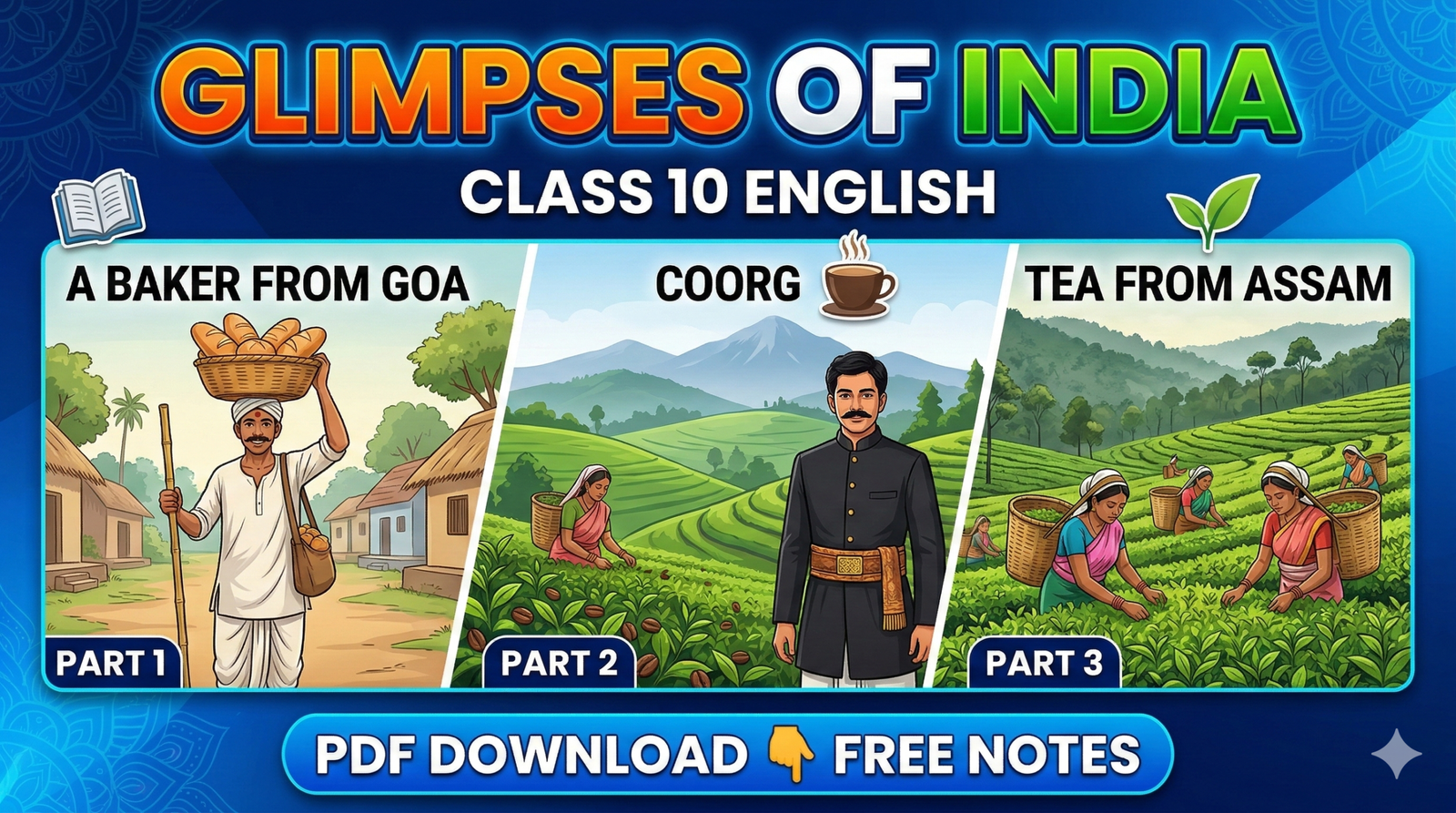
Part I: A Baker from Goa
1. Introduction (Part I)
“A Baker from Goa” by Lucio Rodrigues is a nostalgic portrait of a traditional Goan village baker, known as a ‘pader’. The story highlights the strong Portuguese influence on Goan culture and how, even after the Portuguese left, the traditional bakers and their famous loaves of bread still hold a significant place in Goan society and festivals.
2. Key Elements
- The Baker (Pader): An essential part of Goan life. He used to be a friend, companion, and guide to the children.
- Kabai: The traditional peculiar dress of the bakers—a single-piece long frock reaching down to the knees.
- Bol / Bolinhas: Sweet bread (‘bol’) is a must for marriage gifts, and ‘bolinhas’ are essential for Christmas.
3. Full Summary (A Baker from Goa)
The Portuguese Influence
The author fondly remembers his childhood in Goa, where the elders often reminisced about the good old Portuguese days and their famous loaves of bread. Though the Portuguese eaters of bread have left, the makers are still there. The traditional baker’s furnace still burns, and the familiar ‘thud and jingle’ of the baker’s bamboo can still be heard in the mornings.
The Baker’s Morning Visit
During the author’s childhood, the baker used to visit at least twice a day—once while setting out to sell and then on his return. The jingling sound of his bamboo woke the children up, and they would run to meet him. While the elders bought the regular loaves, the children were excited about the ‘bread-bangles’ or sweet bread.
Importance in Goan Culture
A village baker was indispensable. Marriage gifts were meaningless without the sweet bread called ‘bol’. A mother always prepared sandwiches for her daughter’s engagement. Cakes and ‘bolinhas’ were a must for Christmas and other festivals. The baker’s presence in the village was absolutely essential.
Appearance and Prosperity
In the old days, bakers wore a unique dress called ‘kabai’. Later, they started wearing shirts and trousers shorter than full-length but longer than half pants. Baking was a highly profitable profession. The baker, his family, and his servants never starved; their plump physique was an open testimony to their prosperity.
4. Multiple Choice Questions (Part I)
Q1. Who is the author of “A Baker from Goa”?
(a) Lokesh Abrol | (b) Lucio Rodrigues | (c) Arup Kumar Datta | (d) Ruskin Bond
Answer: (b) Lucio Rodrigues
Q2. What are the traditional bakers of Goa called?
(a) Kabai | (b) Pader | (c) Bol | (d) Chef
Answer: (b) Pader
Q3. What sound announced the arrival of the baker?
(a) A bell ringing | (b) A horn | (c) Thud and jingle of the bamboo | (d) Shouting
Answer: (c) Thud and jingle of the bamboo
Q4. What were the children particularly eager to buy?
(a) Sandwiches | (b) Loaves | (c) Cakes | (d) Bread-bangles
Answer: (d) Bread-bangles
Q5. What was the traditional dress of the Goan baker called?
(a) Bol | (b) Pader | (c) Kabai | (d) Bolinhas
Answer: (c) Kabai
Q6. What is absolutely essential for a Goan marriage gift?
(a) Sandwiches | (b) Sweet bread known as ‘bol’ | (c) Cakes | (d) Biscuits
Answer: (b) Sweet bread known as ‘bol’
5. Short & Long Answer Questions (Part I)
Q1. Why is the baker’s furnace still essential in a Goan village? (Short)
Ans. The baker’s furnace is still essential because bread is an integral part of Goan culture. No marriage is complete without sweet bread (‘bol’), sandwiches are necessary for engagements, and cakes and ‘bolinhas’ are a must for Christmas.
Q2. How did the baker make his musical entry? (Short)
Ans. The baker made his musical entry with the ‘jhang-jhang’ sound of his specially made bamboo staff. One hand supported the basket on his head, and the other banged the bamboo on the ground.
Q3. What did the bakers wear in the Portuguese days and during the author’s childhood? (Short)
Ans. During the Portuguese days, the bakers wore a peculiar dress called ‘kabai’, which was a single-piece long frock reaching down to the knees. During the author’s childhood, they wore shirts and trousers which were shorter than full-length ones and longer than half pants.
Q4. Describe the childhood memories of the author regarding the baker. (Long)
Ans. The author fondly remembers the baker as a friend, companion, and guide during his childhood. The baker visited twice a day, and the jingling sound of his bamboo staff would wake the children. They didn’t even brush their teeth, rushing out to choose their favorite sweet bread-bangles, while the elders bought regular loaves. The baker always greeted the lady of the house respectfully.
Q5. “Baking was indeed a profitable profession in the old days.” Justify the statement. (Long)
Ans. In the old Portuguese days, bread was an essential part of daily life and all important occasions in Goa. Because of this high demand, baking was a very profitable profession. The baker, his family, and his servants never starved. They always looked happy and prosperous. Their plump physique (jackfruit-like physical appearance) was an open testimony to their prosperity and good income.
Part II: Coorg
6. Introduction (Part II)
“Coorg” by Lokesh Abrol is a beautiful pen-portrait of Coorg (Kodagu), the smallest district of Karnataka. Situated between Mysore and Mangalore, this heavenly place is famous for its evergreen rainforests, spices, coffee plantations, and its brave, hospitable martial race of people.
7. Key Elements
- The People of Coorg: Fiercely independent, believed to be of Greek or Arabic descent. They are known for their extreme bravery and hospitality.
- Kuppia: The traditional long, black coat with an embroidered waist-belt worn by the Kodavus, resembling the kuffia worn by Arabs.
- Wildlife & Nature: Home to Macaques, Malabar squirrels, langurs, elephants, and the Mahaseer fish in the Kaveri river.
8. Full Summary (Coorg)
A Piece of Heaven
Coorg, or Kodagu, is the smallest district of Karnataka, rolling hills located midway between Mysore and Mangalore. It is described as a piece of heaven drifted from the kingdom of God. Thirty percent of its area is covered with evergreen rainforests. The best season to visit is from September to March when the weather is perfect, and the air breathes of invigorating coffee.
Greek and Arabic Ancestry
The Coorgi people are fiercely independent and martial. According to a legend, a part of Alexander’s army moved south and settled here when return became impractical. They married the locals, making their culture distinct from the Hindu mainstream. Another theory supports their Arab descent due to the ‘kuppia’—a long black coat with an embroidered waist-belt they wear, which is similar to the ‘kuffia’ worn by Arabs.
Bravery and Hospitality
Coorgi homes have a tradition of hospitality. The people are always ready to recount tales of valor related to their sons and fathers. The Coorg Regiment is one of the most decorated in the Indian Army. In fact, General Cariappa, the first Chief of the Indian Army, was a Coorgi. Even today, Kodavus are the only people in India permitted to carry firearms without a license.
Wildlife and Tourist Attractions
The river Kaveri gets its water from the hills and forests of Coorg. It is home to Mahaseer, a large freshwater fish. Kingfishers, squirrels, and langurs enjoy the environment, while elephants enjoy being bathed in the river. For tourists, climbing the Brahmagiri hills offers a panoramic view of the entire misty landscape. The nearby island of Nisargadhama and the Buddhist monk settlement in Bylakuppe are bonus attractions.
9. Multiple Choice Questions (Part II)
Q1. Coorg is a ______ country.
(a) Tea | (b) Bread | (c) Coffee | (d) Wheat
Answer: (c) Coffee
Q2. Coorg is located midway between Mysore and _______.
(a) Bangalore | (b) Mangalore | (c) Chennai | (d) Ooty
Answer: (b) Mangalore
Q3. What percentage of Coorg is covered by evergreen rainforests?
(a) 10% | (b) 20% | (c) 30% | (d) 40%
Answer: (c) 30%
Q4. The people of Coorg are believed to be of ______ descent.
(a) Greek or Arabic | (b) French or Dutch | (c) British | (d) Chinese
Answer: (a) Greek or Arabic
Q5. What is the traditional dress of the Coorgis called?
(a) Kabai | (b) Kuppia | (c) Kurta | (d) Kuffia
Answer: (b) Kuppia
Q6. Who was the first Chief of the Indian Army?
(a) Bipin Rawat | (b) General Cariappa | (c) Sam Manekshaw | (d) K.M. Cariappa
Answer: (b) General Cariappa
10. Short & Long Answer Questions (Part II)
Q1. Why are the people of Coorg known as descendants of the Arabs? (Short)
Ans. The Coorgis wear a long, black coat with an embroidered waist-belt known as ‘kuppia’. It closely resembles the ‘kuffia’ worn by the Arabs and the Kurds, leading to the theory of their Arab descent.
Q2. What is the story about the Kodavu people’s Greek descent? (Short)
Ans. According to a legend, a part of Alexander’s army moved south along the coast and settled in Coorg when their return became impractical. They married amongst the locals, and their martial traditions, marriage, and religious rites distinctly show their Greek origin.
Q3. Why is the Coorg regiment famous? (Short)
Ans. The Coorg Regiment is one of the most decorated regiments in the Indian Army, having received numerous awards for extreme bravery. The first Chief of the Indian Army, General Cariappa, was also a Coorgi.
Q4. Which sports does Coorg offer to tourists? (Short)
Ans. Coorg offers many high-energy adventure sports to tourists, such as river rafting, canoeing, rappelling, rock climbing, and mountain biking. Trekking is also very popular here.
Q5. Write a note on the people of Coorg, their descent, and their martial traditions. (Long)
Ans. The people of Coorg, or Kodavus, are fiercely independent people of martial origin. They are believed to be of Greek or Arabic descent. They have a great tradition of hospitality and are always proud to recount the tales of bravery of their sons and fathers. They are the only people in India allowed to carry firearms without a license, which proves their trustworthiness and martial nature. The Coorg Regiment is heavily decorated in the Indian Army.
Q6. Describe the wildlife of Coorg. (Long)
Ans. Coorg is extremely rich in wildlife. The Kaveri river flows through it, which is full of a large freshwater fish called Mahaseer. Kingfishers dive for their catch, while squirrels and langurs playfully drop half-eaten fruit in the clear water. Additionally, Macaques, Malabar squirrels, slender lorises, and wild elephants can easily be spotted in the lush evergreen rainforests.
Part III: Tea from Assam
11. Introduction (Part III)
“Tea from Assam” by Arup Kumar Datta is an informative story about two school friends, Rajvir and Pranjol, who are travelling to Assam. Through their conversation, the chapter provides interesting facts about tea, its history, various legends related to its discovery, and beautiful descriptions of Assamese tea gardens.
12. Characters Detail
- Pranjol: A youngster from Assam, studying in a school in Delhi. His father manages a tea garden in Upper Assam.
- Rajvir: Pranjol’s classmate who is invited by Pranjol to visit Assam during the summer vacation. He is highly curious and well-read about tea.
13. Full Summary (Tea from Assam)
The Train Journey
Pranjol and Rajvir were travelling from Delhi to Assam by train. Rajvir was fascinated by the beautiful scenery outside. He saw a sea of tea bushes stretching as far as the eye could see against the backdrop of densely wooded hills. While Rajvir was enjoying the magnificent view, Pranjol, who had grown up on a tea plantation, was busy reading his detective book.
Facts and the Chinese Legend
Rajvir shared interesting facts, mentioning that over eighty crore cups of tea are drunk every day throughout the world. He then told Pranjol the Chinese legend of tea. Once, a Chinese emperor always boiled water before drinking it. One day, a few leaves of the twigs burning under the pot fell into the water, giving it a delicious flavor. It is said they were tea leaves.
The Indian Legend of Tea
Rajvir also narrated an Indian legend about Bodhidharma, an ancient Buddhist ascetic. He felt sleepy during his meditations, so he cut off his eyelids. Ten tea plants grew out of the eyelids. The leaves of these plants, when put in hot water and drunk, banished sleep.
Arrival at Dhekiabari Tea Estate
The train reached Mariani junction, and Pranjol’s parents received them. They drove to the Dhekiabari Tea Estate, managed by Pranjol’s father, Mr. Barua. On both sides of the road, there were acres of neatly pruned tea bushes. Groups of tea pluckers with bamboo baskets on their backs, wearing plastic aprons, were plucking the newly sprouted leaves. Rajvir impressed Mr. Barua with his immense knowledge about the “second-flush” or sprouting period of tea.
14. Multiple Choice Questions (Part III)
Q1. Who is the author of “Tea from Assam”?
(a) Arup Kumar Datta | (b) Lokesh Abrol | (c) Lucio Rodrigues | (d) Ruskin Bond
Answer: (a) Arup Kumar Datta
Q2. Where were Pranjol and Rajvir travelling to?
(a) Goa | (b) Coorg | (c) Assam | (d) Darjeeling
Answer: (c) Assam
Q3. What did the ascetic Bodhidharma cut off to avoid sleep?
(a) His hair | (b) His ears | (c) His eyelids | (d) His nails
Answer: (c) His eyelids
Q4. In which country was tea first drunk?
(a) India | (b) England | (c) China | (d) Japan
Answer: (c) China
Q5. What is the name of the tea estate managed by Pranjol’s father?
(a) Mariani Tea Estate | (b) Dhekiabari Tea Estate | (c) Assam Tea Estate | (d) Darjeeling Tea Estate
Answer: (b) Dhekiabari Tea Estate
Q6. During which flush or sprouting period does tea yield the best crop?
(a) First-flush | (b) Second-flush | (c) Third-flush | (d) Winter-flush
Answer: (b) Second-flush
15. Short & Long Answer Questions (Part III)
Q1. What are the two legends about the discovery of tea? (Short)
Ans. The Chinese legend says that tea leaves accidentally fell into an emperor’s boiling water, giving it a delicious flavor. The Indian legend claims that tea plants grew from the cut eyelids of Bodhidharma, a Buddhist monk, to banish sleep during meditation.
Q2. Why was Rajvir excited while looking out of the train window? Why didn’t Pranjol share his excitement? (Short)
Ans. Rajvir was excited because he had never seen such beautiful, endless stretches of green tea gardens before. Pranjol didn’t share his excitement because he had been born and brought up on a tea plantation, so the sight was very normal for him.
Q3. What information did Rajvir share about the origin of the words ‘chai’ and ‘chini’? (Short)
Ans. Rajvir shared that tea was first drunk in China as far back as 2700 B.C. He explained that words like ‘chai’ and ‘chini’ are originally from the Chinese language. Tea came to Europe only in the sixteenth century and was drunk more as medicine than as a beverage.
Q4. What did Rajvir see in the Dhekiabari Tea Estate? (Long)
Ans. At the Dhekiabari Tea Estate, Rajvir saw acres and acres of tea bushes on both sides of the gravel road. All the bushes were neatly pruned to the same height. Groups of tea pluckers were walking through the rows. They were wearing plastic aprons and carried bamboo baskets on their backs to pluck the newly sprouted tea leaves. It was the second-flush period, which yields the best tea.
Q5. Pranjol and Rajvir discuss their journey to Assam. Describe their train journey and the magnificent views. (Long)
Ans. The train journey to Assam was a visual treat for Rajvir. At first, the train passed through green paddy fields, which soon gave way to tea bushes. It was a magnificent view. Against the backdrop of densely wooded hills, a sea of tea bushes stretched as far as the eye could see. Dwarf tea plants were surrounded by tall, sturdy shade trees. The contrast of the greenery and the neatly pruned rows fascinated Rajvir completely, while Pranjol remained engrossed in his detective book.