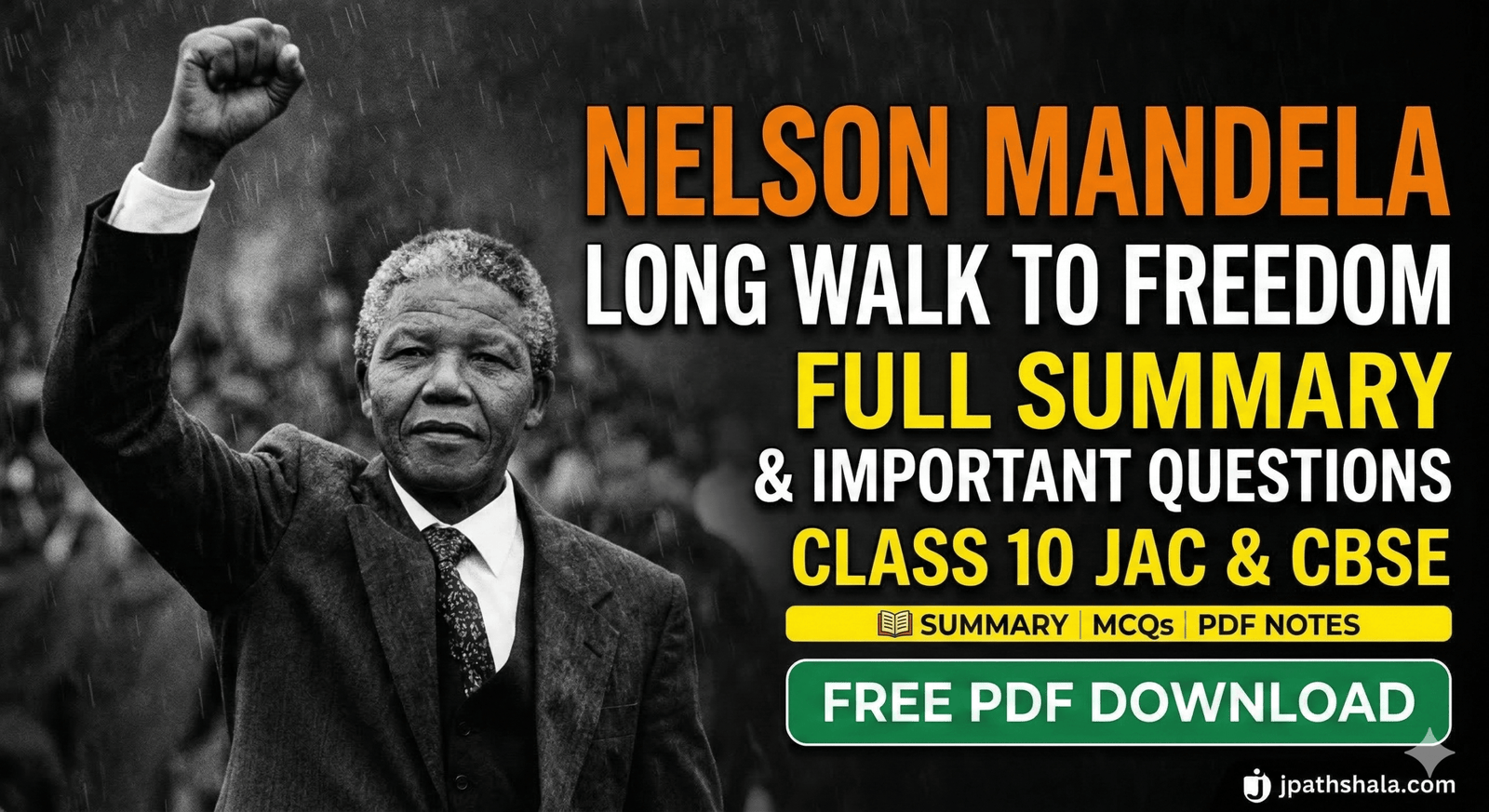
1. Chapter Introduction
“Nelson Mandela: Long Walk to Freedom” is an extract from the autobiography of Nelson Mandela, the first Black President of South Africa. This chapter describes the historic inauguration ceremony of the first democratic, non-racial government in South Africa on 10th May 1994. It highlights Mandela’s long struggle against the cruel system of ‘Apartheid’ (racial discrimination) and his views on freedom, courage, and twin obligations.
2. Characters Detail
- Nelson Mandela: The first Black President of South Africa who fought tirelessly against the apartheid system. He is a symbol of courage, sacrifice, and true leadership.
- Zenani: Nelson Mandela’s daughter, who accompanied him on the day of the inauguration.
- Thabo Mbeki: Sworn in as the first deputy president.
- Mr. de Klerk: Sworn in as the second deputy president.
3. Full Summary
The Historic Inauguration Ceremony
The 10th of May 1994 was a bright and clear day. A historic inauguration ceremony took place in the lovely sandstone amphitheatre formed by the Union Buildings in Pretoria. For decades, this seat of power had been occupied by white supremacy. Now, it was gathering international leaders and dignitaries from more than 140 countries to celebrate the installation of South Africa’s first democratic, non-racial government.
The Swearing-In and Mandela’s Speech
Mandela was accompanied by his daughter Zenani. First, Mr. de Klerk and Thabo Mbeki were sworn in as the second and first deputy presidents, respectively. Finally, Nelson Mandela took the oath as the President. In his speech, he promised to liberate all his people from the continuing bondage of poverty, deprivation, suffering, and gender or other discrimination. He declared, “Never, never, and never again shall it be that this beautiful land will again experience the oppression of one by another.”
Spectacular Display by Military Forces
After the speech, the South African military jets, helicopters, and troop carriers roared in perfect formation over the Union Buildings. It was a demonstration of the military’s loyalty to democracy and the new government. The highest military generals saluted Mandela. Finally, a chevron of Impala jets left a smoke trail of the new South African flag’s colors: black, red, green, blue, and gold.
Twin Obligations
Mandela explains that every man has “twin obligations” in life. The first obligation is to his family, his parents, his wife, and children. The second obligation is to his people, his community, and his country. In a normal civil society, a man can fulfill both. But in apartheid South Africa, if a man of color tried to fulfill his duty to his people, he was punished, isolated, and ripped away from his family.
The Meaning of Freedom and Courage
Mandela reveals how his understanding of freedom changed with age. As a child, freedom meant running in the fields, swimming, and roasting mealies. As a student, he wanted transitional freedom for himself. But as a young man, he realized that not only his freedom but the freedom of everyone who looked like him was curtailed. This realization led him to join the African National Congress (ANC). He also stated that courage is not the absence of fear, but the triumph over it.
4. Multiple Choice Questions (10 MCQs)
Q1. When was the historic inauguration day?
(a) 10 May | (b) 10 March | (c) 20 May | (d) 20 March
Answer: (a) 10 May
Q2. Where did the ceremonies take place?
(a) Red Fort | (b) White House | (c) Union Buildings Amphitheatre | (d) Public Square
Answer: (c) Union Buildings Amphitheatre
Q3. Who accompanied Nelson Mandela on the inauguration day?
(a) His wife | (b) His son | (c) His daughter Zenani | (d) Thabo Mbeki
Answer: (c) His daughter Zenani
Q4. What is ‘Apartheid’?
(a) A disease | (b) A political system of racial discrimination | (c) A political party | (d) A monument
Answer: (b) A political system of racial discrimination
Q5. How many deputy presidents were elected?
(a) Two | (b) Three | (c) One | (d) None
Answer: (a) Two
Q6. What colours did the new South African flag have?
(a) Black, red, green, blue, and gold | (b) Black, red, yellow, blue, and gold | (c) Orange, black, yellow, blue, and silver | (d) Black, blue, green, and white
Answer: (a) Black, red, green, blue, and gold
Q7. According to Mandela, what comes more naturally to the human heart?
(a) Hatred | (b) Jealousy | (c) Love | (d) Discrimination
Answer: (c) Love
Q8. What are a man’s twin obligations according to Mandela?
(a) To family and to country/people | (b) To God and to society | (c) To job and to family | (d) To himself and to God
Answer: (a) To family and to country/people
Q9. Which party did Nelson Mandela join?
(a) Indian National Congress | (b) African National Congress (ANC) | (c) National Party | (d) Independent Party
Answer: (b) African National Congress (ANC)
Q10. “The brave man is not he who does not feel afraid, but he who…”
(a) runs away | (b) fights everyone | (c) conquers that fear | (d) hides from fear
Answer: (c) conquers that fear
5. Short Answer Type Questions (35 Words)
Q1. Where did the ceremonies take place? Can you name any public buildings in India that are made of sandstone?
Ans. The ceremonies took place in the sandstone amphitheatre formed by the Union Buildings in Pretoria, South Africa. In India, public buildings like the Red Fort and Rashtrapati Bhavan in New Delhi are made of red sandstone.
Q2. Why were two national anthems sung?
Ans. Two national anthems were sung to symbolize equality and the end of the apartheid system. ‘Nkosi Sikelel -iAfrika’ was sung by the whites, and ‘Die Stem’ (the old anthem of the Republic) was sung by the blacks, uniting both communities.
Q3. What ideals does Mandela set out for the future of South Africa?
Ans. Mandela set out the ideals of liberating all his people from the continuing bondage of poverty, deprivation, suffering, gender, and other discrimination. He envisioned a nation where everyone is equal and free from oppression.
Q4. What does courage mean to Mandela?
Ans. According to Mandela, courage is not the absence of fear, but the triumph over it. A brave man is not someone who does not feel afraid, but someone who conquers that fear.
Q5. Why did the military generals’ attitude change, and what did it reflect?
Ans. Earlier, the military generals would have arrested Mandela as he was considered a rebel. Now, they were saluting him as the President. This change reflected the establishment of a new democratic and non-racial government.
6. Long Answer Type Questions (60-70 Words)
Q1. What are the “twin obligations” mentioned by Nelson Mandela? Why was it difficult to fulfill them in South Africa?
Ans. Mandela mentions that every man has twin obligations: first, to his family, parents, wife, and children; and second, to his people, community, and country. In apartheid South Africa, it was impossible for a black man to fulfill both. If he tried to live as a free human being and work for his people, he was punished, isolated, and separated from his family.
Q2. How did Mandela’s understanding of freedom change with age and experience?
Ans. As a boy, Mandela thought he was born free—free to run, swim, and roast mealies. As a student, freedom meant staying out at night and choosing what to read. However, as a young man in Johannesburg, he yearned for the basic and honorable freedoms of achieving his potential and earning a keep. Finally, he realized that the freedom of his entire community was curtailed, which changed him into a freedom fighter.
Q3. Describe the inauguration ceremony as depicted in the chapter.
Ans. The inauguration ceremony was held on 10th May 1994 at the Union Buildings amphitheatre in Pretoria. It marked the end of the apartheid regime. Dignitaries and world leaders from over 140 countries attended to witness the installation of South Africa’s first democratic, non-racial government. It featured oath-taking ceremonies by Mandela and his deputies, followed by a spectacular display of military jets painting the sky with the new flag’s colors.
Q4. “The oppressor must be liberated just as surely as the oppressed.” Explain Mandela’s view.
Ans. Mandela strongly believed that both the oppressor and the oppressed need liberation. A man who takes away another man’s freedom is a prisoner of hatred, prejudice, and narrow-mindedness. He is not truly free because he is locked behind the bars of his own hatred. Therefore, the oppressor needs to be freed from his hatred just as the oppressed needs to be freed from his physical chains.
Q5. What did Mandela think about the ‘policy of apartheid’ and its impact on his country?
Ans. Mandela stated that the policy of apartheid created a deep and lasting wound in his country and its people. It was one of the harshest and most inhumane systems the world had ever known. However, it had an unintended positive effect: the decades of oppression and brutality produced great freedom fighters with extraordinary courage, wisdom, and generosity, like Oliver Tambo and Walter Sisulu, who fought to end the system.