
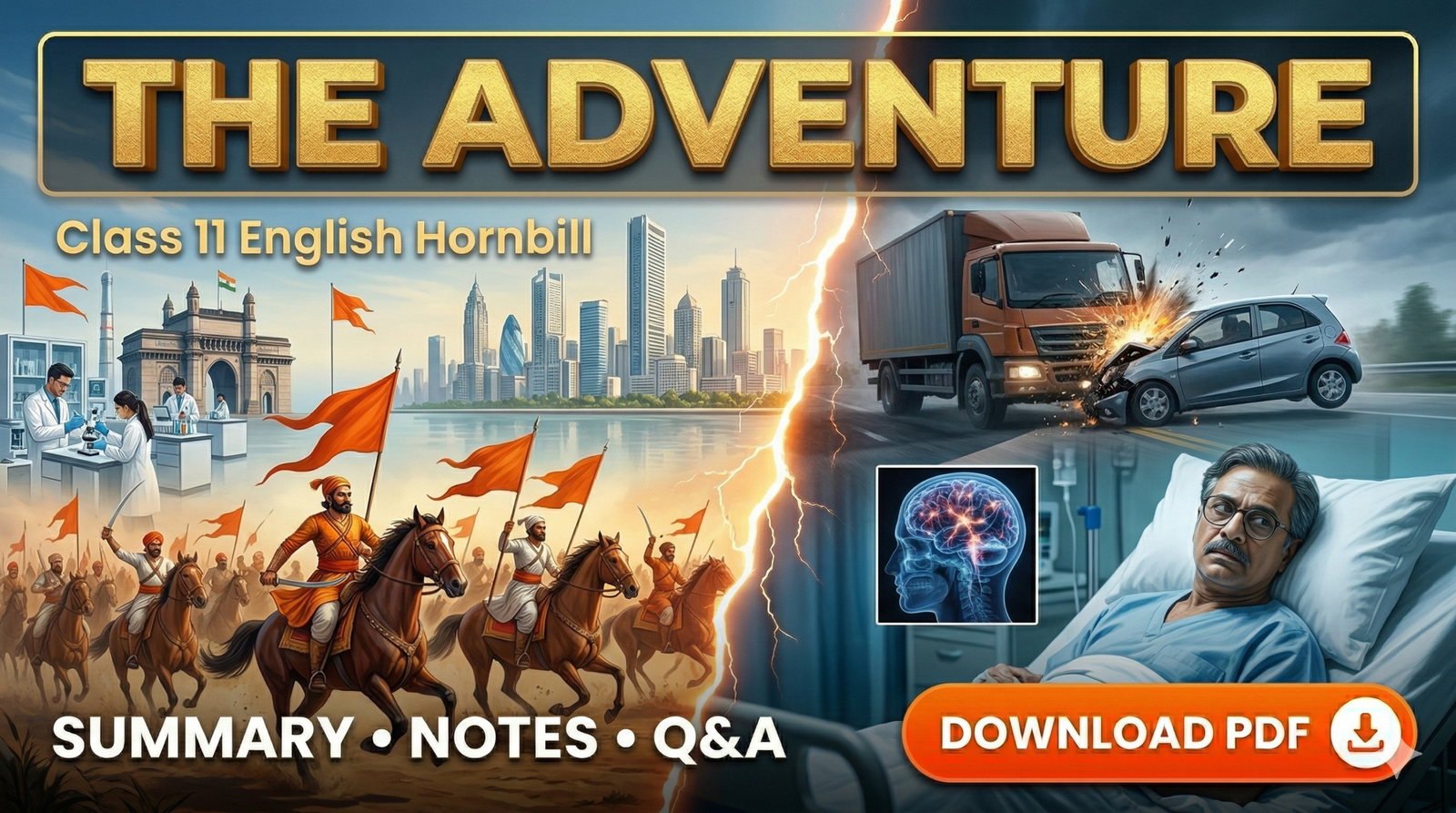
The Adventure Class 11 Notes
Class 11 English Hornbill Chapter 7 | Complete Study Notes, Summary & Q&A
Welcome to the complete The Adventure Class 11 Notes. In this post, we will cover the detailed summary, character sketches, and important multiple-choice and subjective questions for The Adventure written by Jayant Narlikar. This sci-fi chapter blends history with quantum physics, and our notes are perfectly designed to help Class 11 students prepare for their board exams.
✍️ About the Author
Jayant Narlikar is a highly acclaimed Indian astrophysicist and writer. He is known for his work in cosmology and for bringing science to the masses through his science fiction stories. In “The Adventure,” he masterfully combines the concepts of history, the Catastrophe Theory, and quantum mechanics to create a thrilling parallel-universe narrative.
🎭 Key Figures in The Adventure
Professor Gangadharpant Gaitonde
A prominent historian from Pune. He is the protagonist of the story who experiences a transition into a parallel universe after a truck collision, witnessing an alternate history of India.
Rajendra Deshpande
A scientific and mathematical expert. He is Gangadharpant’s friend who provides a logical and scientific explanation for the Professor’s bizarre experience using modern physics.
Khan Sahib
A passenger whom the Professor meets on the Jijamata Express train. He gives the Professor insights into the alternate, independent India that the Professor has entered.
📖 The Adventure Summary Class 11
The Transition: Professor Gangadharpant Gaitonde, a historian, meets with an accident when his car collides with a truck. He falls into a coma but his mind transitions into a parallel universe. In this alternate reality, he travels on the Jijamata Express to Bombay. To his surprise, he finds that India was never fully colonized by the British, and the East India Company only controls a small area around Bombay.
The Alternate History: Reaching Bombay, he goes to the Town Hall library to figure out how history changed. He reads history books and discovers that the turning point was the Third Battle of Panipat in 1761. In real history, the Marathas lost. But in this alternate world, the Marathas won, led by Vishwasrao, who narrowly escaped a bullet. This victory kept India independent, leading to a strong, democratic nation.
The Azad Maidan Incident: After reading, the Professor visits Azad Maidan where a public lecture is going on. He notices the Presidential chair is empty. Being a traditional historian used to presiding over meetings, he steps onto the stage and sits in the chair. The crowd, which believes in a purely democratic setup without a “President” figurehead, gets angry and throws him off the stage. At that very moment, he wakes up in a hospital bed in the real world.
The Scientific Explanation: Gangadharpant narrates his experience to his friend Rajendra Deshpande and shows him a torn page from an alternate history book as proof. Rajendra explains this using two scientific theories: the Catastrophe Theory (a small change in circumstances—like a bullet missing Vishwasrao—leads to a massive change in outcome) and the Lack of Determinism in Quantum Theory (suggesting parallel worlds exist simultaneously, and the Professor’s mind temporarily transitioned from one to another during the accident).
🧠 The Adventure MCQs
1. Who is the author of “The Adventure”?
✅ Answer: B. Jayant Narlikar
2. What was Professor Gaitonde’s profession?
✅ Answer: C. Historian
3. Which battle changed the course of history in the parallel universe?
✅ Answer: C. Third Battle of Panipat
4. Who was the leader that narrowly escaped the bullet in the alternate reality?
✅ Answer: B. Vishwasrao
5. What theory did Rajendra use to explain the Professor’s experience?
✅ Answer: B. Catastrophe Theory
6. What physical evidence did the Professor bring back from the alternate world?
✅ Answer: A. A torn page of the Bakhar
7. Where did the Professor go to read history books in the alternate Bombay?
✅ Answer: C. Town Hall library
📝 Important Short Answer Questions
Q1. What was the exact moment when history took a different turn in the alternate universe?
Ans: History changed during the Third Battle of Panipat. In the alternate reality, a bullet brushed past Vishwasrao instead of hitting him. This tiny event boosted the morale of the Maratha army, leading to their victory instead of defeat.
Q2. How did the crowd react to Professor Gaitonde at Azad Maidan?
Ans: At Azad Maidan, the crowd was listening to a lecture without a chairman. When Gaitonde sat on the empty presidential chair, the crowd got angry. They threw tomatoes and eggs at him and physically pushed him off the stage because they hated the old custom of having a president presiding over meetings.
Q3. Why was Professor Gaitonde’s transition triggered by the accident?
Ans: Right before the truck collision, the Professor was thinking about the Catastrophe theory and its role in history, particularly the Battle of Panipat. According to Rajendra, the collision provided the sudden energy needed for his neurons to make a transition to a parallel universe based on his current thoughts.
✍️ Long Answer Type Questions
Q1. Explain how Rajendra Deshpande justified Professor Gaitonde’s experience scientifically.
Ans: Rajendra Deshpande used two advanced scientific theories to explain Gaitonde’s experience. First, he used the Catastrophe Theory, which states that a minor change in circumstances can lead to huge shifts in behavior and outcomes. He applied this to the Battle of Panipat: the bullet missing Vishwasrao was the minor change that led to the Marathas winning instead of losing. Second, he used the Quantum Theory (Lack of Determinism). In quantum physics, electrons can transition between energy levels without a definitive path, suggesting parallel realities can exist simultaneously. Rajendra explained that the accident caused the Professor’s consciousness to transition from our reality to an alternate one that existed side-by-side.
Q2. Describe the alternate Bombay that Professor Gaitonde witnessed.
Ans: The Bombay that Professor Gaitonde entered was vastly different from the real one. It was part of a strong, self-reliant India that was never fully subjugated by the British. The East India Company’s presence was restricted to just a small area around Bombay, essentially functioning as an outpost. The city itself looked different; the train station was exceptionally clean, and the staff included Anglo-Indians and British officers. Instead of the Forbes building where his son worked in the real world, there was the East India House. The society he witnessed was a proud, democratic, and independent one that had evolved without foreign rule.
Want to read offline? Download the complete notes!
Download PDF NotesClicking this button will redirect you to the download page.