
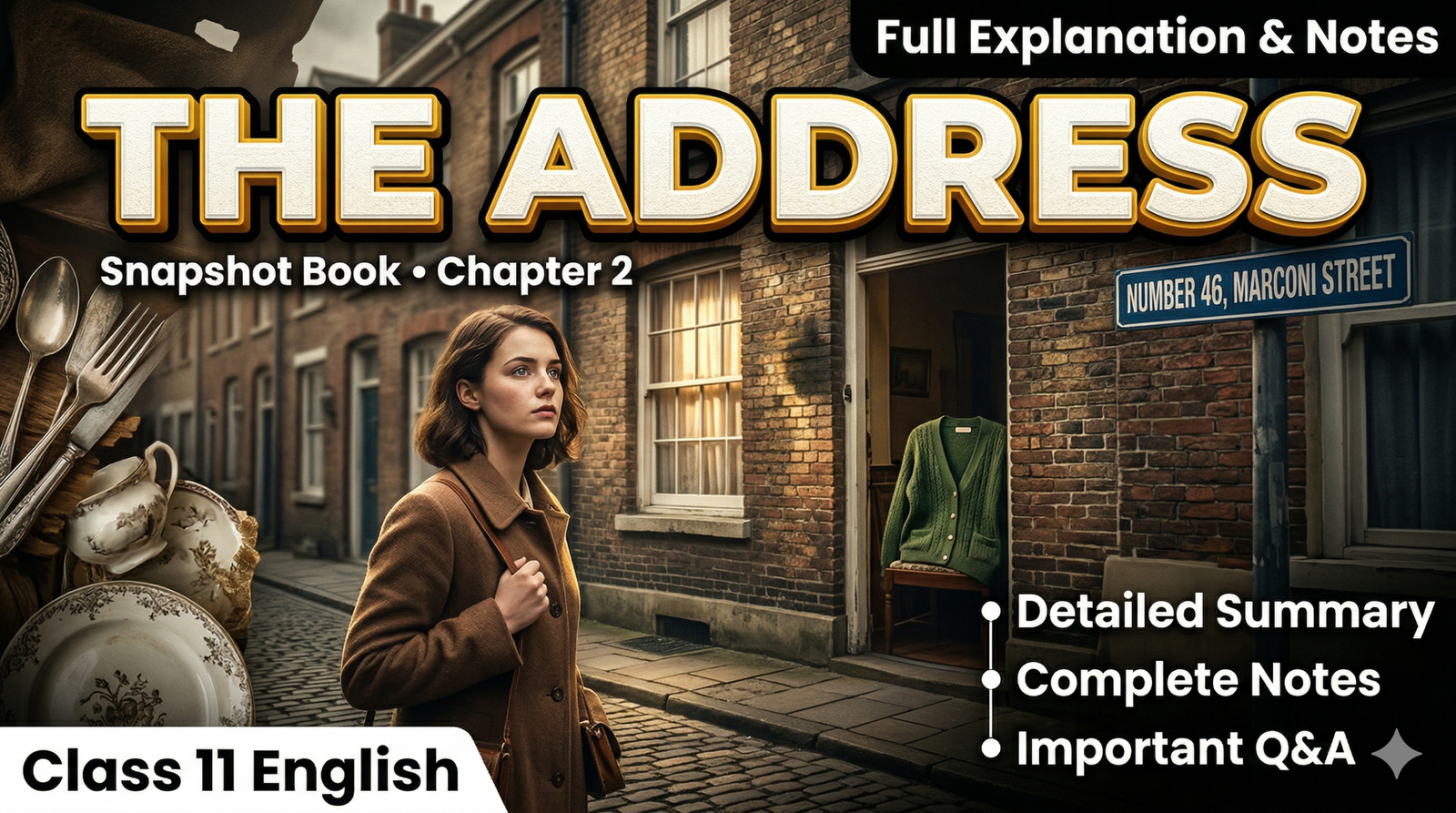
1. Chapter Introduction: The Address
“The Address” by Marga Minco is a touching story about the human predicament that follows war. Set in the aftermath of World War II in Holland, the story revolves around a young Jewish girl who returns to her native city to claim her dead mother’s belongings. The narrative of The Address beautifully explores themes of loss, painful memories, and the harsh reality that physical objects lose their true value when the people associated with them are no more. It is a powerful tale of finding closure and moving on from a tragic past.
2. Characters Detail in The Address
- The Narrator (Marga Minco): A young Jewish woman who survived the war but lost her mother and her home. She returns to “The Address” to find her mother’s belongings but eventually decides to leave them behind to escape painful memories.
- Mrs. S (Narrator’s Mother): A simple, trusting, and naive woman. During the war, she allowed an old acquaintance to take her precious belongings for “safekeeping,” completely unaware of the woman’s selfish intentions.
- Mrs. Dorling: A selfish, opportunistic, and greedy woman. She takes away Mrs. S’s antiques and silver but treats the narrator with cold hostility when she comes back to claim them after the war.
- Mrs. Dorling’s Daughter: A 15-year-old girl who opens the door during the narrator’s second visit. Unlike her mother, she is hospitable and invites the narrator inside.
3. Full Summary of The Address
The First Visit to Number 46, Marconi Street
After the war ends, the narrator returns to her city and decides to visit The Address her mother had given her years ago: Number 46, Marconi Street. She knocks on the door, and it is opened by Mrs. Dorling. The woman acts cold and refuses to recognize the narrator. However, the narrator notices that Mrs. Dorling is wearing her mother’s green knitted cardigan, confirming she is at the right place. Mrs. Dorling rudely dismisses her, saying it is not a convenient time and shuts the door.
The Flashback of the War Days
While walking back to the station, the narrator remembers the past. During the first half of the war, she had noticed many beautiful things missing from her home. Her mother, Mrs. S, explained that an old acquaintance, Mrs. Dorling, was taking the antiques and silver in suitcases every time she visited. Mrs. Dorling claimed she wanted to “save” their precious things in case they had to flee. Mrs. S blindly trusted her and even scolded the narrator for doubting Mrs. Dorling’s intentions.
The Second Visit and the Realization
Determined, the narrator makes a second visit to The Address. This time, Mrs. Dorling is out, and her 15-year-old daughter lets the narrator in. As she enters the living room, the narrator is horrified. She sees all her mother’s precious belongings—the Hanukkah menorah, the antique plates, the silver cutlery—arranged tastelessly in a musty, strange room. The familiar objects suddenly seem alien and oppressive in this new, uninviting environment.
The Resolution to Move On
Looking at her mother’s things, the narrator realizes that objects lose their emotional value when severed from the people and the environment they once belonged to. Seeing them only brings back the pain of her lost family and her shattered past. Without waiting for Mrs. Dorling to return, the narrator rushes out of the house. She resolves to entirely forget The Address—Number 46, Marconi Street—and decides that moving on is the best way to heal from the trauma of the war.
4. Multiple Choice Questions (10 MCQs)
Q1. Who is the author of the story “The Address”?
(a) Shirley Toulson | (b) Marga Minco | (c) Khushwant Singh | (d) William Saroyan
Answer: (b) Marga Minco
Q2. What was the exact address given to the narrator by her mother?
(a) Number 46, Macaroni Street | (b) Number 46, Marconi Street | (c) Number 48, Marconi Street | (d) Number 46, Dorling Street
Answer: (b) Number 46, Marconi Street
Q3. Who was Mrs. Dorling?
(a) The narrator’s aunt | (b) A close friend | (c) An old acquaintance of the narrator’s mother | (d) The narrator’s neighbor
Answer: (c) An old acquaintance of the narrator’s mother
Q4. How did Mrs. Dorling treat the narrator on her first visit?
(a) She welcomed her warmly | (b) She offered her tea | (c) She refused to recognize her and was very cold | (d) She returned the belongings
Answer: (c) She refused to recognize her and was very cold
Q5. What confirmed to the narrator that she was at the right address?
(a) The nameplate on the door | (b) Mrs. Dorling was wearing her mother’s green knitted cardigan | (c) Mrs. Dorling told her | (d) She saw the silver spoons from the window
Answer: (b) Mrs. Dorling was wearing her mother’s green knitted cardigan
Q6. Why did Mrs. Dorling take the belongings from the narrator’s house?
(a) Because she bought them | (b) She wanted to ‘save’ them in case the family had to leave during the war | (c) Because Mrs. S owed her money | (d) She was a thief
Answer: (b) She wanted to ‘save’ them in case the family had to leave during the war
Q7. Who opened the door when the narrator visited the house for the second time?
(a) Mrs. Dorling | (b) Mrs. Dorling’s husband | (c) Mrs. Dorling’s 15-year-old daughter | (d) A maid
Answer: (c) Mrs. Dorling’s 15-year-old daughter
Q8. How did the narrator feel when she saw her mother’s belongings inside Mrs. Dorling’s house?
(a) She felt happy and nostalgic | (b) She felt oppressed by the tasteless arrangement and musty smell | (c) She wanted to steal them back | (d) She felt nothing
Answer: (b) She felt oppressed by the tasteless arrangement and musty smell
Q9. What is the Hanukkah used for in the story?
(a) A type of carpet | (b) A heavy candle-holder | (c) A silver spoon | (d) A teacup
Answer: (b) A heavy candle-holder
Q10. What final decision did the narrator make at the end of the story?
(a) To file a police complaint | (b) To wait for Mrs. Dorling | (c) To forget the address and leave the belongings behind | (d) To take only the silver cutlery
Answer: (c) To forget the address and leave the belongings behind
5. Short Answer Type Questions (35 Words)
Q1. Why did the narrator go to Number 46, Marconi Street?
Ans. After the war, the narrator went to Number 46, Marconi Street to see, touch, and remember her dead mother’s precious belongings, which had been given to Mrs. Dorling for safekeeping during the war.
Q2. How did Mrs. Dorling react when the narrator visited her the first time?
Ans. Mrs. Dorling was cold and hostile. She half-hid behind the door, pretended not to recognize the narrator, and rudely told her that she had no time to talk, eventually shutting the door on her face.
Q3. How did the narrator realize she had come to the right address on her first visit?
Ans. The narrator initially doubted if she had rung the wrong bell. However, she noticed that Mrs. Dorling was wearing her mother’s green knitted cardigan with wooden buttons. This confirmed she was at the right address.
Q4. Why did the narrator’s mother give her belongings to Mrs. Dorling?
Ans. During the war, Jews faced the threat of having to flee their homes suddenly. Mrs. S, being naive, trusted Mrs. Dorling’s suggestion to take their antique and silver items to her house to “save” them.
Q5. Why did the narrator resolve to forget the address?
Ans. The narrator resolved to forget the address because the objects had lost their emotional value. Seeing them arranged tastelessly in a strange, musty environment only brought back painful memories of her dead family and the tragic war.
6. Long Answer Type Questions (60-70 Words)
Q1. Justify the title of the story “The Address”.
Ans. The title “The Address” is highly appropriate. The entire plot revolves around “Number 46, Marconi Street,” the address where the narrator’s mother’s belongings were kept. Initially, the address holds a deep emotional pull for the narrator, symbolizing a connection to her past and her dead mother. She makes two visits to this specific location. However, by the end of the story, she realizes the address only brings painful memories. Her final decision to permanently “forget” this address signifies her moving on from the trauma of the war.
Q2. Describe the narrator’s second visit to Mrs. Dorling’s house. Why did she leave without taking her belongings?
Ans. During her second visit, Mrs. Dorling was absent, and her daughter let the narrator inside. The narrator was horrified to see her mother’s elegant belongings—the Hanukkah, antique plates, and silver—kept in a small, musty room, arranged tastelessly. She felt oppressed by the strange atmosphere. She realized that the objects had lost their true value because they were cut off from her mother and her old life. Taking them to her small, rented room wouldn’t bring her mother back. Thus, to escape the painful memories, she left without claiming them.