1. Chapter Introduction
“From the Diary of Anne Frank” is an excerpt from “The Diary of a Young Girl”. It revolves around a 13-year-old Jewish girl, Anne Frank, who goes into hiding during World War II to escape the Nazis. In this particular chapter, she shares her background, her deep thoughts on why she needs a diary, and a very humorous incident from her school days involving her strict math teacher, Mr. Keesing.
2. Characters Detail
- Anne Frank: A 13-year-old, highly intelligent, observant, and talkative Jewish girl. She feels lonely despite having a family and longs for a true friend, which she finds in her diary.
- Mr. Keesing: Anne’s Mathematics teacher. He is an old-fashioned and strict teacher who frequently punishes Anne for talking too much in class, but ultimately appreciates her clever sense of humor.
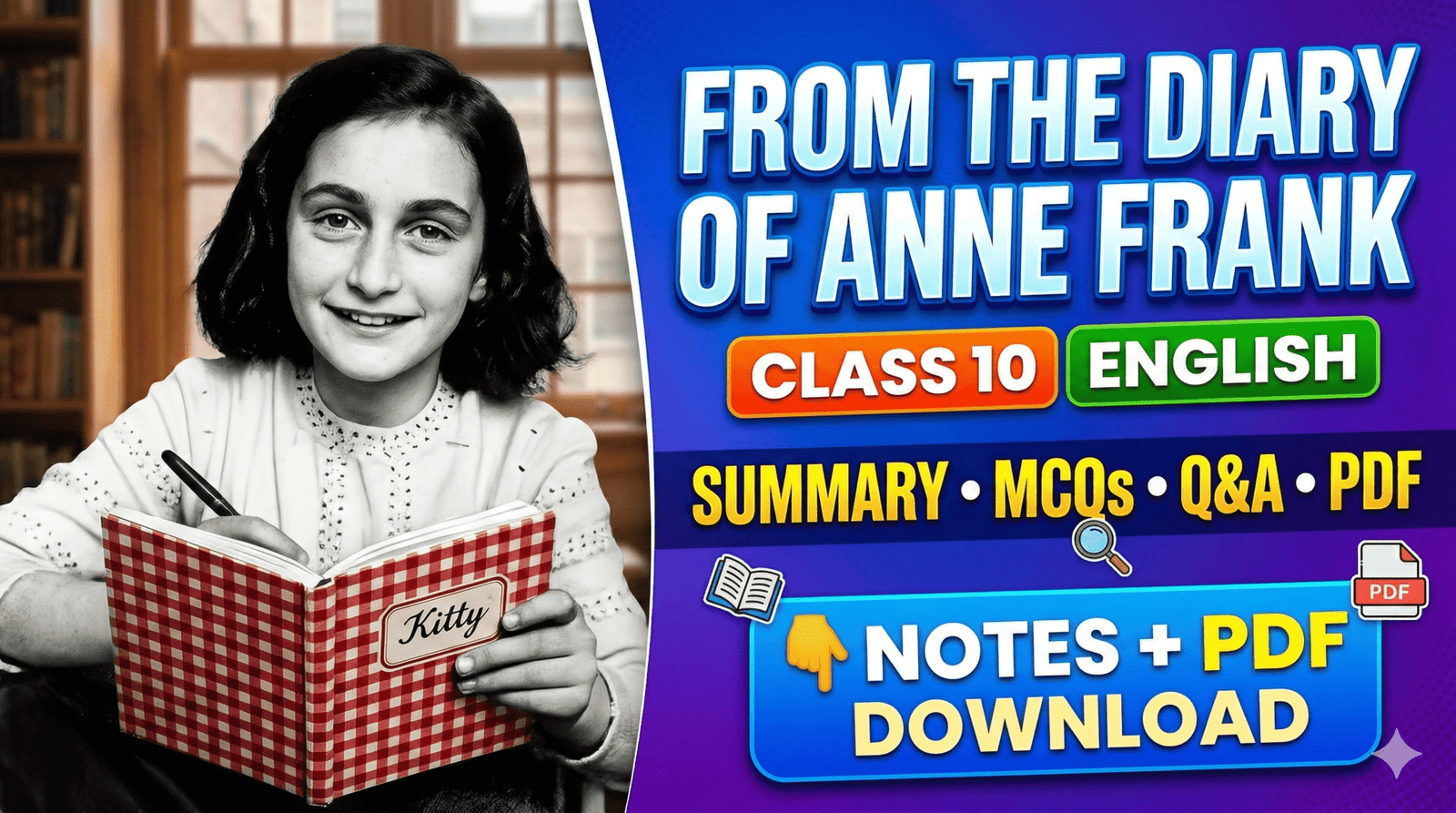
- Kitty: The name Anne gives to her red-and-white checkered diary, treating it as her only true and patient friend.
3. Full Summary
Anne’s Deep Loneliness and Need for a Diary
Anne Frank, a 13-year-old girl, felt that “paper has more patience than people.” Though she lived with loving parents, a sixteen-year-old sister (Margot), and had about thirty people she could call friends, she felt completely alone from inside. She could chat with them about ordinary, everyday things, but she couldn’t share her deepest, most personal feelings. Because she didn’t have a single “true friend” to confide in, she decided to make her diary that friend. She named her diary ‘Kitty’ and began her first entry on Saturday, 20 June 1942.
Anne’s Family Background and Schooling
To help ‘Kitty’ understand her life, Anne writes a brief sketch of her background. Her parents, Otto and Edith Frank, emigrated to Holland in 1933 due to the rising Nazi threat in Germany. Anne and Margot were sent to Aachen to live with their grandmother before moving to Holland to join their parents. Anne started her education at a Montessori nursery school in Holland. In the sixth form, she had a very emotional and tearful farewell with her headmistress, Mrs. Kuperus. Anne also shares her deep emotional connection with her grandmother, who died in 1942. To show her love, Anne lit a special, separate candle for her grandmother on her own birthday.
Classroom Anxiety and the Strict Math Teacher
Moving to her current school life, Anne describes a day when her entire class was “quaking in its boots” (extremely nervous). The teachers were having a meeting to decide which students would be promoted to the next class and who would be kept back. Half the class was making bets. Anne was quite confident about herself and her friends passing, except for Mathematics. She got along well with eight of her nine teachers, but the Math teacher, Mr. Keesing, an old-fashioned man, was always annoyed with her simply because she talked too much in his class.
The Series of Punishment Essays
To punish Anne for her continuous talking, Mr. Keesing assigned her extra homework: an essay on the topic “A Chatterbox.” Anne thought hard and wrote three pages, cleverly arguing that talking is a student’s natural trait and that she couldn’t cure it because she had inherited this habit from her talkative mother. Mr. Keesing laughed at her arguments, but when she talked again in the next lesson, he assigned her a second essay: “An Incorrigible Chatterbox.” When she still didn’t stop talking during the third lesson, he gave her a final, ridiculous topic: “Quack, Quack, Quack, Said Mistress Chatterbox.”
Anne’s Masterpiece and Mr. Keesing’s Change of Heart
Hearing the third topic, the whole class roared with laughter, and Anne laughed too. She knew she had to write something exceptional this time. With the help of her friend Sanne, who was good at poetry, Anne wrote the essay in the form of a humorous poem. The poem was about a father swan who brutally bit his three baby ducklings to death just because they quacked too much. Mr. Keesing immediately understood the joke directed at him. Fortunately, he took it in the right spirit, read the poem to the class with his own funny comments, and completely changed his attitude. After that day, he allowed Anne to talk in class and never gave her any extra homework again.
4. Multiple Choice Questions (10 MCQs)
Q1. What name did Anne give to her diary?
(a) Betty | (b) Kitty | (c) Marie | (d) Sanne
Answer: (b) Kitty
Q2. Why did Anne decide to write a diary?
(a) She loved writing | (b) She wanted to be an author | (c) She had no real friend to confide in | (d) Her teacher forced her
Answer: (c) She had no real friend to confide in
Q3. “Paper has more ________ than people.” Complete the quote.
(a) secrets | (b) space | (c) words | (d) patience
Answer: (d) patience
Q4. Which subject did Mr. Keesing teach?
(a) English | (b) Mathematics | (c) History | (d) Science
Answer: (b) Mathematics
Q5. Why was Mr. Keesing annoyed with Anne?
(a) She was poor at math | (b) She never did her homework | (c) She talked too much in class | (d) She was late to class
Answer: (c) She talked too much in class
Q6. What was the topic of the first essay given as punishment?
(a) An Incorrigible Chatterbox | (b) Quack, Quack, Quack | (c) Silence is Gold | (d) A Chatterbox
Answer: (d) A Chatterbox
Q7. From whom did Anne inherit her talkative nature?
(a) Her father | (b) Her grandmother | (c) Her mother | (d) Her sister
Answer: (c) Her mother
Q8. Who helped Anne write the third essay in verse (poetry)?
(a) Her sister Margot | (b) Her friend Sanne | (c) Her mother | (d) Mr. Keesing
Answer: (b) Her friend Sanne
Q9. What happened to the baby ducklings in Anne’s poem?
(a) They flew away | (b) They were bitten to death by the father swan | (c) They became silent | (d) They turned into swans
Answer: (b) They were bitten to death by the father swan
Q10. Did Mr. Keesing change his attitude at the end?
(a) No, he expelled her | (b) Yes, he allowed her to talk and stopped punishing her | (c) No, he gave her more essays | (d) He stopped teaching the class
Answer: (b) Yes, he allowed her to talk and stopped punishing her
5. Short Answer Questions (35 Words)
Q1. Why does Anne say that “paper has more patience than people”?
Ans. Anne felt that people get bored or irritated listening to someone’s problems. However, paper silently absorbs all thoughts and emotions without judging, interrupting, or losing patience. That is why she trusted her diary more than people.
Q2. Why does Anne provide a brief sketch of her life?
Ans. Anne provides a brief sketch of her life because she feels that no one would understand a word of her stories to ‘Kitty’ if she plunged right in. She wanted to give her imaginary friend a proper background.
Q3. How did Anne justify her being a chatterbox in her essay?
Ans. Anne gave two arguments: first, that talking is a student’s natural trait, and second, that she couldn’t do much to cure it because she had inherited this habit from her mother, who was also very talkative.
Q4. What was the subject of the third essay? How did Anne write it?
Ans. The subject of the third essay was “Quack, Quack, Quack, Said Mistress Chatterbox.” To make it original, Anne wrote it in the form of a humorous poem with the help of her friend Sanne.
Q5. How does Anne show her love for her grandmother?
Ans. Anne loved her grandmother dearly and missed her a lot after she passed away in 1942. To show her love, Anne lit a special, separate candle for her grandmother on her own birthday celebration in 1942.
6. Long Answer Questions (60-70 Words)
Q1. Give a brief character sketch of Anne Frank.
Ans. Anne Frank was a 13-year-old, highly intelligent, and mature Jewish girl. Despite having a loving family, she felt isolated and yearned for a true friend, leading her to confide in her diary, ‘Kitty’. She was exceptionally talkative, a trait she defended cleverly. Her brilliant sense of humor, creativity, and presence of mind are evident in the way she outsmarted her strict math teacher, Mr. Keesing, using a witty poem.
Q2. How did Anne respond to the punishment given by Mr. Keesing? What does it tell us about her?
Ans. Anne did not sulk or get angry when Mr. Keesing punished her with extra essays on being a “Chatterbox.” Instead, she took it as a challenge and used her intellect and humor to respond. In her essays, she logically argued that talking is an inherited student trait. For the final essay, she wrote a sarcastic yet funny poem about a swan biting his ducklings for quacking too much. This shows she was creative, witty, and possessed excellent writing skills.
Q3. “Mr. Keesing was a strict but understanding teacher.” Explain this statement with reference to the story.
Ans. Initially, Mr. Keesing appears as a strict, old-fashioned teacher who gets easily annoyed by Anne’s continuous talking. To discipline her, he assigns her extra homework. However, he is not entirely rigid. He reads Anne’s funny essays and appreciates her arguments. When Anne presents her final poem, which was a direct joke on him, he doesn’t get offended. Instead, he takes the joke in the right spirit, laughs at it, reads it to the class, and finally stops punishing Anne. This proves he was ultimately an understanding and sporty teacher.