
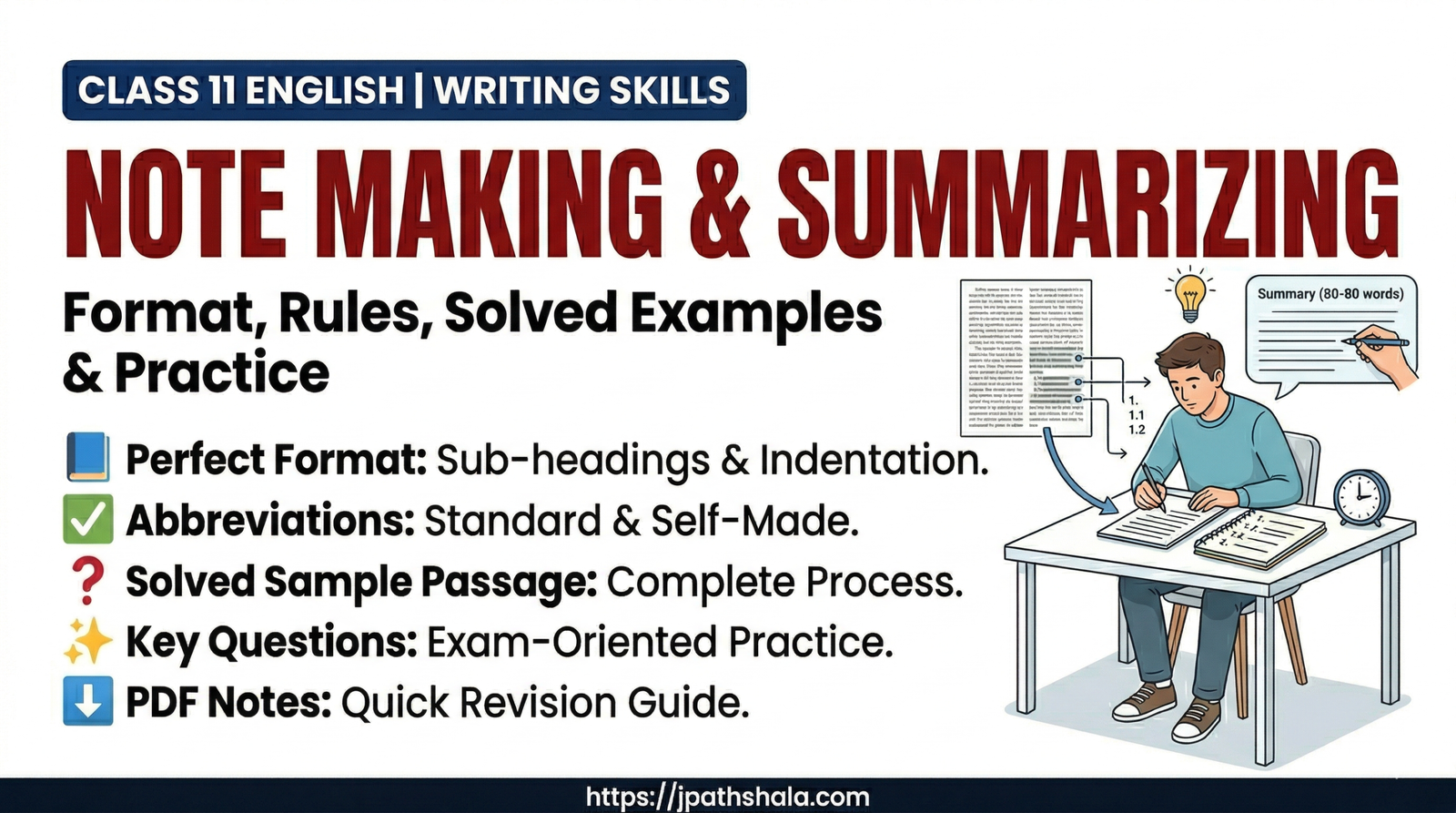
Note Making and Summarizing
CBSE Class 11 English Core – Ultimate Study Guide
Welcome to the ultimate guide on Note Making and Summarizing for Class 11 English. Whether you are revising for your final exams or learning this format for the first time, this comprehensive guide will help you secure full marks in the writing section!
📘 What is Note Making?
Note making is an essential academic skill. It involves reading a passage, understanding its core message, and extracting the most crucial points in a short, structured, and readable format. It saves time during exams and helps in quick revision.
✨ Golden Rules of Note Making
- Never use full sentences. Always use phrases and short points.
- Use a proper Heading and Sub-headings.
- Maintain proper Indentation (spacing from the margin).
- Use standard and self-made Abbreviations (minimum 4-5).
- Do not include your own opinions or examples not found in the text.
📝 The Correct Format (CBSE Standard)
1. Govt. – Government
2. Imp. – Important
3. & – And
4. Edu. – Education
✍️ How to Write a Summary
A summary is a brief paragraph that covers the main ideas of the original passage. Here is how you write a perfect summary:
- Use complete grammatical sentences (unlike notes).
- Keep it strictly to the word limit (usually 50-80 words).
- Write it as a single paragraph.
- Base your summary entirely on the notes you just made. Do not add new information.
🎯 Test Your Knowledge: Top 10 MCQs
1. What is the main purpose of note-making?
A) To copy the whole passage
B) To create a brief, structured record of information
C) To practice handwriting
D) To add personal opinions
Answer: B) To create a brief, structured record of information
2. Which of the following is STRICTLY AVOIDED in note-making?
A) Abbreviations
B) Sub-headings
C) Full grammatical sentences
D) Indentation
Answer: C) Full grammatical sentences
3. What is the ideal length of a summary?
A) Equal to the original passage
B) 1/3rd of the original passage
C) 2 to 3 pages long
D) Half of the notes
Answer: B) 1/3rd of the original passage
4. What is indentation in note-making?
A) Using colorful pens
B) Proper spacing and alignment of sub-headings and points
C) Writing in capital letters
D) Drawing borders around the text
Answer: B) Proper spacing and alignment of sub-headings and points
5. How many minimum abbreviations are generally expected in Class 11 note-making?
A) 1 to 2
B) 10 to 12
C) 4 to 5
D) Zero
Answer: C) 4 to 5
6. Where should the “Key to Abbreviations” box be placed?
A) At the top of the page
B) Inside the summary paragraph
C) Immediately after the notes, before the summary
D) At the back of the answer sheet
Answer: C) Immediately after the notes, before the summary
7. While writing a summary, which of these is correct?
A) Use bullet points
B) Write in a single paragraph using complete sentences
C) Add your personal thoughts
D) Use abbreviations heavily
Answer: B) Write in a single paragraph using complete sentences
8. What should the heading of your notes reflect?
A) The first line of the passage
B) The main central idea of the entire passage
C) The author’s name
D) A random interesting fact
Answer: B) The main central idea of the entire passage
9. Which numbering system is widely accepted in note-making?
A) 1., 1.1, 1.2, 2., 2.1…
B) A, B, C, D…
C) Random symbols (#, @, *)
D) Roman numerals only
Answer: A) 1., 1.1, 1.2, 2., 2.1…
10. What forms the basis of a good summary?
A) The entire original text
B) A dictionary
C) The notes you have just created
D) Internet research
Answer: C) The notes you have just created