1. Chapter Introduction
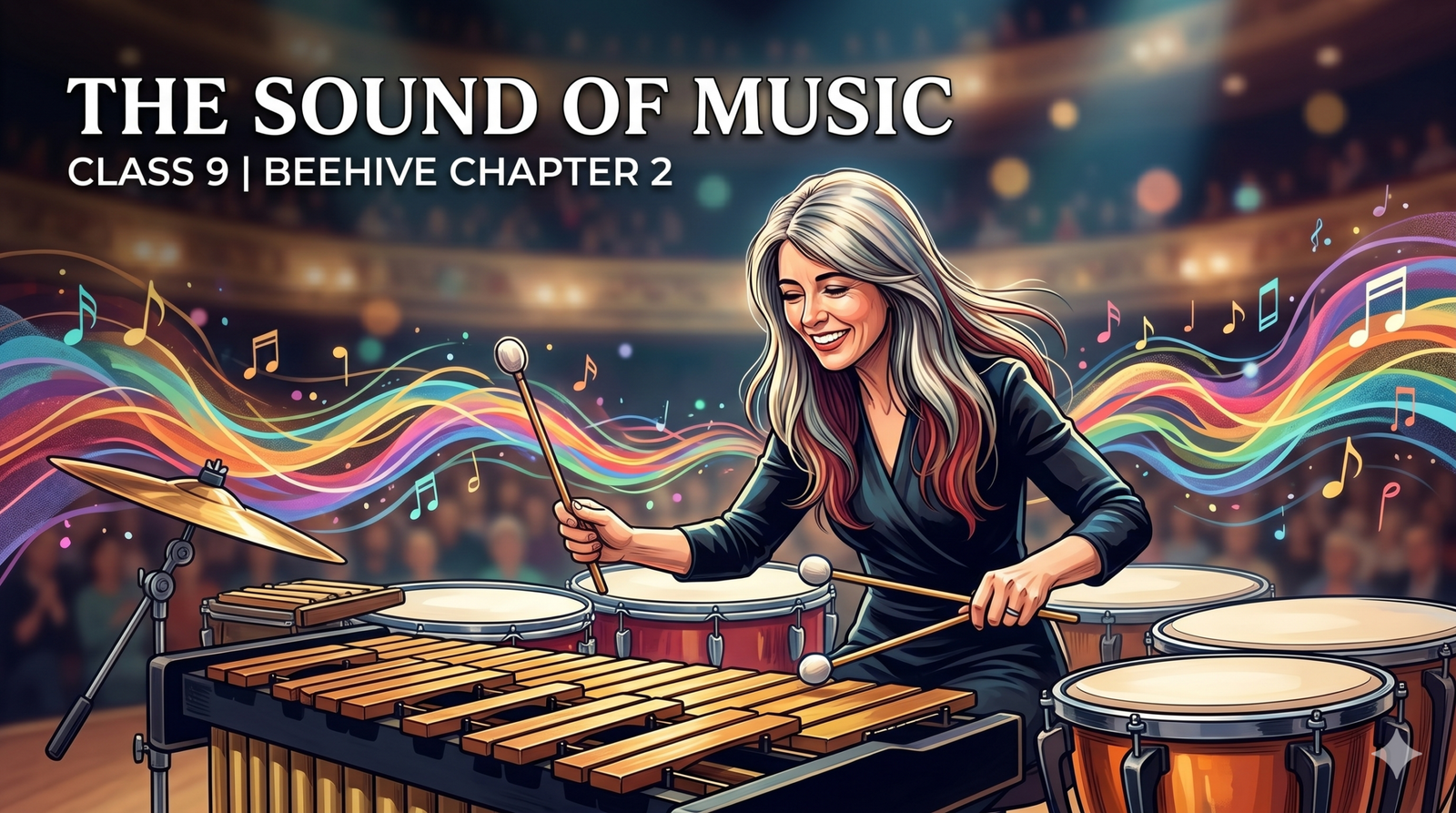
Welcome students! Today we are going to explore Class 9 English Chapter 2: “The Sound of Music”. This inspiring chapter is divided into two parts, both focusing on the profound impact of music and the sheer determination required to achieve greatness. Part I tells the incredible story of Evelyn Glennie, a Scottish girl who became a world-renowned percussionist despite being profoundly deaf. Part II takes us on a historical journey with Ustad Bismillah Khan, the legendary maestro who elevated the Shehnai from a common folk instrument to a symbol of Indian classical music. Let’s dive into these beautiful stories of passion and hard work!
2. Characters Detail
- Evelyn Glennie (Part I): A profoundly deaf girl who never gave up. She learned to feel music through different parts of her body and became one of the most sought-after percussionists in the world.
- Ron Forbes (Part I): A percussionist who spotted Evelyn’s potential. He encouraged her to feel the music rather than listen to it, changing her life forever.
- Ustad Bismillah Khan (Part II): The legendary Shehnai player of India. He brought the Shehnai onto the classical stage and was the first Indian to greet the nation with his Shehnai on 15 August 1947.
- Ali Bux (Part II): Bismillah Khan’s maternal uncle, who played the Shehnai at the Vishnu temple in Benaras and became his first real teacher.
3. Full Summary
Part I: Evelyn Glennie Listens to Sound Without Hearing It
Evelyn Glennie was eight years old when her mother first noticed something was wrong with her hearing. By the time she was eleven, her deafness was confirmed due to gradual nerve damage. Teachers advised her parents to send her to a school for the deaf, but Evelyn was determined to lead a normal life and pursue her interest in music.
While most teachers discouraged her, percussionist Ron Forbes saw her potential. He tuned two large drums to different notes and asked her to “feel” the sound instead of listening through her ears. Evelyn realized she could feel the higher drum from the waist up and the lower drum from the waist down. She joined the Royal Academy of Music in London, scored one of the highest marks in its history, and eventually became a solo performer playing thousands of instruments globally. She inspires millions by proving that physical disabilities cannot stop true determination.
Part II: The Shehnai of Bismillah Khan
The story begins with Emperor Aurangzeb banning the musical instrument ‘pungi’ in the royal residence because of its shrill, unpleasant sound. A barber from a family of musicians decided to improve it. He chose a hollow stem, made seven holes in it, and played it. The sound was melodious. Since it was played in the Shah’s chamber by a Nai (barber), it was named the ‘Shehnai’.
Bismillah Khan was born in 1916 into a family of musicians in Bihar. He spent his childhood in Benaras, mesmerized by his uncle Ali Bux playing the Shehnai at the Vishnu temple. Bismillah Khan practiced for hours on the banks of the river Ganga, inventing new raagas. His biggest moment came on 15 August 1947, when he became the first Indian to greet the newly independent nation with his Shehnai at the Red Fort. His love for India and Benaras was so deep that he refused an offer to start a Shehnai school in the USA. In 2001, he was awarded India’s highest civilian award, the Bharat Ratna.
4. Multiple Choice Questions (10 MCQs)
Q1. How old was Evelyn when her deafness was first noticed?
(a) 8 years | (b) 11 years | (c) 15 years | (d) 5 years
Answer: (a) 8 years
Q2. Who helped Evelyn to continue with music?
(a) Her mother | (b) Ron Forbes | (c) Her headmistress | (d) A doctor
Answer: (b) Ron Forbes
Q3. Which award was presented to Evelyn in 1991?
(a) Bharat Ratna | (b) Soloist of the Year | (c) Grammy Award | (d) Padma Shri
Answer: (b) Soloist of the Year
Q4. How does Evelyn manage to play beautifully despite her deafness?
(a) Hearing aids | (b) Lip-reading | (c) Feeling vibrations through her body | (d) Guessing the notes
Answer: (c) Feeling vibrations through her body
Q5. Who banned the playing of the pungi?
(a) Akbar | (b) Aurangzeb | (c) Shah Jahan | (d) Babur
Answer: (b) Aurangzeb
Q6. Who transformed the pungi into the Shehnai?
(a) Bismillah Khan | (b) Ali Bux | (c) A barber | (d) A court singer
Answer: (c) A barber
Q7. Where did Bismillah Khan regularly play the Shehnai in his childhood?
(a) Red Fort | (b) Vishnu temple in Benaras | (c) Taj Mahal | (d) Mecca
Answer: (b) Vishnu temple in Benaras
Q8. What historic event did Bismillah Khan participate in on 15 August 1947?
(a) He met Mahatma Gandhi | (b) He went to the USA | (c) He played at the Red Fort | (d) He received the Bharat Ratna
Answer: (c) He played at the Red Fort
Q9. Why did Bismillah Khan refuse to start a Shehnai school in the USA?
(a) He hated the USA | (b) They didn’t pay him enough | (c) He couldn’t leave the river Ganga and Benaras | (d) He was too old
Answer: (c) He couldn’t leave the river Ganga and Benaras
Q10. In which year was Ustad Bismillah Khan awarded the Bharat Ratna?
(a) 1947 | (b) 1999 | (c) 2001 | (d) 2006
Answer: (c) 2001
5. Short Answer Questions (30-40 Words)
Q1. How did Evelyn’s deafness come to light?
Ans. Evelyn’s deafness was first noticed by her mother when she was eight. By the time she was eleven, her marks deteriorated, and the headmistress urged her parents to visit a specialist, who confirmed her hearing loss.
Q2. What advice did Ron Forbes give to Evelyn?
Ans. Ron Forbes tuned two large drums to different notes and told Evelyn not to listen through her ears. He advised her to try and “sense” or feel the sound vibrations through different parts of her body.
Q3. Why did Aurangzeb ban the playing of the pungi?
Ans. Emperor Aurangzeb banned the playing of the musical instrument pungi in the royal residence because it produced a very shrill, harsh, and unpleasant sound.
Q4. How is a shehnai different from a pungi?
Ans. A shehnai has a better tonal quality than a pungi. It is made from a natural hollow stem that is longer and broader than the pungi, and it has seven holes on its body, producing a soft, melodious sound.
Q5. Where did Bismillah Khan play the shehnai on 15 August 1947? Why was the event historic?
Ans. He played the shehnai at the Red Fort on 15 August 1947. The event was historic because India had just gained independence, and he was the first Indian to greet the newly free nation with his music.
6. Long Answer Questions (60-80 Words)
Q1. How does Evelyn hear music despite her deafness? Explain.
Ans. Evelyn hears music by feeling its vibrations. Ron Forbes taught her to sense notes through her body. She feels the higher drum from the waist up and the lower drum from the waist down. When playing the xylophone, she can sense the sound passing up the stick into her fingertips. By leaning against the drums, she feels the resonances flowing into her body. On a wooden platform, she removes her shoes so vibrations pass through her bare feet and up her legs.
Q2. Evelyn Glennie is a shining example of determination and hard work. Discuss.
Ans. Evelyn Glennie proves that physical disability is not a barrier to success if one has sheer determination. Despite losing her hearing completely by the age of eleven, she never gave up. Instead of attending a special school, she pursued her passion for music in a regular environment. Through immense hard work and her unique ability to feel music, she auditioned for the Royal Academy of Music and achieved the highest marks. She became an inspiration for millions, proving that impossible is nothing.
Q3. Write a brief note on Bismillah Khan’s love for India and Benaras.
Ans. Bismillah Khan had a deep, unconditional love for his motherland, India, and the city of Benaras. His soul belonged to the banks of the river Ganga, where he practiced and found inspiration for his raagas. This love was so strong that when a student offered him a chance to head a shehnai school in the USA, he refused. He asked if they could transport the river Ganga there. He proudly stated that whenever he was in a foreign country, he kept yearning to see Hindustan.