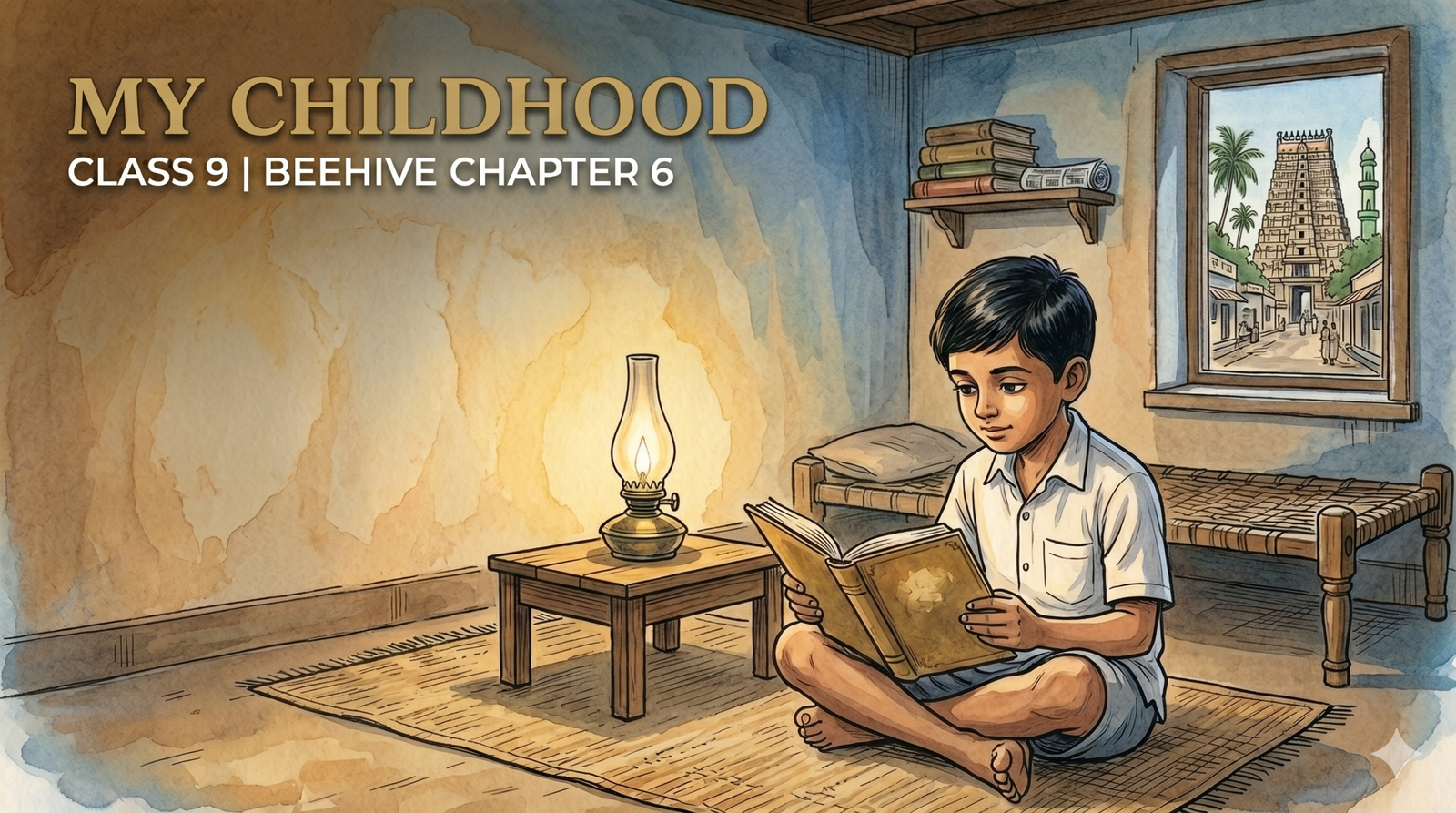
1. Chapter Introduction
Hello students! Today we are going to study a very inspiring chapter, Class 9 English Chapter 6: “My Childhood”. This chapter is an extract from the famous autobiography ‘Wings of Fire’ written by one of India’s greatest scientists and our 11th President, Dr. A.P.J. Abdul Kalam. In this chapter, he shares beautiful memories of his childhood in Rameswaram, his loving parents, his friends from different religious backgrounds, and the teachers who helped shape his brilliant mind and broke the barriers of social inequality.
2. Characters Detail
- A.P.J. Abdul Kalam: The narrator of the story. A young, curious boy from a middle-class Muslim family who later became a great scientist.
- Jainulabdeen: Kalam’s father. He was not highly educated or wealthy, but he possessed great innate wisdom, honesty, and a generous spirit.
- Ashiamma: Kalam’s mother. A kind-hearted woman who fed many outsiders every day along with her own family.
- Ramanadha Sastry: Kalam’s closest childhood friend. He was the son of the high priest of the Rameswaram temple.
- Sivasubramania Iyer: Kalam’s science teacher. An orthodox Brahmin who fought against social barriers and invited Kalam to dine at his house.
3. Full Summary
Humble Beginnings in Rameswaram
Abdul Kalam was born into a middle-class Tamil family in the island town of Rameswaram. He lived in his ancestral house on Mosque Street. His father, Jainulabdeen, was an austere man who avoided all inessential comforts and luxuries, yet provided his family with all necessities like food, medicine, and clothes. Kalam inherited honesty and self-discipline from his father, and deep faith in goodness and kindness from his mother, Ashiamma.
Earning His First Wages
When the Second World War broke out in 1939, Kalam was just eight years old. A sudden demand for tamarind seeds erupted, and Kalam used to collect and sell them to a provision shop. Later, due to the war, the train halt at Rameswaram station was suspended. The newspapers had to be bundled and thrown out of the moving train. Kalam’s cousin, Samsuddin, who distributed newspapers, needed a helping hand to catch the bundles. Kalam took the job and felt a great surge of pride in earning his own money for the first time.
Childhood Friends and the Poison of Discrimination
Kalam had three close friends: Ramanadha Sastry, Aravindan, and Sivaprakasan. All three were from orthodox Hindu Brahmin families, but they never felt any religious differences. However, when Kalam was in the fifth standard, a new teacher came to the class. He could not tolerate a Muslim boy sitting beside the Hindu priest’s son (Ramanadha Sastry) in the front row. He ordered Kalam to go and sit on the back bench. Both boys felt very sad.
After school, Ramanadha Sastry’s father, Lakshmana Sastry, summoned the teacher. He strictly told him not to spread the poison of social inequality and communal intolerance in the minds of innocent children. The teacher apologized and reformed his behavior.
The Rebel Science Teacher
Kalam’s science teacher, Sivasubramania Iyer, was an orthodox Brahmin, but he wanted to break social barriers. One day, he invited Kalam to his home for a meal. However, his conservative wife was horrified at the idea of a Muslim boy eating in her ritually pure kitchen and refused to serve him. Iyer didn’t get angry; instead, he served Kalam with his own hands and sat down beside him to eat. When Kalam was invited again the next weekend, Iyer’s wife took him inside her kitchen and served him food with her own hands, showing a complete change of heart.
Leaving Home for Higher Studies
After the Second World War ended, India’s freedom was imminent. Kalam asked his father for permission to leave Rameswaram and study at the district headquarters in Ramanathapuram. His father happily agreed. Quoting the philosopher Khalil Gibran, he told Kalam’s mother that children are the sons and daughters of Life’s longing for itself. They come through their parents but do not belong to them, and they must be allowed to fly away and chase their own thoughts and dreams.
4. Multiple Choice Questions (10 MCQs)
Q1. From which book is the chapter “My Childhood” taken?
(a) Ignited Minds | (b) Wings of Fire | (c) Turning Points | (d) Mission India
Answer: (b) Wings of Fire
Q2. Where was Abdul Kalam born?
(a) Chennai | (b) Madurai | (c) Rameswaram | (d) Coimbatore
Answer: (c) Rameswaram
Q3. What was the name of Abdul Kalam’s father?
(a) Samsuddin | (b) Jainulabdeen | (c) Jalaluddin | (d) Lakshmana Sastry
Answer: (b) Jainulabdeen
Q4. How did Kalam earn his first wages?
(a) By selling tamarind seeds | (b) By catching newspaper bundles | (c) By tutoring students | (d) By sweeping the mosque
Answer: (b) By catching newspaper bundles
Q5. Who was Kalam’s closest childhood friend?
(a) Aravindan | (b) Sivaprakasan | (c) Ramanadha Sastry | (d) Samsuddin
Answer: (c) Ramanadha Sastry
Q6. What did the new teacher in the fifth standard do?
(a) Praised Kalam | (b) Sent Kalam to the back bench | (c) Expelled Kalam | (d) Made him the monitor
Answer: (b) Sent Kalam to the back bench
Q7. Who scolded the new teacher for spreading social inequality?
(a) Kalam’s father | (b) Sivasubramania Iyer | (c) Lakshmana Sastry | (d) The Headmaster
Answer: (c) Lakshmana Sastry
Q8. Who was Sivasubramania Iyer?
(a) The English Teacher | (b) The Science Teacher | (c) The Temple Priest | (d) Kalam’s Cousin
Answer: (b) The Science Teacher
Q9. Why did the science teacher’s wife initially refuse to serve Kalam?
(a) He was late | (b) She disliked him | (c) Because he was a Muslim boy | (d) The food was over
Answer: (c) Because he was a Muslim boy
Q10. Whose words did Kalam’s father quote when Kalam decided to leave for higher studies?
(a) Mahatma Gandhi | (b) Rabindranath Tagore | (c) Khalil Gibran | (d) William Shakespeare
Answer: (c) Khalil Gibran
5. Short Answer Questions (30-40 Words)
Q1. Describe Abdul Kalam’s house.
Ans. Abdul Kalam lived in his ancestral house, which was built in the middle of the 19th century. It was a fairly large pucca house made of limestone and brick, located on Mosque Street in Rameswaram.
Q2. What characteristics did Kalam inherit from his parents?
Ans. Kalam inherited honesty and self-discipline from his strict but loving father. From his mother, he inherited a deep faith in goodness, generosity, and kindness.
Q3. Who was Samsuddin, and how did he help Kalam?
Ans. Samsuddin was Kalam’s cousin who distributed newspapers in Rameswaram. During World War II, when moving trains didn’t stop at the station, he hired Kalam to catch the newspaper bundles thrown from the train, helping Kalam earn his first wages.
Q4. How did Lakshmana Sastry reform the new teacher?
Ans. Lakshmana Sastry summoned the new teacher and bluntly told him not to poison the minds of innocent children with social inequality and communal intolerance. He asked the teacher to either apologize or quit the school.
Q5. What did Kalam’s father say when he asked for permission to study outside Rameswaram?
Ans. His father happily agreed and gave the example of a seagull that flies across the sun alone. He quoted Khalil Gibran, saying that children have their own thoughts and must be allowed to pursue their dreams independently.
6. Long Answer Questions (60-80 Words)
Q1. Narrate the incident that happened in the fifth standard when a new teacher came to the class.
Ans. When Kalam was in the fifth standard, he used to sit in the front row next to his best friend, Ramanadha Sastry, wearing a cap that marked him as a Muslim. A new teacher joined the school and could not stomach a Hindu priest’s son sitting with a Muslim boy. Based on social ranking, he ordered Kalam to sit on the back bench. Both friends were deeply heartbroken and cried. Later, Ramanadha’s father severely scolded the teacher, which eventually reformed him.
Q2. How did Sivasubramania Iyer attempt to break social barriers in Rameswaram?
Ans. Kalam’s science teacher, Sivasubramania Iyer, was an orthodox Brahmin, but he rebelled against the rigid social norms of Rameswaram. He invited Kalam to his house for a meal. When his conservative wife refused to serve a Muslim boy in her “pure” kitchen, Iyer calmly served Kalam with his own hands and sat beside him to eat. His patience and love eventually changed his wife’s attitude, and the next time, she herself took Kalam into the kitchen and served him food.
Q3. Write a brief character sketch of A.P.J. Abdul Kalam’s father, Jainulabdeen.
Ans. Jainulabdeen was not highly educated or wealthy, but he possessed immense practical wisdom and a generous spirit. He was an austere man who avoided all non-essential comforts and luxuries. However, he ensured his family lacked no necessities, providing ample food, medicine, and clothes. He was a man of great tolerance and believed in religious harmony. He instilled strong values of honesty and self-discipline in his children and encouraged them to fly out of their comfort zones to achieve their dreams.