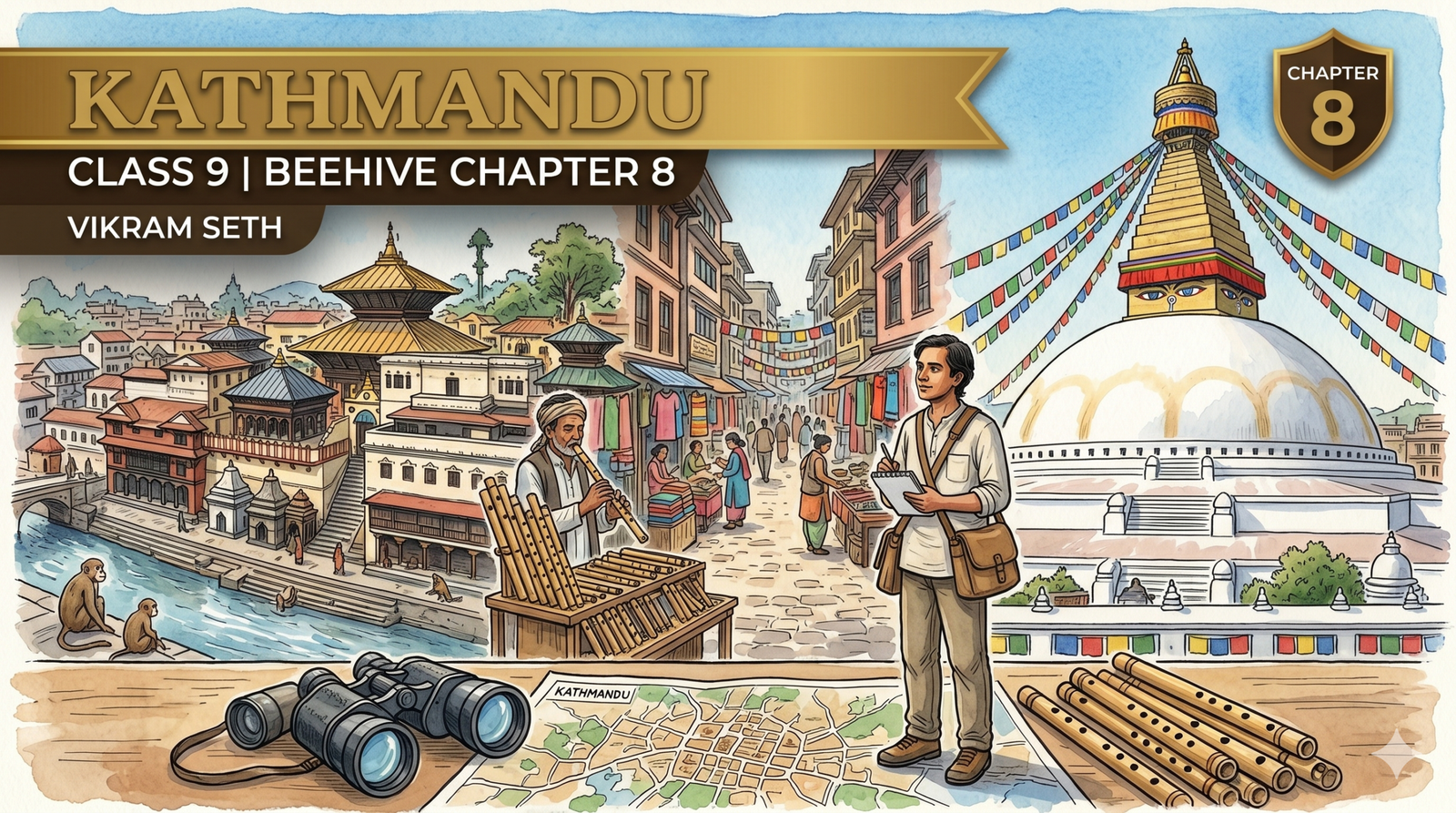
1. Chapter Introduction
Hello students! Welcome to the beautiful and lively journey of Class 9 English Chapter: “Kathmandu”. This chapter is an extract from the travelogue ‘From Heaven Lake’ written by the renowned Indian author Vikram Seth. In this chapter, he vividly describes his visit to the capital of Nepal, Kathmandu. He contrasts the chaotic and noisy atmosphere of the Hindu temple, Pashupatinath, with the profound stillness and peace of the Buddhist shrine, the Baudhnath Stupa. Finally, he shares a mesmerizing observation of a flute seller that highlights the universal language of music.
2. Key Places & Figures
- Vikram Seth (The Narrator): The author who is traveling through Kathmandu. He is a keen observer of human behavior, religion, and the everyday hustle and bustle of the city.
- Pashupatinath Temple: A highly revered Hindu temple in Kathmandu, characterized by intense crowds, fighting monkeys, and “febrile confusion.”
- Baudhnath Stupa: A major Buddhist shrine in Kathmandu, characterized by immense quietness, stillness, and a large white dome.
- The Flute Seller: A calm and composed vendor standing in a busy square, playing his flute meditatively, oblivious to the chaos around him.
3. Full Summary
Arrival in Kathmandu and Pashupatinath Temple
Vikram Seth arrives in Kathmandu and rents a cheap room in the center of town. With a companion, he visits the two most important religious sites in the city. The first is the Pashupatinath temple. A signboard outside announces: “Entrance for the Hindus only.” Inside, there is an atmosphere of ‘febrile confusion’ (extreme chaos). Priests, hawkers, devotees, tourists, cows, monkeys, pigeons, and dogs roam freely through the grounds. People push each other to get closer to the priest. Two monkeys fight right in front of the holy Bagmati River, which flows next to the temple.
The Belief About the Half-Submerged Shrine
At the banks of the Bagmati river, a corpse is being cremated. Washerwomen are washing clothes, and children are bathing. The author spots a small shrine half protruding from the stone platform on the riverbank. There is a local belief that when the shrine emerges fully, the goddess inside will escape, and the evil period of the Kalyug will finally end on earth.
The Peace at Baudhnath Stupa
In sharp contrast to the chaotic Pashupatinath, the Baudhnath Stupa offers a haven of peace. This Buddhist shrine has a huge white dome ringed by a road. Small shops owned by Tibetan immigrants surround the outer edge, selling felt bags, Tibetan prints, and silver jewellery. There are no crowds, and the area is a haven of quietness and stillness amidst the busy city.
The Streets of Kathmandu
The author describes Kathmandu as vivid, mercenary, and deeply religious. The streets are extremely busy and narrow. There are shops selling everything from copper utensils to Nepalese antiques, cosmetics, and chocolates. The streets are filled with the noises of film songs blaring from radios, car horns, bicycle bells, and the cries of stray cows. Seth indulges himself by buying a roasted corn on the cob, a marzipan bar, and reading a couple of love-story comics.
The Flute Seller
While deciding how to return home to Delhi, Seth notices a flute seller standing in a corner of the square near his hotel. Unlike other street vendors who scream to sell their wares, this seller is completely quiet. He has a pole with fifty or sixty flutes sticking out like the quills of a porcupine. Slowly and meditatively, he plays a tune on a flute. The music is so beautiful and pure that it captivates the author. Seth reflects that the flute is a universal instrument found in every culture, and its music connects all of humanity.
4. Multiple Choice Questions (10 MCQs)
Q1. Who is the author of the chapter “Kathmandu”?
(a) Ruskin Bond | (b) Vikram Seth | (c) Isaac Asimov | (d) R.K. Narayan
Answer: (b) Vikram Seth
Q2. From which book is the chapter “Kathmandu” taken?
(a) The Golden Gate | (b) A Suitable Boy | (c) From Heaven Lake | (d) Two Lives
Answer: (c) From Heaven Lake
Q3. Which two temples did the author visit in Kathmandu?
(a) Pashupatinath and Golden Temple | (b) Pashupatinath and Baudhnath Stupa | (c) Meenakshi Temple and Baudhnath Stupa | (d) Sun Temple and Pashupatinath
Answer: (b) Pashupatinath and Baudhnath Stupa
Q4. What does the signboard outside the Pashupatinath temple say?
(a) No photography allowed | (b) Entrance for Hindus only | (c) Keep Silence | (d) Beware of monkeys
Answer: (b) Entrance for Hindus only
Q5. Which river flows right next to the Pashupatinath temple?
(a) Ganga | (b) Yamuna | (c) Bagmati | (d) Brahmaputra
Answer: (c) Bagmati
Q6. What will happen when the small shrine on the Bagmati riverbank emerges fully?
(a) A flood will occur | (b) The goddess will escape, ending Kalyug | (c) The temple will sink | (d) A new king will be born
Answer: (b) The goddess will escape, ending Kalyug
Q7. What was the atmosphere like at the Baudhnath Stupa?
(a) Febrile confusion | (b) Full of fighting monkeys | (c) A haven of quietness and stillness | (d) Very noisy and commercial
Answer: (c) A haven of quietness and stillness
Q8. Who owned the small shops outside the Baudhnath Stupa?
(a) Chinese tourists | (b) Indian merchants | (c) Tibetan immigrants | (d) Nepalese locals
Answer: (c) Tibetan immigrants
Q9. How was the flute seller selling his flutes?
(a) By shouting loudly | (b) By offering heavy discounts | (c) By playing the flute slowly and meditatively | (d) By running behind tourists
Answer: (c) By playing the flute slowly and meditatively
Q10. What does the author compare the flutes sticking out of the pole to?
(a) Branches of a tree | (b) Quills of a porcupine | (c) Spikes of a fence | (d) Needles of a cactus
Answer: (b) Quills of a porcupine
5. Short Answer Questions (30-40 Words)
Q1. What is the atmosphere at the Pashupatinath temple?
Ans. The atmosphere at the Pashupatinath temple is one of “febrile confusion.” It is extremely crowded, noisy, and chaotic with priests, hawkers, tourists, cows, dogs, and monkeys roaming around freely and people elbowing each other.
Q2. Contrast the atmosphere of Baudhnath Stupa with that of Pashupatinath.
Ans. While Pashupatinath is chaotic, noisy, and crowded, the Baudhnath Stupa is entirely the opposite. It offers a haven of profound quietness and stillness. There are no crowds, and the vast white dome brings a sense of deep peace.
Q3. What is the local belief about the half-submerged shrine on the river Bagmati?
Ans. The locals believe that when the small shrine fully emerges from the stone platform on the riverbank, the goddess inside will escape. This event will mark the end of the evil period of the Kalyug on earth.
Q4. How does the author describe the streets of Kathmandu?
Ans. The author describes Kathmandu’s streets as vivid, narrow, and very busy. They are filled with fruit sellers, flute sellers, hawkers of postcards, and shops selling antiques, cosmetics, and chocolates, accompanied by a cacophony of street noises.
Q5. Why is the author deeply affected by the music of the flute?
Ans. The author is affected by the flute’s music because it is played slowly, meditatively, and without any desperation to sell. He realizes that the flute is the most universal instrument, representing the common breath of all humanity.
6. Long Answer Questions (60-80 Words)
Q1. Compare and contrast the atmospheres of Pashupatinath Temple and Baudhnath Stupa as described by Vikram Seth.
Ans. The two religious shrines in Kathmandu present a stark contrast. Pashupatinath Temple, open only to Hindus, is a place of “febrile confusion.” It is overcrowded, noisy, and chaotic, with fighting monkeys, pushing devotees, and bathing children in the Bagmati river. On the other hand, the Buddhist shrine, Baudhnath Stupa, is a haven of quietness and stillness. Despite the small shops owned by Tibetan immigrants around it, there are no crowds. The huge white dome radiates profound peace, making it a refuge from the busy city.
Q2. Describe the flute seller and his style of playing the instrument. Why did it attract the author?
Ans. The flute seller stood in a corner of the square holding a pole from which fifty or sixty flutes protruded, looking like the quills of a porcupine. Unlike other vendors who shouted hoarsely to attract customers, the flute seller was calm. He randomly selected a flute and played it slowly and meditatively. His music rose clearly above the traffic noise. The author was deeply attracted to this serene approach because the pure, universal sound of the flute felt deeply connected to the human breath and soul.
Q3. How does the author highlight the lively and commercial nature of Kathmandu’s streets?
Ans. Vikram Seth vividly captures the mercenary and vivid nature of Kathmandu’s streets. They are narrow, busy, and packed with diverse businesses. One can find fruit sellers, postcard hawkers, and shops selling everything from western cosmetics and Nepalese antiques to copper utensils. The atmosphere is filled with a loud mix of sounds—film songs blaring from radios, car horns honking, bicycle bells ringing, and stray cows lowing. It represents a vibrant, unorganized, yet fascinating blend of religion and commerce.