The Voice of the Rain Class 11: Full Notes, Poem & MCQs
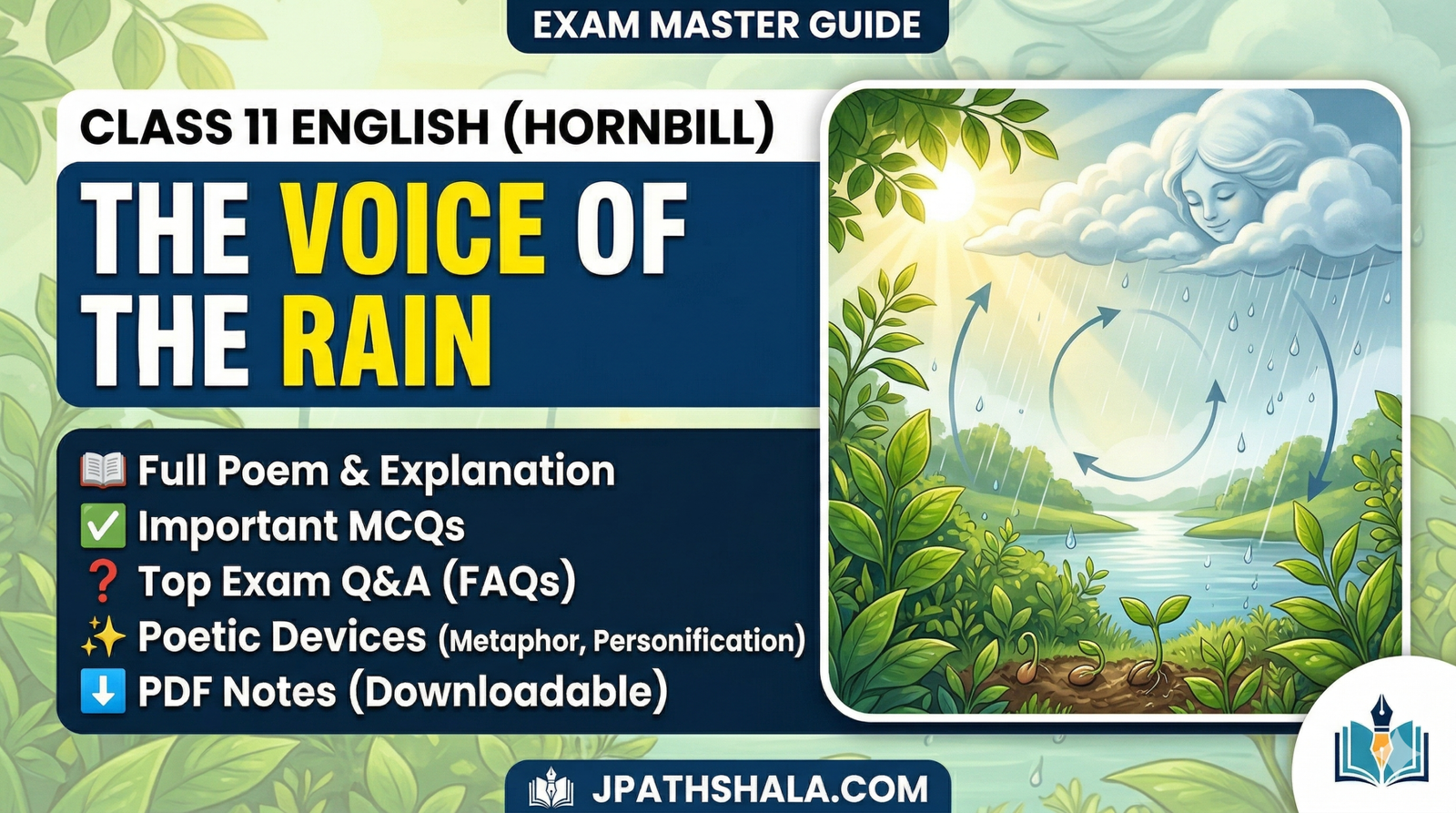
Welcome to the complete study guide for Class 11 English Hornbill chapter, “The Voice of the Rain”. Written by Walt Whitman, this unique poem presents an imaginary conversation between the poet and the rain, highlighting the cyclical nature of rain and its striking similarity to poetry and music.
The Poem: “The Voice of the Rain” by Walt Whitman
And who art thou? said I to the soft-falling shower,
Which, strange to tell, gave me an answer, as here translated:
I am the Poem of Earth, said the voice of the rain,
Eternal I rise impalpable out of the land and the bottomless sea,
Upward to heaven, whence, vaguely form’d, altogether changed, and yet the same,
I descend to lave the drouths, atomies, dust-layers of the globe,
And all that in them without me were seeds only, latent, unborn;
And forever, by day and night, I give back life to my own origin,
And make pure and beautify it;
(For song, issuing from its birth-place, after fulfilment, wandering
Reck’d or unreck’d, duly with love returns.)
Complete Summary of The Voice of the Rain
The poem is a profound exploration of the water cycle and its life-giving properties, beautifully compared to the journey of a song.
Phase 1: The Question and The Surprising Answer
The poem begins with the poet asking the softly falling rain, “Who are you?” Surprisingly, the rain replies. The poet translates the rain’s answer for the readers. The rain introduces itself as the “Poem of Earth.”
Phase 2: The Upward Journey (Evaporation & Condensation)
The rain explains its continuous, eternal cycle. It rises from the land and the deep sea in the form of water vapor. In this state, it is “impalpable” (cannot be touched). It rises to the sky, where it forms clouds. Although its form completely changes (from water to vapor to clouds), its core essence remains the same.
Phase 3: The Downward Journey (Precipitation & Rejuvenation)
The rain then falls back to earth to wash away droughts, dust, and tiny particles. It provides life to seeds that were lying hidden and dormant under the soil, waiting for water to sprout. By continuously falling day and night, the rain purifies and beautifies the earth, giving life back to its own origin.
Phase 4: The Parallel with Music (Last Two Lines)
The last two lines of the poem are enclosed in brackets. Here, the poet compares the rain to a song. Just like a song originates from the heart of the singer, travels around the world (whether people pay attention to it or not), and eventually returns to the creator in the form of love and appreciation, the rain also completes its cycle and returns to beautify its birthplace (the Earth).
Important Word Meanings
| Word/Phrase |
Meaning in English |
| Thou |
You (Old English). |
| Impalpable |
Something that cannot be touched or felt physically. |
| Lave |
To wash or bathe. |
| Latent |
Hidden; dormant; existing but not yet developed. |
| Reck’d or unreck’d |
Cared for or not cared for (whether people notice it or not). |
Important Multiple Choice Questions (MCQs)
Test your understanding with these exam-oriented MCQs covering key themes and poetic devices.
1. Who is the poet of ‘The Voice of the Rain’?
- A) Shirley Toulson
- B) Ted Hughes
- C) Walt Whitman
- D) Marcus Natten
Answer: C) Walt Whitman
2. What does the rain call itself?
- A) The tears of the sky
- B) The Poem of Earth
- C) The life-giver
- D) The song of nature
Answer: B) The Poem of Earth
3. Which poetic device is used in the phrase “I am the Poem of Earth”?
- A) Simile
- B) Metaphor
- C) Personification
- D) Both B and C
Answer: D) Both B and C (Metaphor for comparing rain to a poem, Personification because rain is speaking).
4. What does the word ‘impalpable’ mean in the poem?
- A) Something that cannot be seen or touched
- B) Something heavy
- C) Something very loud
- D) Something transparent
Answer: A) Something that cannot be seen or touched (referring to water vapor).
5. According to the rain, what would happen to the seeds without it?
- A) They would dry up and die
- B) They would remain hidden and unborn
- C) They would grow slowly
- D) They would be eaten by birds
Answer: B) They would remain hidden and unborn
6. What is the rain’s origin or birthplace?
- A) The clouds
- B) The mountains
- C) The land and bottomless sea
- D) The sky
Answer: C) The land and bottomless sea
7. Why are the last two lines placed in brackets?
- A) Because they are a mistake
- B) Because they are spoken by the rain
- C) Because they are the poet’s own thoughts comparing rain to a song
- D) Because they are less important
Answer: C) Because they are the poet’s own thoughts comparing rain to a song.
8. What does the rain do to its own origin?
- A) It destroys it
- B) It makes it pure and beautiful
- C) It floods it
- D) It ignores it
Answer: B) It makes it pure and beautiful
9. “Altogether changed, and yet the same.” What does this mean?
- A) The rain changes color but not shape
- B) The water changes its form (vapor/cloud/water) but its core element (H2O) remains the same
- C) The rain changes its direction
- D) The rain sounds different but looks the same
Answer: B) The water changes its form but its core element remains the same.
10. What is the poetic device in “soft-falling shower”?
- A) Alliteration
- B) Simile
- C) Personification
- D) Hyperbole
Answer: A) Alliteration (Repetition of the ‘s’ sound).
Top Exam Questions and Answers (FAQs)
Q1: There are two voices in the poem. Who do they belong to? Which lines indicate this?
Answer: The two voices in the poem belong to the poet and the rain. The poet’s voice is indicated by the line, “And who art thou? said I to the soft-falling shower”. The voice of the rain is indicated by the line, “I am the Poem of Earth, said the voice of the rain”.
Q2: How is the cyclic movement of rain brought out in the poem? Compare it with what you have learnt in science.
Answer: In the poem, the rain rises from the land and sea as ‘impalpable’ vapor, forms clouds in the sky, and then falls back to earth to wash the droughts and give life to seeds. This perfectly matches the scientific water cycle consisting of evaporation, condensation, and precipitation. Both explain how water moves from the earth to the sky and back again.
Q3: Why are the last two lines put within brackets?
Answer: The last two lines are placed in brackets because they are not a part of the conversation between the poet and the rain. Instead, they represent the poet’s own inner thoughts and observations, where he draws a beautiful parallel between the life cycle of the rain and the journey of a song (poetry/music).