1. Poem Introduction
“A Photograph” by Shirley Toulson is a tender and touching tribute to her mother. The poem explores the transience of human life in contrast to the permanence of nature. Through an old photograph, the poet recalls her mother’s childhood, her mother’s laughter at the memory, and finally, the poet’s own grief after her mother’s death. It beautifully captures the passage of time and the lingering silence of loss.
2. The Poem
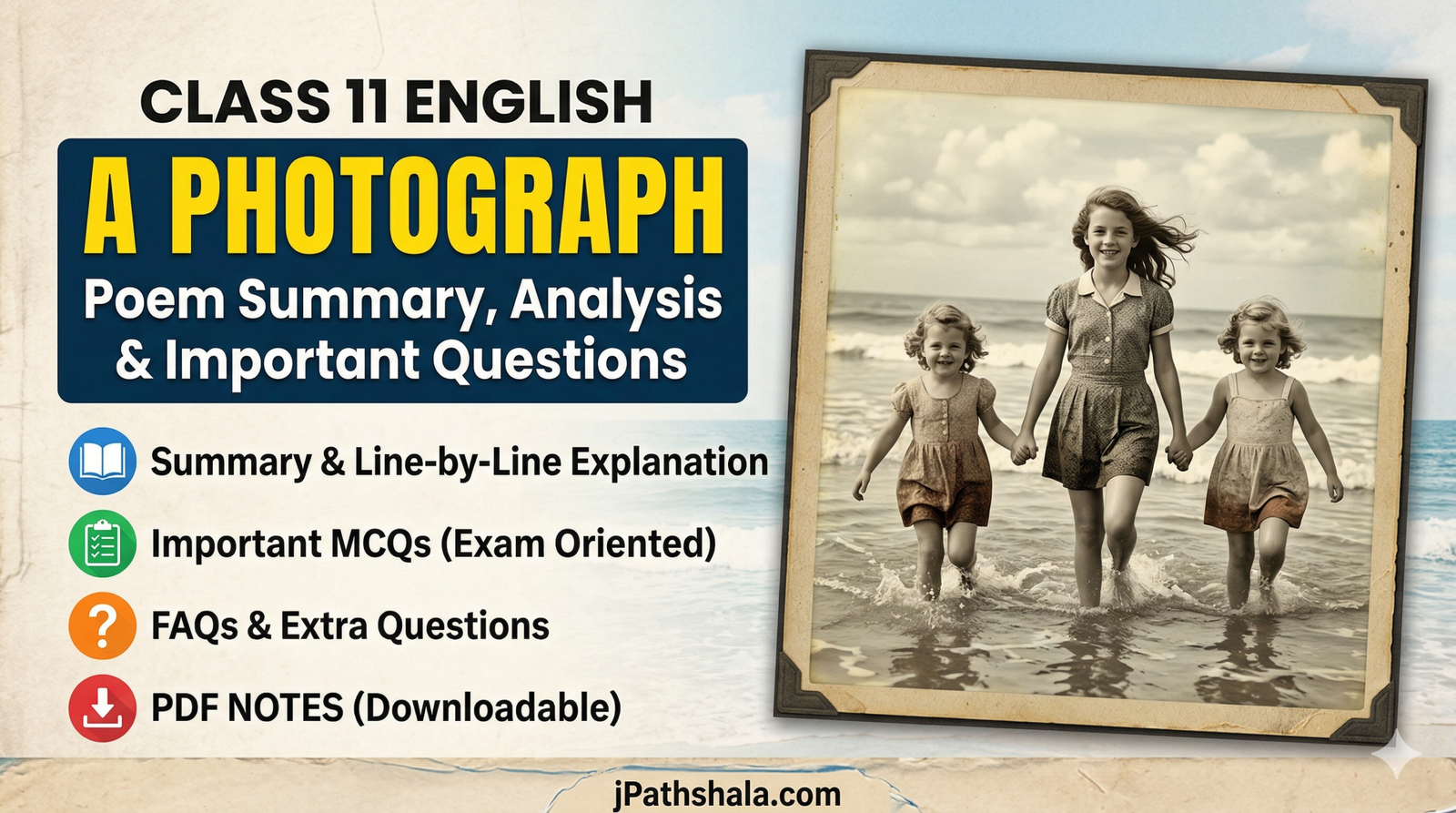
The cardboard shows me how it was
When the two girl cousins went paddling,
Each one holding one of my mother’s hands,
And she the big girl — some twelve years or so.
All three stood still to smile through their hair
At the uncle with the camera. A sweet face,
My mother’s, that was before I was born.
And the sea, which appears to have changed less,
Washed their terribly transient feet.
Some twenty — thirty — years later
She’d laugh at the snapshot. “See Betty
And Dolly,” she’d say, “and look how they
Dressed us for the beach.” The sea holiday
Was her past, mine is her laughter. Both wry
With the laboured ease of loss.
Now she’s been dead nearly as many years
As that girl lived. And of this circumstance
There is nothing to say at all.
Its silence silences.
– Shirley Toulson
3. Word Meanings (Vocabulary)
- Cardboard: गत्ता / तस्वीर (A stiff material; here it refers to an old photograph pasted on thick paper).
- Paddling: पानी में छपछपाते हुए चलना (Walking bare feet in shallow water at the beach).
- Transient: क्षणिक / अस्थायी (Short-lived, temporary, representing the impermanence of human life).
- Snapshot: तस्वीर (A quick photograph).
- Wry: टेढ़ा / निराशापूर्ण (Disappointed, expressing a mix of irony and sorrow).
- Laboured ease: मुश्किल से पाया हुआ आराम (A struggle to accept a loss and appear normal).
- Circumstance: परिस्थिति (Here it refers to the situation of the mother’s death and the poet’s current state of loneliness).
4. Key Elements & Characters
- The Poet (Shirley Toulson): She is deeply nostalgic and heartbroken over the loss of her mother. The photograph triggers a sense of profound grief and silence within her.
- The Mother: A sweet-faced girl of about twelve in the photograph. As an adult, she was joyful and nostalgic when looking back at her childhood memories.
- Betty and Dolly: The mother’s two younger girl cousins who held her hands during the beach holiday.
- The Sea: A symbol of eternity and permanence. It highlights how humans age and die, but nature remains unchanged over time.
5. Full Summary
First Phase: The Mother’s Childhood
The poet looks at an old photograph pasted on cardboard. The picture captures a moment from the past when her mother was just a twelve-year-old girl. She had gone for a sea holiday with her two younger cousins, Betty and Dolly. The cousins were holding the hands of the poet’s mother, who was the eldest. They stood in the shallow water, smiling happily as their uncle clicked their photograph. The poet notes how sweet her mother’s face was. In this stanza, the poet beautifully contrasts the temporary human life (their “transient feet”) with the vast, unchanging eternal sea.
Second Phase: Nostalgia and Laughter
The second phase brings us twenty or thirty years forward from the time the photograph was taken. The mother, now a grown woman, would look at the photograph and laugh nostalgically. She would point out Betty and Dolly, amused by the strange and funny beach clothes their parents made them wear. For the mother, the sea holiday was a happy memory of her past. For the poet, her mother’s joyous laughter is now a memory of the past. Both women experience a sense of loss—the mother lost her innocent childhood, and the poet lost her mother. Both try to cope with this loss with a “laboured ease.”
Third Phase: Death and Silence
In the final phase, the poet reveals that her mother has been dead for almost twelve years—the same age the mother was in the photograph. The poet is left alone to deal with her grief. The pain of her mother’s death leaves her completely speechless. There is an overwhelming, heavy silence around her, and she has no words to express her deep sorrow. The final line, “Its silence silences,” perfectly captures the emptiness caused by death.
6. Multiple Choice Questions (10 MCQs)
Q1. Who is the poet of the poem “A Photograph”?
(a) Shirley Toulson | (b) Sylvia Plath | (c) William Wordsworth | (d) Walt Whitman
Answer: (a) Shirley Toulson
Q2. What does the word ‘cardboard’ denote in the poem?
(a) A thick box | (b) A photograph | (c) A wooden frame | (d) A boat
Answer: (b) A photograph
Q3. Who are Betty and Dolly?
(a) Poet’s sisters | (b) Mother’s friends | (c) Mother’s girl cousins | (d) Poet’s daughters
Answer: (c) Mother’s girl cousins
Q4. How old was the poet’s mother when the photograph was taken?
(a) 15 years | (b) 12 years | (c) 20 years | (d) 10 years
Answer: (b) 12 years
Q5. Who took the photograph?
(a) The mother | (b) Betty | (c) The father | (d) The uncle
Answer: (d) The uncle
Q6. What does the phrase “transient feet” suggest?
(a) Moving feet | (b) Permanent marks | (c) Short-lived nature of human life | (d) Dirty feet
Answer: (c) Short-lived nature of human life
Q7. What was the mother’s past in the second stanza?
(a) Her school days | (b) The sea holiday | (c) The day of her wedding | (d) Her youth
Answer: (b) The sea holiday
Q8. What is the poet’s past?
(a) Her childhood | (b) The sea holiday | (c) Her mother’s laughter | (d) Betty and Dolly
Answer: (c) Her mother’s laughter
Q9. What does the word “wry” mean?
(a) Happy | (b) Disappointed / Ironical | (c) Excited | (d) Angry
Answer: (b) Disappointed / Ironical
Q10. How many years have passed since the mother died?
(a) Nearly 20 years | (b) Just 1 year | (c) Nearly 12 years | (d) 30 years
Answer: (c) Nearly 12 years
7. Short Answer Questions (30-40 Words)
Q1. What has not changed over the years? Does this suggest something to you?
Ans. The sea has not changed over the years. It is a symbol of eternity and permanence. This strongly contrasts with the transient, short-lived nature of human life, as humans grow old and eventually die, while nature remains the same.
Q2. Why did the mother laugh at the snapshot?
Ans. The mother laughed at the snapshot remembering her happy childhood memories. She found it amusing to see how peculiarly her parents had dressed her and her cousins, Betty and Dolly, for the beach holiday.
Q3. What is the meaning of the line “Both wry with the laboured ease of loss”?
Ans. ‘Both’ refers to the mother and the poet. The mother lost the innocent joys of her childhood, and the poet lost her mother’s comforting laughter. Both have suffered a sense of loss and tried to accept it with great difficulty (“laboured ease”).
Q4. What does “this circumstance” refer to?
Ans. “This circumstance” refers to the death of the poet’s mother. It highlights the present situation of the poet, where she is left completely alone with the painful memory of her mother, enveloped in deep silence.
Q5. Why did the girls smile ‘through their hair’?
Ans. The wind at the beach must have been blowing strongly, causing the girls’ hair to fly across their faces. Despite this, they stood still and smiled at their uncle who was capturing the moment with his camera.
8. Long Answer Questions (60-70 Words)
Q1. Discuss the central theme of the poem “A Photograph”.
Ans. The central theme of “A Photograph” is the inevitability of death and the passing of time. The poet uses an old photograph to highlight the transience of human life compared to the permanence of nature (the sea). The poem moves through three stages: the mother’s happy childhood, her nostalgic adulthood, and finally, her death, showing how time spares no one and leaves behind only silent memories.
Q2. How does the poet contrast the human lifespan with the eternity of nature?
Ans. The poet creates a sharp contrast between human life and nature using the image of the sea. The sea, which washed the girls’ feet in the photograph, “appears to have changed less” over decades. On the other hand, the girls’ “transient feet” represent the temporary nature of human life. The mother grew up, aged, and eventually died, proving that while human existence is mortal, nature is eternal.
Q3. What are the three phases described in the poem?
Ans. The poem describes three phases of time. The first phase relates to the mother’s childhood when she went for a sea holiday with her cousins. The second phase is during her middle age, twenty or thirty years later, when she laughs at the photograph. The third phase is the present time, where the mother has been dead for twelve years, leaving the poet in a state of silent grief.
Q4. “Its silence silences.” Explain the context and meaning of this closing line.
Ans. The line reflects the poet’s profound grief over her mother’s death. The reality of death brings absolute silence; it takes away all words and expressions. The sorrow is so deep that the poet finds herself utterly speechless. The silence of her mother’s absence silences the poet’s own thoughts and voice, emphasizing the absolute finality and emptiness caused by losing a loved one.