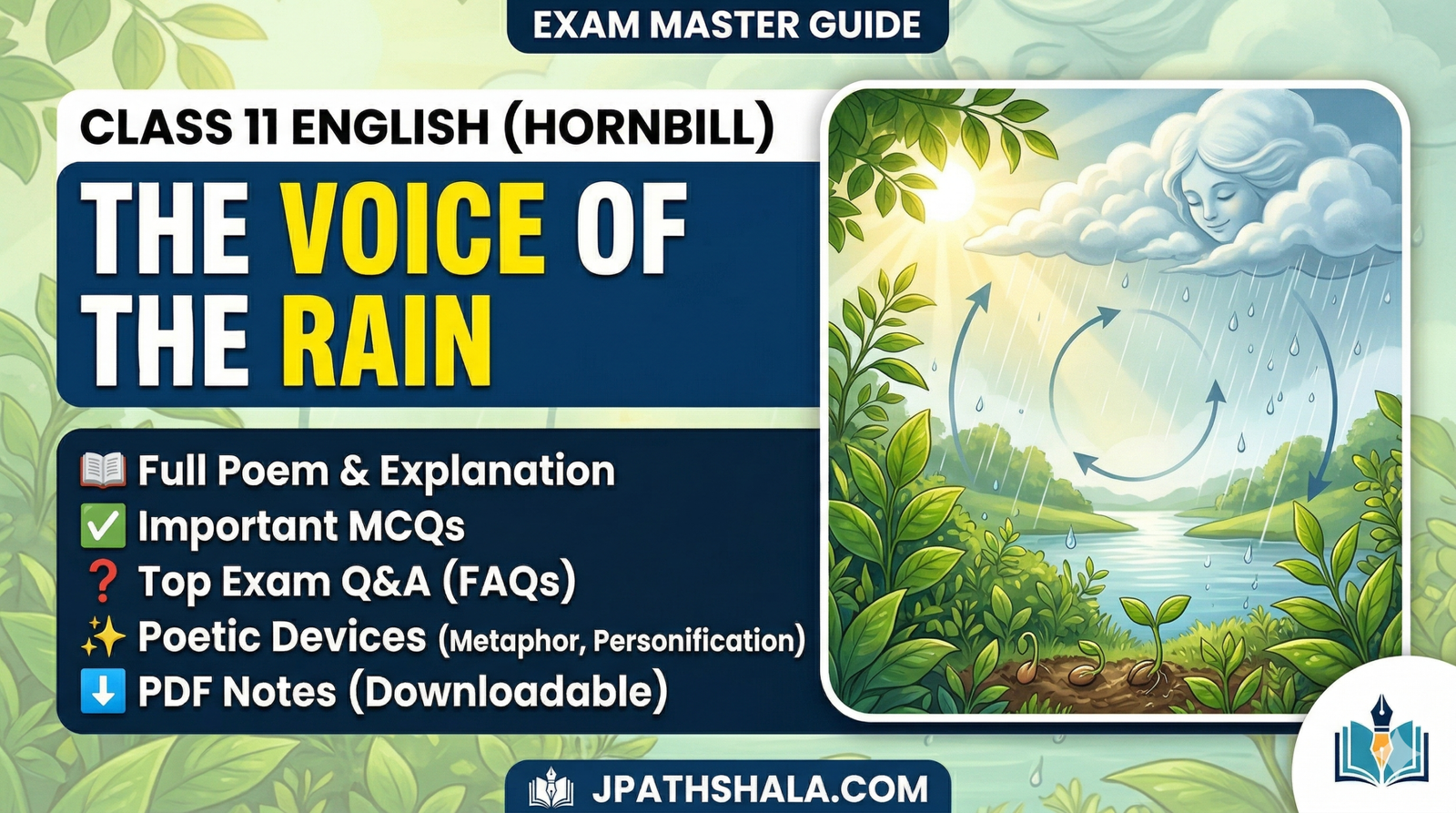
1. Poem Introduction
“The Voice of the Rain” by Walt Whitman is a beautiful poem that celebrates rain and its accompanying cyclic journey. The poem is framed as a conversation between the poet and the falling rain. The poet asks the rain who it is, and surprisingly, the rain answers, calling itself the “Poem of Earth.” The poem beautifully illustrates the water cycle, comparing the journey of the rain to the journey of a song or poetry, both of which return to their creator with love after fulfilling their purpose.
2. The Poem
And who art thou? said I to the soft-falling shower,
Which, strange to tell, gave me an answer, as here translated:
I am the Poem of Earth, said the voice of the rain,
Eternal I rise impalpable out of the land and the bottomless sea,
Upward to heaven, whence, vaguely form’d, altogether changed, and yet the same,
I descend to lave the droughts, atomies, dust-layers of the globe,
And all that in them without me were seeds only, latent, unborn;
And forever, by day and night, I give back life to my own origin,
And make pure and beautify it;
(For song, issuing from its birth-place, after fulfilment, wandering
Reck’d or unreck’d, duly with love returns.)
– Walt Whitman
3. Word Meanings (Vocabulary)
- Art thou: तुम कौन हो (Old English for ‘are you’).
- Impalpable: जिसे छुआ न जा सके (Something that cannot be touched or physically felt, like water vapor).
- Eternal: अनंत / हमेशा (Everlasting, unending).
- Bottomless: बहुत गहरा (Very deep, referring to the sea).
- Vaguely: अस्पष्ट रूप से (Not clearly expressed or formed).
- Descend: नीचे आना (To come or fall down).
- Lave: धोना / नहलाना (To wash or bathe).
- Droughts: सूखा (Dry spells or lack of rain).
- Atomies: छोटे कण (Tiny particles of dust or matter).
- Latent: छिपा हुआ / निष्क्रिय (Hidden, dormant, or not yet developed).
- Reck’d or unreck’d: परवाह की जाए या नहीं (Cared for or not cared for / Noticed or ignored).
4. Key Elements & Characters
- The Poet: The observer and questioner who interacts with nature and translates the rain’s language for the readers. He draws a beautiful parallel between nature’s rain and human art (song).
- The Rain: Personified in the poem. It calls itself the “Poem of Earth.” It acts as a life-giver, a cleanser, and a beautifier of its birthplace (the Earth).
- The Song (Poetry): Used as a metaphor in the final bracketed lines. Just as rain rises from the earth and returns to it, a song rises from the poet’s heart, wanders the world, and returns to the poet as love.
5. Full Summary
The Poet’s Question and the Rain’s Reply
The poem opens with the poet asking a question to a gentle, soft-falling rain shower: “And who art thou?” (Who are you?). To the poet’s great surprise, the rain actually answers him. The poet translates the rain’s reply for his readers. The rain introduces itself by saying, “I am the Poem of Earth.” This means that just as a poem brings joy to human hearts, rain brings joy and life to the Earth.
The Origin and Transformation (The Water Cycle)
The rain explains its continuous, never-ending journey (the water cycle). It says that it constantly rises from the land and the deep, “bottomless” sea in the form of water vapor. In this state, it is “impalpable” (it cannot be touched or seen). It travels upward towards the sky (heaven). In the sky, it takes the shape of clouds. Although its form changes completely from liquid/vapor to clouds, its core essence remains exactly the same—it is still water.
Returning to Earth as a Life-Giver
After forming clouds, the rain falls back down to Earth. It descends to wash away droughts, dry lands, and layers of dust across the globe. By returning, it breathes life into the seeds that were lying hidden (“latent”) and unborn under the soil. Without the rain, these seeds would have remained just seeds and would never have sprouted into plants. Day and night, the rain continuously gives life back to its own birthplace (the Earth), making it pure and beautiful again.
The Parallel between Rain and a Song
The last two lines of the poem are enclosed in brackets because they are not spoken by the rain; they are the poet’s own thoughts. The poet compares the life cycle of the rain to the journey of a song. A song originates from the heart of a poet or singer. After fulfilling its purpose of bringing joy to people, it wanders around the world. Whether people pay attention to it (“reck’d”) or ignore it (“unreck’d”), the song eventually returns to its creator in the form of love and appreciation, just as the rain returns to the Earth.
6. Multiple Choice Questions (10 MCQs)
Q1. Who is the poet of “The Voice of the Rain”?
(a) Shirley Toulson | (b) Walt Whitman | (c) Ted Hughes | (d) William Wordsworth
Answer: (b) Walt Whitman
Q2. What does the poet ask the soft-falling shower?
(a) Where are you going? | (b) And who art thou? | (c) Why are you crying? | (d) When will you stop?
Answer: (b) And who art thou?
Q3. What does the rain call itself?
(a) The Tears of the Sky | (b) The Poem of Earth | (c) The Water of Life | (d) The Song of Heaven
Answer: (b) The Poem of Earth
Q4. What is the meaning of the word “impalpable”?
(a) Very heavy | (b) Something that cannot be touched | (c) Easily broken | (d) Extremely loud
Answer: (b) Something that cannot be touched
Q5. Where does the rain rise from?
(a) The mountains | (b) The land and bottomless sea | (c) The forests | (d) The clouds
Answer: (b) The land and bottomless sea
Q6. What does “altogether changed, and yet the same” mean?
(a) Rain turns to snow | (b) Its appearance changes to clouds, but it is still water | (c) It completely disappears | (d) It changes its color
Answer: (b) Its appearance changes to clouds, but it is still water
Q7. Why does the rain descend to the Earth?
(a) To cause floods | (b) To lave droughts and dust-layers | (c) To hide the sun | (d) To destroy crops
Answer: (b) To lave droughts and dust-layers
Q8. What would happen to the seeds without rain?
(a) They would burn | (b) They would grow faster | (c) They would remain latent and unborn | (d) They would turn into dust
Answer: (c) They would remain latent and unborn
Q9. What does the rain give back to its origin?
(a) Destruction | (b) Life, purity, and beauty | (c) Darkness | (d) Silence
Answer: (b) Life, purity, and beauty
Q10. In the last two lines, what is the rain compared to?
(a) A song | (b) A bird | (c) A machine | (d) A river
Answer: (a) A song
7. Short Answer Questions (30-40 Words)
Q1. Why does the poet get surprised when he speaks to the rain?
Ans. The poet gets surprised because when he asks the softly falling rain “And who art thou?”, the non-living rain actually answers him back like a living being, calling itself the “Poem of Earth.”
Q2. How is the rain “impalpable”?
Ans. The rain calls itself impalpable because it rises from the land and sea in the form of invisible water vapor. Since vapor is a gas, it cannot be felt or touched physically like liquid water can.
Q3. Explain the phrase “altogether changed, and yet the same”.
Ans. This phrase explains the water cycle. When water vapor rises into the sky, its physical form changes completely as it becomes fluffy clouds. However, despite this visual change, its core essence remains exactly the same—it is still water.
Q4. How does the rain help the seeds?
Ans. The seeds remain hidden (“latent”) and “unborn” under the dry soil. When the rain descends, it waters the earth, allowing these dormant seeds to sprout and grow into new plants, thereby giving them life.
Q5. Why are the last two lines put in brackets?
Ans. The last two lines are placed in brackets because they are not part of the conversation between the poet and the rain. They contain the poet’s own thoughts and reflections, comparing the journey of rain to that of a song.
8. Long Answer Questions (60-70 Words)
Q1. Discuss the central theme of the poem ‘The Voice of the Rain’.
Ans. The central theme of the poem is the cyclic nature of rain and its life-giving properties. The poem beautifully describes how rain rises from the Earth, goes to the sky, and returns to rejuvenate its birthplace. Another key theme is the parallel drawn between rain and art (poetry/music). Just as rain nourishes the earth, poetry nourishes the human soul, and both return to their creators with love.
Q2. Describe the never-ending journey of rain as portrayed in the poem.
Ans. The rain undergoes a continuous, eternal cycle. It originates invisibly as impalpable vapor from the land and the bottomless sea. It travels upward to heaven (the sky) where it transforms into clouds. Though its form changes, its essence remains water. Finally, it descends as rain to wash away droughts, dust, and give life to dormant seeds, thus returning to its origin and making the Earth beautiful again.
Q3. How is the cyclic movement of rain similar to that of a song?
Ans. The poet draws a profound comparison between rain and a song. Rain rises from the Earth, fulfills its duty of watering the land, and returns to make its birthplace beautiful. Similarly, a song originates from the heart of a poet. It travels around the world, bringing joy to listeners. Whether people care for it or not, it ultimately returns to the creator’s heart filled with love and appreciation.
Q4. “I give back life to my own origin.” Explain the significance of this line.
Ans. This line highlights the rain’s role as a savior and life-giver. The rain originates from the Earth’s water bodies and land. When the Earth suffers from droughts and dust, the rain returns in the form of showers. By falling back on the land, it provides water to thirsty plants, helps unborn seeds sprout, and washes away the dust, thereby giving new life and beauty back to its own birthplace.