
1. Poem Introduction
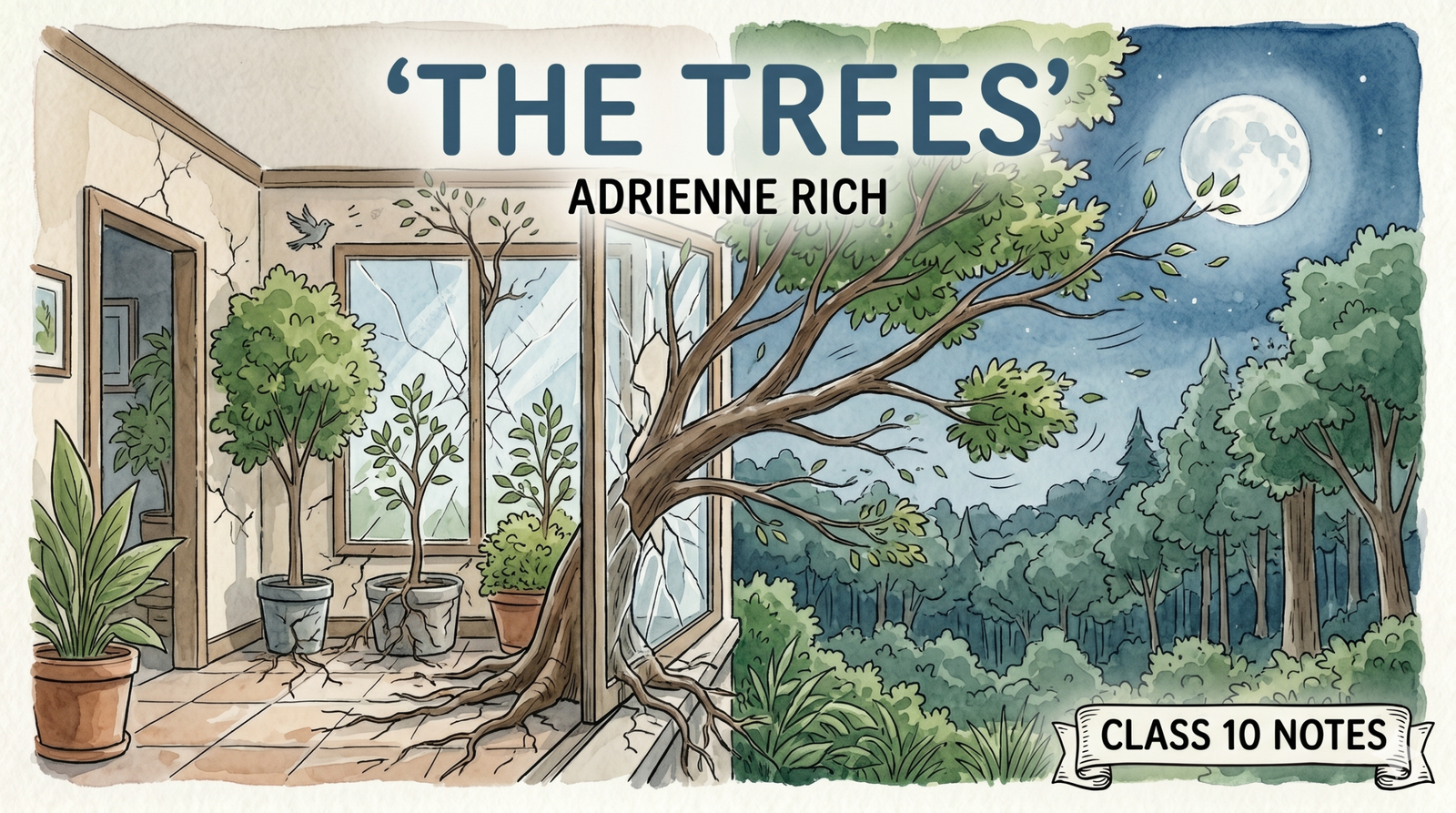
“The Trees” by Adrienne Rich is a highly symbolic poem that can be understood on two levels. Literally, it describes the struggle of decorative trees trapped inside a house, breaking free and marching toward their natural home—the forest. Metaphorically, the poem is a powerful feminist statement. The trees symbolize women who have been confined to the four walls of their houses by a patriarchal society. The poem portrays their strong desire, struggle, and triumphant exit from domestic confinement to the outside world to claim their freedom and equality.
2. The Poem
The trees inside are moving out into the forest,
the forest that was empty all these days
where no bird could sit
no insect hide
no sun bury its feet in shadow
the forest that was empty all these nights
will be full of trees by morning.
All night the roots work
to disengage themselves from the cracks
in the veranda floor.
The leaves strain toward the glass
small twigs stiff with exertion
long-cramped boughs shuffling under the roof
like newly discharged patients
half-dazed, stumbling
to the clinic doors.
I sit inside, doors open to the veranda
writing long letters
in which I scarcely mention the departure
of the forest from the house.
The night is fresh, the whole moon shines
in a sky still open
the smell of leaves and lichen
still reaches like a voice into the rooms.
My head is full of whispers
which tomorrow will be silent.
Listen. The glass is breaking.
The trees are stumbling forward
into the night. Winds rush to meet them.
The moon is broken like a mirror,
its pieces flash now in the crown
of the tallest oak.
– Adrienne Rich
3. Word Meanings (Vocabulary)
- Disengage: अलग करना / आज़ाद होना (To separate or free oneself)
- Strain: जोर लगाना / खिंचाव (To make a forceful effort)
- Exertion: कड़ी मेहनत / थकान (Hard physical effort)
- Cramped: सिकुड़ा हुआ / तंग (Confined in a small space)
- Boughs: पेड़ की बड़ी शाखाएं (Large branches of a tree)
- Shuffling: पैर घसीट कर चलना (Walking by dragging one’s feet)
- Half-dazed: आधा बेहोश / चकराया हुआ (Confused or shocked)
- Stumbling: लड़खड़ाना (Tripping or walking unsteadily)
- Scarcely: मुश्किल से / ना के बराबर (Hardly / barely)
- Lichen: काई / शैवाल (Crusty patches of fungi and algae on tree trunks)
- Crown: पेड़ का सबसे ऊपरी हिस्सा (The top part of a tree)
4. Key Symbols in the Poem
- The Trees: They represent nature trapped by humans. More deeply, they symbolize women who are restricted to indoor, domestic lives and are now struggling for their freedom and rights.
- The Empty Forest: It represents the natural habitat that has been destroyed by human greed. It also symbolizes a world without the active participation of women.
- The House/Glass: Represents the restrictions, traditions, and the patriarchal society that confines women inside.
- Newly Discharged Patients: A simile comparing the trees’ desperate and unsteady movement to patients who have been in a hospital for a long time and are rushing to get out.
5. Full Summary
The Movement Towards the Forest
The poem begins with a dramatic shift. The trees that were planted inside the house for decoration are now moving out into their natural home—the forest. The poet says that the forest had been empty for a long time. Because there were no trees, birds couldn’t sit, insects couldn’t hide, and the sun couldn’t cast any shadows. However, by the next morning, the forest will be full of trees again.
The Long and Hard Struggle
In the second stanza, the poet describes the massive effort the trees are making to break free. Throughout the night, their roots work tirelessly to break out of the cracks in the veranda floor. The leaves push hard against the glass windows. The small branches become stiff from the hard work, and the large, cramped branches drag themselves toward the exit. The poet compares these trees to newly discharged hospital patients who are confused and stumbling toward the clinic doors to finally go home.
The Poet’s Observation
The poet is sitting inside her house with the veranda doors open, writing long letters. Surprisingly, she hardly mentions this massive “departure of the forest” in her letters. It shows the human tendency to ignore the silent rebellion of nature (or women). The night is clear, the moon is shining, and the smell of leaves and lichen enters the room like a voice calling out for freedom.
The Triumphant Exit
In the final stanza, the poet’s head is full of “whispers” (the sound of leaves and branches moving), which will become completely silent by tomorrow once the trees are gone. Suddenly, she hears the glass breaking. The trees stumble forward into the dark night. The fast winds rush to welcome them back to the forest. As the tallest oak tree stands free, its upper branches cover the moon, making the moon look like a broken mirror whose pieces are flashing in the tree’s crown. The trees (and women) have finally achieved their victory and freedom.