The Trees Class 10 Notes: Summary, MCQs, Q&A & Meanings

The Trees – Chapter Notes

1. Poem Introduction

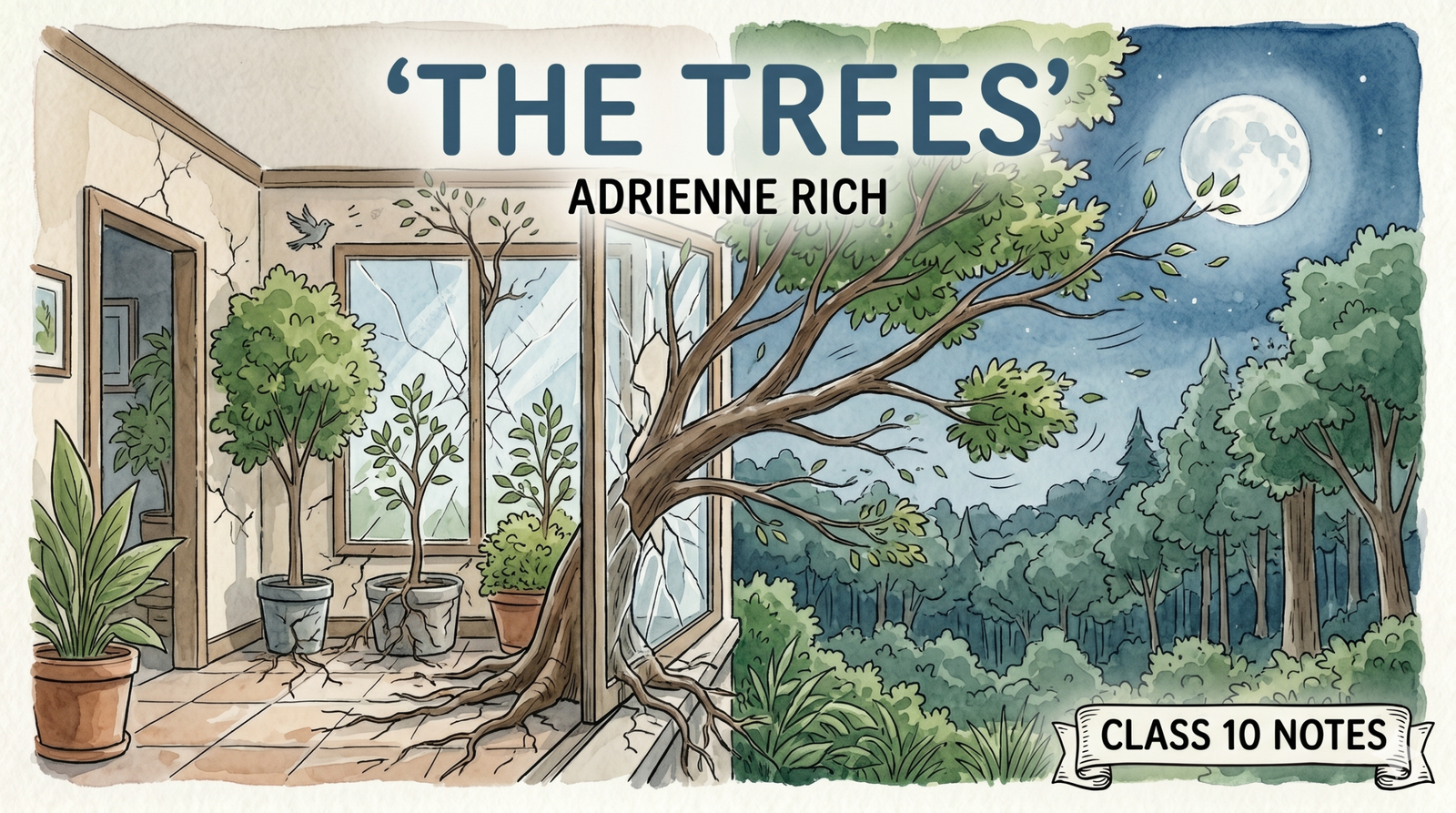
“The Trees” by Adrienne Rich is a highly symbolic poem that can be understood on two levels. Literally, it describes the struggle of decorative trees trapped inside a house, breaking free and marching toward their natural home—the forest. Metaphorically, the poem is a powerful feminist statement. The trees symbolize women who have been confined to the four walls of their houses by a patriarchal society. The poem portrays their strong desire, struggle, and triumphant exit from domestic confinement to the outside world to claim their freedom and equality.

2. The Poem

The trees inside are moving out into the forest,
the forest that was empty all these days
where no bird could sit
no insect hide
no sun bury its feet in shadow
the forest that was empty all these nights
will be full of trees by morning.

All night the roots work
to disengage themselves from the cracks
in the veranda floor.
The leaves strain toward the glass
small twigs stiff with exertion
long-cramped boughs shuffling under the roof
like newly discharged patients
half-dazed, stumbling
to the clinic doors.

I sit inside, doors open to the veranda
writing long letters
in which I scarcely mention the departure
of the forest from the house.
The night is fresh, the whole moon shines
in a sky still open
the smell of leaves and lichen
still reaches like a voice into the rooms.

My head is full of whispers
which tomorrow will be silent.
Listen. The glass is breaking.
The trees are stumbling forward
into the night. Winds rush to meet them.
The moon is broken like a mirror,
its pieces flash now in the crown
of the tallest oak.

– Adrienne Rich

3. Word Meanings (Vocabulary)

  • Disengage: अलग करना / आज़ाद होना (To separate or free oneself)
  • Strain: जोर लगाना / खिंचाव (To make a forceful effort)
  • Exertion: कड़ी मेहनत / थकान (Hard physical effort)
  • Cramped: सिकुड़ा हुआ / तंग (Confined in a small space)
  • Boughs: पेड़ की बड़ी शाखाएं (Large branches of a tree)
  • Shuffling: पैर घसीट कर चलना (Walking by dragging one’s feet)
  • Half-dazed: आधा बेहोश / चकराया हुआ (Confused or shocked)
  • Stumbling: लड़खड़ाना (Tripping or walking unsteadily)
  • Scarcely: मुश्किल से / ना के बराबर (Hardly / barely)
  • Lichen: काई / शैवाल (Crusty patches of fungi and algae on tree trunks)
  • Crown: पेड़ का सबसे ऊपरी हिस्सा (The top part of a tree)

4. Key Symbols in the Poem

  • The Trees: They represent nature trapped by humans. More deeply, they symbolize women who are restricted to indoor, domestic lives and are now struggling for their freedom and rights.
  • The Empty Forest: It represents the natural habitat that has been destroyed by human greed. It also symbolizes a world without the active participation of women.
  • The House/Glass: Represents the restrictions, traditions, and the patriarchal society that confines women inside.
  • Newly Discharged Patients: A simile comparing the trees’ desperate and unsteady movement to patients who have been in a hospital for a long time and are rushing to get out.

5. Full Summary

The Movement Towards the Forest

The poem begins with a dramatic shift. The trees that were planted inside the house for decoration are now moving out into their natural home—the forest. The poet says that the forest had been empty for a long time. Because there were no trees, birds couldn’t sit, insects couldn’t hide, and the sun couldn’t cast any shadows. However, by the next morning, the forest will be full of trees again.

The Long and Hard Struggle

In the second stanza, the poet describes the massive effort the trees are making to break free. Throughout the night, their roots work tirelessly to break out of the cracks in the veranda floor. The leaves push hard against the glass windows. The small branches become stiff from the hard work, and the large, cramped branches drag themselves toward the exit. The poet compares these trees to newly discharged hospital patients who are confused and stumbling toward the clinic doors to finally go home.

The Poet’s Observation

The poet is sitting inside her house with the veranda doors open, writing long letters. Surprisingly, she hardly mentions this massive “departure of the forest” in her letters. It shows the human tendency to ignore the silent rebellion of nature (or women). The night is clear, the moon is shining, and the smell of leaves and lichen enters the room like a voice calling out for freedom.

The Triumphant Exit

In the final stanza, the poet’s head is full of “whispers” (the sound of leaves and branches moving), which will become completely silent by tomorrow once the trees are gone. Suddenly, she hears the glass breaking. The trees stumble forward into the dark night. The fast winds rush to welcome them back to the forest. As the tallest oak tree stands free, its upper branches cover the moon, making the moon look like a broken mirror whose pieces are flashing in the tree’s crown. The trees (and women) have finally achieved their victory and freedom.

6. Multiple Choice Questions (10 MCQs)

Q1. Who is the poet of “The Trees”?
(a) Robert Frost | (b) Adrienne Rich | (c) Sylvia Plath | (d) Walt Whitman
Answer: (b) Adrienne Rich
Q2. Where are the trees currently located at the beginning of the poem?
(a) In the forest | (b) Inside a house/greenhouse | (c) In a park | (d) On a mountain
Answer: (b) Inside a house/greenhouse
Q3. Why was the forest empty all these days?
(a) It was cut down by humans | (b) The trees were inside the house | (c) Animals ate the trees | (d) It was winter
Answer: (b) The trees were inside the house
Q4. What do the roots do all night?
(a) They drink water | (b) They sleep | (c) They work to disengage from the veranda floor | (d) They grow deeper
Answer: (c) They work to disengage from the veranda floor
Q5. To whom does the poet compare the cramped boughs?
(a) To wild animals | (b) To newly discharged patients | (c) To old people | (d) To prisoners
Answer: (b) To newly discharged patients
Q6. What is the poet doing while sitting inside?
(a) Sleeping | (b) Reading a book | (c) Writing long letters | (d) Watching TV
Answer: (c) Writing long letters
Q7. What smell reaches into the rooms like a voice?
(a) Smell of flowers | (b) Smell of rain | (c) Smell of perfume | (d) Smell of leaves and lichen
Answer: (d) Smell of leaves and lichen
Q8. What rushes to meet the trees outside?
(a) The rain | (b) The winds | (c) The animals | (d) The birds
Answer: (b) The winds
Q9. What happens to the glass in the final stanza?
(a) It becomes dirty | (b) It is cleaned | (c) It breaks | (d) It melts
Answer: (c) It breaks
Q10. How does the moon look at the end of the poem?
(a) Like a full circle | (b) Like a broken mirror | (c) Like a silver coin | (d) Like a white cloud
Answer: (b) Like a broken mirror

7. Short Answer Questions (30-40 Words)

Q1. Why are the trees moving out?
Ans. The trees are moving out because their natural habitat is the forest, not the inside of a house. They feel suffocated indoors and are struggling to regain their freedom and return to the open environment.
Q2. What are three things that cannot happen in an empty forest?
Ans. In an empty forest without trees, birds cannot find a place to sit, insects cannot find a place to hide, and the sun cannot bury its feet in the shadows (create shadows).
Q3. Why has the poet compared the branches to “newly discharged patients”?
Ans. Just like patients who have been in a hospital for a long time feel weak and confused while leaving, the long-cramped branches of the trees stumble out, exhausted and half-dazed, after being trapped indoors for so long.
Q4. Why does the poet scarcely mention the “departure of the forest” in her letters?
Ans. The poet does not mention it because humanity has become insensitive to the rebellion of nature. Also, it might symbolise a woman’s silent inner struggle for freedom which is often ignored or not openly discussed in conventional society.
Q5. Explain the image: “The moon is broken like a mirror”.
Ans. When the tall oak tree comes out into the open, its widespread upper branches (crown) partially block the full moon. The light of the moon shines through the leaves, making it look like a mirror broken into several flashing pieces.

8. Long Answer Questions (60-70 Words)

Q1. How does the poem show the conflict between Man and Nature?
Ans. The poem strongly highlights the conflict between Man and Nature. Humans, out of greed and aesthetic pleasure, uproot trees from the forest and imprison them in greenhouses or homes. This leaves the natural forest empty and lifeless. However, nature cannot be subdued forever. The trees struggle intensely all night to break the man-made glass and concrete floors. Their triumphant march back to the forest proves that nature will ultimately reclaim its freedom.
Q2. Discuss the poem from a feminist perspective. What do the ‘trees’ symbolize?
Ans. From a feminist perspective, the ‘trees’ symbolize women. For centuries, a patriarchal society has confined women inside the four walls of the house, cutting them off from the outside world (the forest). Just like the trees whose roots work all night to break the floor, women have been silently struggling to break the barriers of traditions and restrictions. The breaking of the glass represents the breaking of stereotypes, as women march out to claim equality and freedom.
Q3. Describe the struggle of the trees to get out of the house.
Ans. The trees make a tremendous and painful effort to break free. Throughout the night, their roots apply immense pressure to disengage from the cracks in the veranda floor. The leaves strain against the glass windows to break them. The small twigs become stiff due to overexertion, and the long branches, cramped in a small space, drag and stumble toward the exit like weak, newly discharged hospital patients rushing for fresh air.
Q4. What is the central message or theme of the poem “The Trees”?
Ans. The central theme of the poem is the intense desire for freedom and the impossibility of suppressing nature (or the human spirit). Everything naturally craves its rightful place in the open world. The poem conveys that whether it is nature confined in artificial indoor environments or women suppressed by social norms, the urge to break free will eventually shatter all boundaries. Freedom is a fundamental right that will forcefully claim itself.

Leave a Comment