1. Poem Introduction
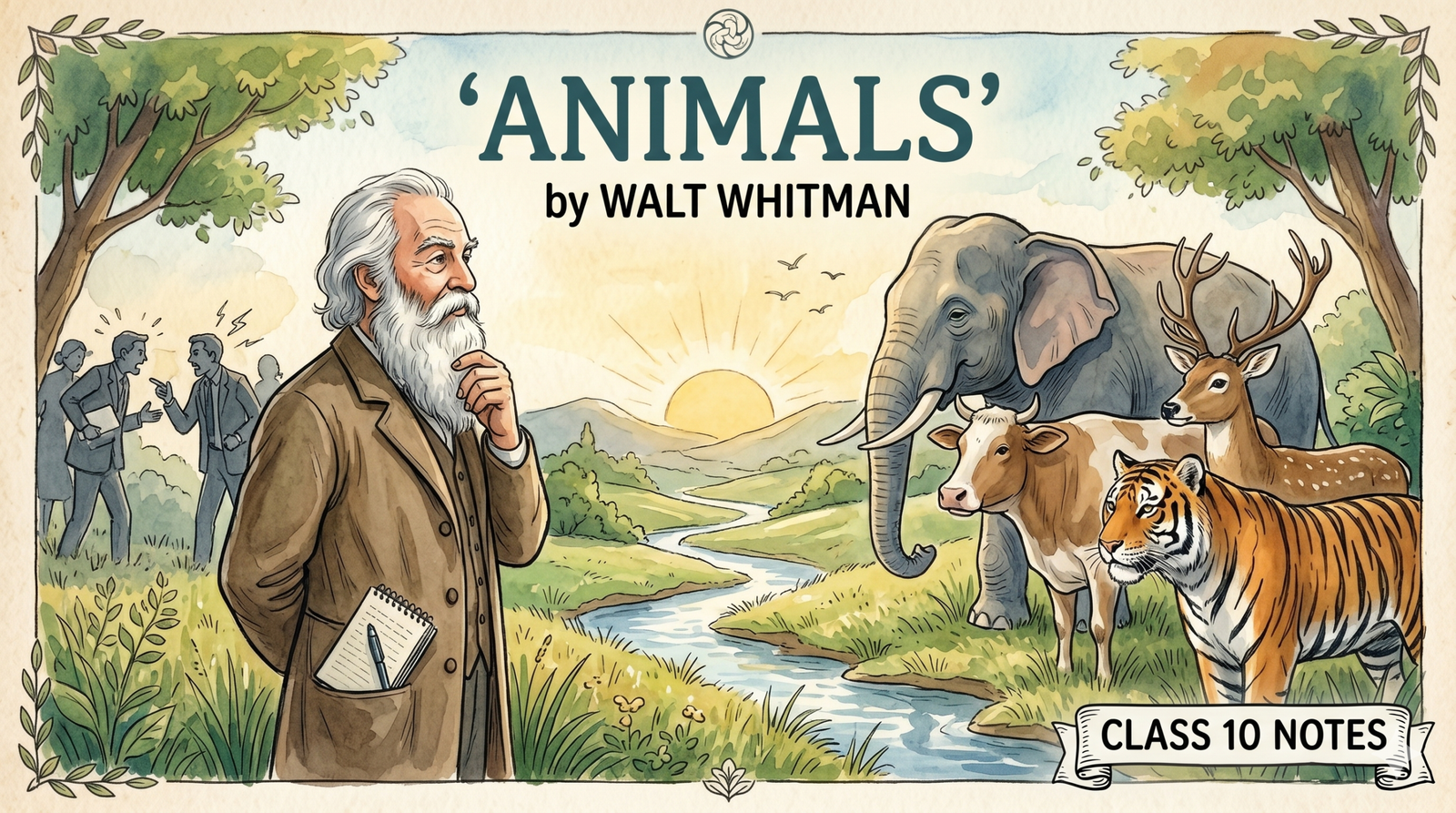
“Animals” by Walt Whitman is a thought-provoking poem where the poet compares human beings with animals. He highlights the flaws, greed, and complexities of human nature and contrasts them with the peaceful, satisfied, and simple lives of animals. The poet feels so alienated from the corrupted human society that he expresses a deep desire to turn away from humans and live among animals, who have preserved the basic virtues of life that humans lost a long time ago.
2. The Poem
I think I could turn and live with animals, they are
so placid and self-contain’d,
I stand and look at them long and long.
They do not sweat and whine about their condition,
They do not lie awake in the dark and weep for their sins,
They do not make me sick discussing their duty to God,
Not one is dissatisfied, not one is demented with
the mania of owning things,
Not one kneels to another, nor to his kind that
lived thousands of years ago,
Not one is respectable or unhappy over the whole earth.
So they show their relations to me and I accept them,
They bring me tokens of myself, they evince
them plainly in their possession.
I wonder where they get those tokens,
Did I pass that way huge times ago and negligently drop them?
– Walt Whitman
3. Word Meanings (Vocabulary)
- Placid: शांत (Calm and peaceful)
- Self-contain’d: आत्म-निर्भर / संयमी (In control of oneself; independent)
- Whine: रोना-धोना या शिकायत करना (To complain in an annoying, crying voice)
- Demented: पागल / विक्षिप्त (Crazy or behaving irrationally)
- Mania: पागलपन / जुनून (Obsession or extreme desire)
- Kneels: घुटने टेकना (To go down on one’s knees; showing submission)
- Tokens: गुण / प्रतीक (Symbols or qualities of goodness, innocence, love)
- Evince: दिखाना / प्रकट करना (To show clearly)
- Negligently: लापरवाही से (Carelessly)
4. Key Comparisons: Humans vs. Animals
- Complaints: Humans always “sweat and whine” about their problems. Animals never complain about their condition; they accept it peacefully.
- Guilt & Religion: Humans commit sins, cry in the dark, and loudly boast about their “duty to God.” Animals are innocent, do not commit sins, and don’t pretend to be overly religious.
- Materialism: Humans suffer from the “mania” (crazy obsession) of owning things. Animals have no desire to collect wealth and are perfectly satisfied.
- Equality: Humans kneel to other humans or ancestors (showing inequality and class division). Among animals, everyone is equal. Nobody is “respectable” (superior) or unhappy.
5. Full Summary
Desire to Live with Animals
The poet begins by stating that he wants to “turn” away from the human world and live with animals. He is fascinated by them because they are so ‘placid’ (calm) and ‘self-contained’ (independent and peaceful). He finds them so attractive that he can stand and look at them for a very long time.
The Flaws of Human Beings
In the next few lines, the poet highlights the negative traits of humans by telling us what animals DO NOT do. Animals do not cry, complain, or “whine” about their difficult lives. Unlike humans, they do not commit sins, so they don’t have to stay awake at night crying out of guilt. Also, animals do not irritate the poet by constantly showing off their religious acts or “duty to God” the way humans do.
No Greed and No Inequality
The poet observes that no animal is dissatisfied with its life. Animals do not suffer from the madness (mania) of owning material things. In the animal kingdom, there is pure equality. No animal kneels before another animal or worships its ancestors. Because there is no social class or hierarchy, no one is considered overly “respectable,” and therefore, no one is unhappy on the whole earth.
The Lost “Tokens” of Humanity
The poet accepts the animals and feels a deep connection with them. He says that animals show him “tokens” of himself. These tokens represent the basic virtues of life—innocence, kindness, truthfulness, and love. The poem ends with a deeply philosophical question: The poet wonders where the animals got these good qualities. He guesses that humans (“I”) had these virtues a long time ago, but humans carelessly and “negligently” dropped them in the race for civilization, and the animals picked them up.
6. Multiple Choice Questions (10 MCQs)
Q1. Who is the poet of the poem “Animals”?
(a) Robert Frost | (b) Walt Whitman | (c) Leslie Norris | (d) John Berryman
Answer: (b) Walt Whitman
Q2. What does the poet want to turn into?
(a) A bird | (b) An animal | (c) A child | (d) A tree
Answer: (b) An animal
Q3. According to the poet, animals are very:
(a) Greedy and violent | (b) Placid and self-contained | (c) Sad and weeping | (d) Clever and cunning
Answer: (b) Placid and self-contained
Q4. What do humans do in the dark?
(a) Sleep peacefully | (b) Hunt for food | (c) Weep for their sins | (d) Count their money
Answer: (c) Weep for their sins
Q5. What ‘mania’ do human beings suffer from?
(a) Mania of owning things | (b) Mania of singing | (c) Mania of sleeping | (d) Mania of running
Answer: (a) Mania of owning things
Q6. Do animals kneel to each other?
(a) Yes, to the king | (b) Yes, to the older ones | (c) No, not one kneels to another | (d) Yes, for food
Answer: (c) No, not one kneels to another
Q7. What makes the poet “sick”?
(a) Eating too much | (b) The smell of animals | (c) Humans discussing their duty to God | (d) The dark night
Answer: (c) Humans discussing their duty to God
Q8. What does the word “Tokens” mean in the poem?
(a) Coins | (b) Virtues/Good qualities like innocence | (c) Tickets | (d) Weapons
Answer: (b) Virtues/Good qualities like innocence
Q9. How did humans lose their “tokens”?
(a) They were stolen | (b) They were sold for money | (c) Humans negligently dropped them huge times ago | (d) Animals snatched them
Answer: (c) Humans negligently dropped them huge times ago
Q10. What is the overall tone of the poem?
(a) Humorous | (b) Aggressive | (c) Reflective and critical of humans | (d) Joyful
Answer: (c) Reflective and critical of humans
7. Short Answer Questions (30-40 Words)
Q1. Why does the poet want to live with animals?
Ans. The poet wants to live with animals because he finds them placid (calm), self-contained, and peaceful. Unlike humans, they are not greedy, they don’t complain about their lives, and they do not harm others.
Q2. What do humans do that animals don’t, regarding their sins?
Ans. Humans commit bad deeds (sins) during the day and then lie awake in the dark at night, crying out of guilt. Animals do not commit such sins, so they sleep peacefully without any guilt.
Q3. What is the “mania of owning things”?
Ans. It refers to the human obsession with materialism and greed. Humans are never satisfied and constantly chase wealth and property. Animals, on the other hand, are free from this madness and are always content.
Q4. How do animals behave towards each other?
Ans. Animals treat each other with total equality. No animal kneels before another to show submission, nor do they worship their ancestors. Because there is no class system, no animal feels superior or inferior.
Q5. What are the “tokens” the poet refers to?
Ans. The “tokens” refer to the noble qualities and virtues of human nature, such as innocence, honesty, love, compassion, and contentment. The poet feels humans have lost these qualities, but animals still possess them.
8. Long Answer Questions (60-70 Words)
Q1. Explain the differences between human beings and animals as depicted by Walt Whitman.
Ans. Whitman draws a sharp contrast between humans and animals. Humans are greedy, restless, and constantly complain about their problems. They are hypocritical—they commit sins and then pretend to be religious by discussing their “duty to God.” Animals, however, are peaceful, satisfied, and self-contained. They do not run after material wealth, they do not cry over sins, and they maintain perfect equality where no one kneels to another.
Q2. What makes the poet “sick”? How does this reflect on human society?
Ans. The poet feels “sick” when humans constantly discuss their duty to God. He finds human society deeply hypocritical. People commit evil deeds and then try to cover them up by praying loudly or showing off their religious nature. This fake display of morality frustrates the poet. He prefers the silent, innocent, and genuine nature of animals over the complicated and false behavior of human beings.
Q3. Discuss the central theme of the poem “Animals”.
Ans. The central theme of the poem is the loss of human virtues. The poet argues that in the race for civilization and material success, human beings have lost their basic, noble qualities (“tokens”) like innocence, simplicity, and contentment. Ironically, these lost human virtues have been retained by animals. The poem is a strong criticism of human greed, hypocrisy, and inequality, urging humans to look at animals and learn how to live peacefully.
Q4. “Did I pass that way huge times ago and negligently drop them?” Explain the meaning of this line.
Ans. In this concluding line, the poet asks a deeply philosophical question. He observes the animals displaying “tokens” (good qualities) like love, innocence, and lack of greed. He wonders how animals got these traits. He concludes that thousands of years ago, early humans possessed these beautiful virtues. However, as humans became “civilized” and greedy, they carelessly (negligently) dropped these qualities behind, and the animals picked them up.