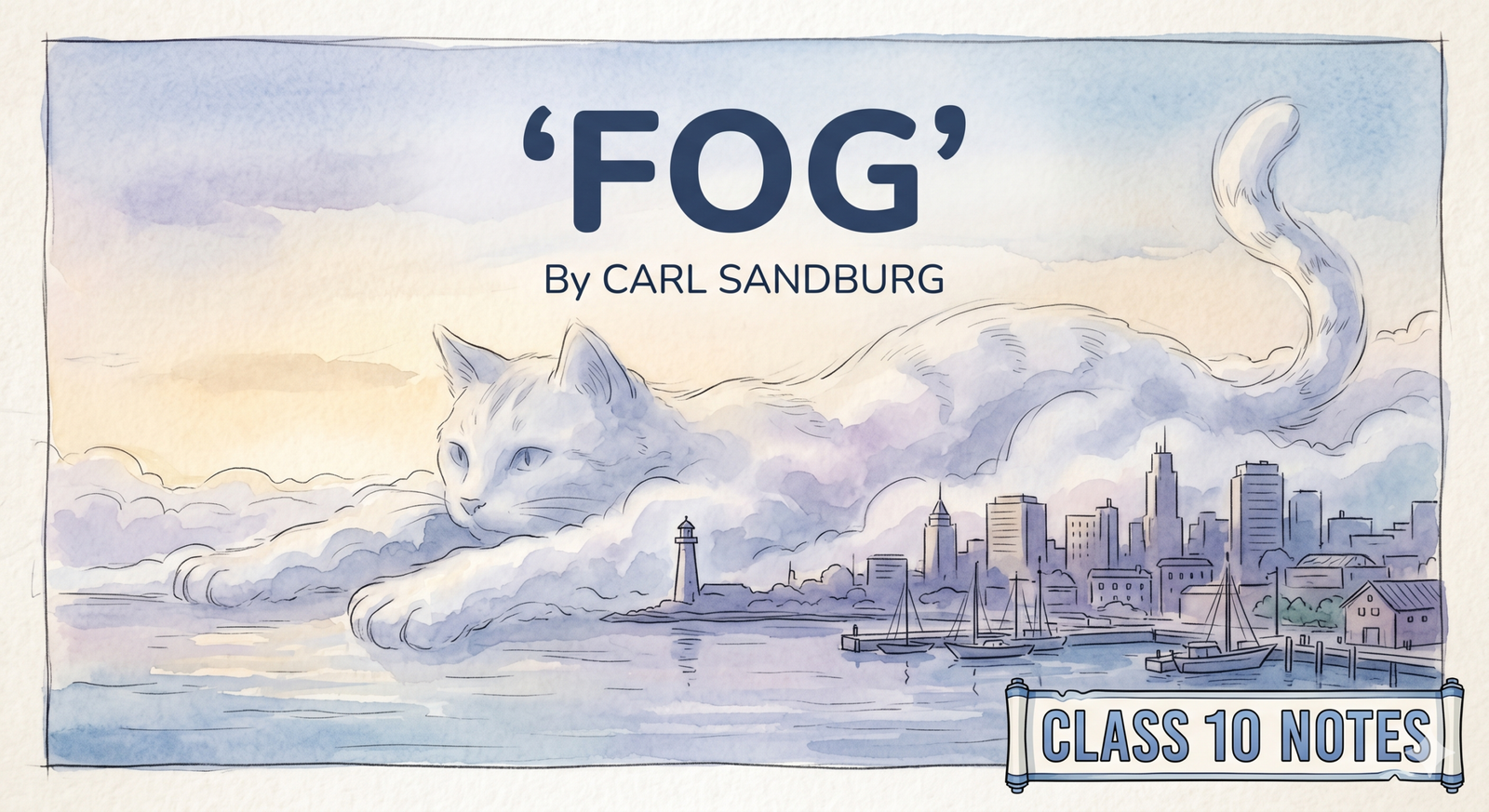
1. Poem Introduction
“Fog” by Carl Sandburg is the shortest poem in the Class 10 syllabus, consisting of just six lines. It is written in free verse (without any rhyming scheme). In this poem, the poet brilliantly captures the natural phenomenon of fog (thick mist) arriving over a city. He uses an extended metaphor, comparing the fog to a little cat. Just like a cat, the fog arrives silently, sits quietly observing its surroundings, and then vanishes without making any noise. The poem highlights the silent, mysterious, and transient (temporary) nature of things in the natural world.
2. The Poem
The fog comes
on little cat feet.
It sits looking
over harbor and city
on silent haunches
and then moves on.
– Carl Sandburg
3. Word Meanings (Vocabulary)
- Fog: कोहरा / धुंध (A thick cloud of tiny water droplets suspended in the atmosphere)
- Harbor: बंदरगाह (A place on the coast where ships can tie up and find shelter)
- Haunches: पीछे के पैर / घुटने मोड़कर बैठना (Sitting with knees bent; the thighs and buttocks of an animal)
- Moves on: आगे बढ़ जाना / गायब हो जाना (Goes away or disappears)
4. Key Comparison (Metaphor)
- The Fog as a Cat: The entire poem is built on this single metaphor.
– Arrival: A cat walks so softly that no one hears it coming. Similarly, the fog covers the city slowly and silently.
– Stay: A cat often sits on its haunches (back legs) observing things silently. The fog does the same as it settles over the harbor and the city.
– Departure: A cat leaves a place quietly without making a fuss. The fog, too, clears up and moves on silently when the weather changes.
5. Full Summary
The Silent Arrival
The poet describes the arrival of the fog in the city. He compares the fog to a small cat. Just as a cat enters a room silently on its soft little paws without anyone noticing, the fog advances towards the city very slowly and quietly. Nobody can hear it coming; it just gradually envelopes the surroundings.
Observing the City
Once the fog arrives, it settles down. The poet imagines the fog sitting like a cat on its “haunches” (knees bent). The fog sits quietly, covering the busy harbor (port) and the entire city. It seems as if it is carefully looking over and observing the city, just like a cat silently watches its surroundings while sitting on a wall or a roof.
The Departure
Fog is a natural weather condition, and it does not stay forever. After hovering over the city for some time, the fog silently moves away as the wind blows or the sun comes out. Just as a cat gets up and leaves without making any sound, the fog simply clears up and “moves on,” leaving the city clear once again.
6. Multiple Choice Questions (10 MCQs)
Q1. Who is the poet of the poem “Fog”?
(a) Carl Sandburg | (b) Robert Frost | (c) Walt Whitman | (d) W.B. Yeats
Answer: (a) Carl Sandburg
Q2. What has the fog been compared to?
(a) A dog | (b) A cat | (c) A cloud | (d) A ghost
Answer: (b) A cat
Q3. How does the fog come?
(a) With loud thunder | (b) Silently, on little cat feet | (c) With heavy rain | (d) Quickly like a storm
Answer: (b) Silently, on little cat feet
Q4. What does the fog look over?
(a) The mountains | (b) The harbor and city | (c) The forest | (d) The village
Answer: (b) The harbor and city
Q5. How does the fog sit?
(a) On trees | (b) On the roof | (c) On silent haunches | (d) On the ships
Answer: (c) On silent haunches
Q6. What does the fog do at the end of the poem?
(a) It starts raining | (b) It moves on | (c) It freezes | (d) It stays forever
Answer: (b) It moves on
Q7. What is the rhyme scheme of the poem?
(a) aabb | (b) abab | (c) abcd | (d) Free verse (No rhyme scheme)
Answer: (d) Free verse (No rhyme scheme)
Q8. Which poetic device is used when fog is compared to a cat?
(a) Simile | (b) Metaphor | (c) Alliteration | (d) Oxymoron
Answer: (b) Metaphor
Q9. What does the word “haunches” mean?
(a) Paws | (b) Tail | (c) Sitting with bent knees | (d) Ears
Answer: (c) Sitting with bent knees
Q10. What quality of nature is highlighted in this poem?
(a) Its destructiveness | (b) Its loud noise | (c) Its silent, transient, and mysterious nature | (d) Its permanence
Answer: (c) Its silent, transient, and mysterious nature
7. Short Answer Questions (30-40 Words)
Q1. How does the poet compare the arrival of the fog to that of a cat?
Ans. The poet says the fog comes “on little cat feet.” Just like a cat enters a place very softly and silently without making any footsteps or noise, the thick fog also covers the city slowly and quietly.
Q2. What does the fog do while it sits over the city?
Ans. While sitting over the harbor and the city, the fog completely covers the area. It sits quietly on its “haunches” like a cat, seemingly observing everything happening below it in absolute silence.
Q3. What does “on silent haunches” mean in the poem?
Ans. “Haunches” means sitting with knees bent, resting on the back legs. It paints a visual image of a cat sitting still. It implies that the fog has settled down over the city and is quietly resting there.
Q4. What happens when the fog “moves on”?
Ans. When the weather changes or the wind blows, the fog silently lifts and disappears. Just like a cat that gets up and walks away quietly, the fog moves on, leaving the city and harbor clear.
Q5. Why has the poet used free verse for this poem?
Ans. The poet used free verse (without rhyming) to match the free, formless, and unpredictable nature of the fog. The natural flow of the words without a strict rhyme mirrors the slow and silent drifting of the fog.
8. Long Answer Questions (60-70 Words)
Q1. Discuss the extended metaphor used by Carl Sandburg in the poem “Fog”.
Ans. Carl Sandburg uses a beautiful extended metaphor comparing the fog to a cat. The comparison works on three levels. First, the arrival: the fog comes silently and stealthily, just like a cat walking on its soft padded feet. Second, the stay: the fog settles over the city and harbor, resembling a cat sitting on its haunches and silently observing its surroundings. Third, the departure: eventually, without any noise or warning, the fog disappears, just as a cat quietly gets up and walks away.
Q2. “Nature has its own ways of arriving and departing.” Discuss this statement with reference to the poem “Fog”.
Ans. The poem perfectly illustrates that nature operates on its own terms, often silently and mysteriously. The fog does not announce its arrival with thunder or loud noises; it simply creeps in quietly. It stays for as long as it wants, covering the vast city and harbor in a blanket of mist. Once its time is over, it doesn’t leave a dramatic trace; it simply “moves on.” This shows the transient (temporary), peaceful, yet powerful way nature functions around us.
Q3. How does the poet capture the essence of a cat and apply it to a natural phenomenon?
Ans. The poet captures a cat’s most defining traits—stealth, silence, independence, and mystery. By applying these traits to the fog, he brings a lifeless weather condition to life. The fog is no longer just water vapor; it becomes an independent creature that chooses when to arrive, sits quietly to observe the world on its “haunches,” and then leaves at its own will. This brilliant personification makes the brief poem highly visual and memorable.