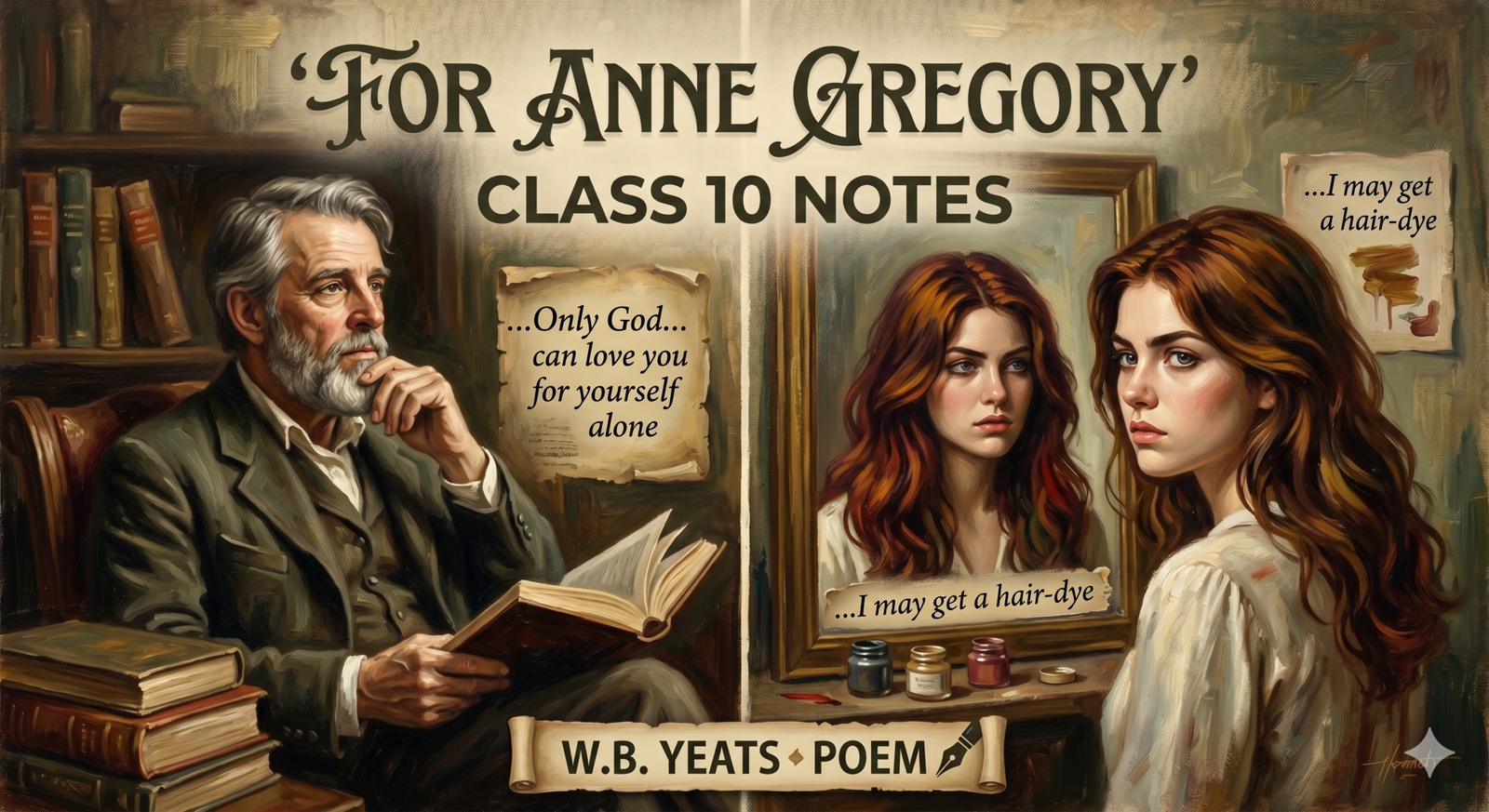
1. Poem Introduction
“For Anne Gregory” by W.B. Yeats is a profound poem presented as a conversation between the poet (or a young man) and a young woman named Anne Gregory. The poem deals with the true nature of love. It raises a very important question: Do people love us for our physical beauty, or for our inner qualities (our soul)? The poem concludes with a philosophical truth that human beings are easily distracted by physical appearance, and only God has the capacity to love a person entirely for who they are on the inside.
2. The Poem
“Never shall a young man,
Thrown into despair
By those great honey-coloured
Ramparts at your ear,
Love you for yourself alone
And not your yellow hair.”
“But I can get a hair-dye
And set such colour there,
Brown, or black, or carrot,
That young men in despair
May love me for myself alone
And not my yellow hair.”
“I heard an old religious man
But yesternight declare
That he had found a text to prove
That only God, my dear,
Could love you for yourself alone
And not your yellow hair.”
– W.B. Yeats
3. Word Meanings (Vocabulary)
- Despair: निराशा / दुख (State of hopelessness or sadness, usually due to unreturned love)
- Ramparts: किले की दीवार (High, wide walls of a fort; here it refers to Anne’s thick hair falling over her ears like a protective wall)
- Honey-coloured: शहद के रंग का / सुनहरा (Golden yellow color)
- Yesternight: पिछली रात (The previous night)
- Declare: घोषणा करना (To announce or state firmly)
- Text: धार्मिक ग्रंथ (A religious book or scripture)
4. Key Elements & Characters
- The Young Man (Speaker 1): He represents the worldly view. He tells Anne that men are attracted to her beautiful yellow hair, making it impossible for them to look past her physical beauty to love her soul.
- Anne Gregory (Speaker 2): A young, beautiful woman with gorgeous honey-colored hair. She is innocent and desires true love. She is willing to ruin her physical beauty (dye her hair) just so someone will love her for her inner self.
- God: The ultimate symbol of pure, unconditional love. He is the only one who looks beyond the physical form and loves a human for their true inner self.
5. Full Summary
The Young Man’s Opinion on Love
In the first stanza, a young man is talking to Anne Gregory. He tells her that her honey-colored (golden-yellow) hair is so beautiful that it acts like a high wall (“ramparts”) around her face, capturing the attention of any young man. Because her hair is so attractive, men fall madly in love with her physical appearance and get “thrown into despair” if they can’t have her. He warns her that a man will always love her for her beautiful yellow hair, and it is impossible for a human to love her only for her inner qualities.
Anne Gregory’s Innocent Reply
In the second stanza, Anne Gregory replies to the young man. She does not want to be loved merely for her outward appearance; she wants to be loved for her true self. She says that physical beauty is temporary and changeable. To prove this, she says she can easily buy hair dye and change her beautiful yellow hair to black, brown, or carrot (red). She believes that by destroying the thing that makes her physically attractive, young men will finally stop looking at her hair and start loving her for her soul.
The Ultimate Truth (The Religious Man’s Text)
In the third and final stanza, the young man answers Anne’s innocent wish. He tells her that just the previous night (“yesternight”), he heard an old religious man declare a profound truth. The old man had found a text (a religious scripture) that proved a harsh reality about human nature: human beings are easily fooled and distracted by physical appearances. Therefore, only God has the divine capacity to look past the physical body (the yellow hair) and love a person completely and purely for themselves alone.
6. Multiple Choice Questions (10 MCQs)
Q1. Who is the poet of the poem “For Anne Gregory”?
(a) W.B. Yeats | (b) Walt Whitman | (c) Robert Frost | (d) Ogden Nash
Answer: (a) W.B. Yeats
Q2. What is the color of Anne Gregory’s hair?
(a) Black | (b) Brown | (c) Honey-coloured (Yellow) | (d) Carrot
Answer: (c) Honey-coloured (Yellow)
Q3. What does the poet compare Anne’s hair to?
(a) Gold | (b) Ramparts (fort walls) | (c) A river | (d) Silk
Answer: (b) Ramparts (fort walls)
Q4. What does Anne Gregory offer to do to her hair?
(a) Cut it short | (b) Hide it under a hat | (c) Wash it | (d) Dye it
Answer: (d) Dye it
Q5. Which colors does Anne say she can dye her hair?
(a) Blue, green, or red | (b) Brown, black, or carrot | (c) White, silver, or grey | (d) Pink, purple, or orange
Answer: (b) Brown, black, or carrot
Q6. Why does Anne want to change her hair color?
(a) She is bored of yellow | (b) So men will love her for herself, not her hair | (c) To follow a fashion trend | (d) To look older
Answer: (b) So men will love her for herself, not her hair
Q7. Who did the speaker hear talking “yesternight”?
(a) A king | (b) An old religious man | (c) A young boy | (d) A scientist
Answer: (b) An old religious man
Q8. What did the old religious man find?
(a) A magic potion | (b) A text (religious book) | (c) A golden ring | (d) A treasure
Answer: (b) A text (religious book)
Q9. According to the text, who is the ONLY one that can love Anne for herself alone?
(a) Her parents | (b) The young man | (c) God | (d) Her friends
Answer: (c) God
Q10. What does the word “despair” mean in the context of the poem?
(a) Happiness | (b) Extreme sadness or hopelessness in love | (c) Anger | (d) Excitement
Answer: (b) Extreme sadness or hopelessness in love
7. Short Answer Questions (30-40 Words)
Q1. What does the young man say about Anne Gregory’s hair?
Ans. The young man says that Anne’s honey-colored hair is so beautiful that it acts like “ramparts” (fort walls) falling over her ears. It distracts men so much that they fall in love with her hair, not her inner self.
Q2. Why is the young man “thrown into despair”?
Ans. The young man is thrown into despair because he is deeply mesmerized by Anne’s outward physical beauty (her golden hair). He desperately wants her love, and the pain of longing for her causes him extreme sadness and hopelessness.
Q3. What is Anne Gregory’s view on love?
Ans. Anne Gregory believes that true love should be based on a person’s inner qualities and soul, not on temporary physical beauty. She wants a young man to love her “for herself alone” and not just for her attractive yellow hair.
Q4. What solution does Anne offer to avoid being loved just for her hair?
Ans. To avoid being loved merely for her physical appearance, Anne suggests that she can easily dye her beautiful yellow hair into less attractive colors like brown, black, or carrot. This way, men might look past her hair and love her soul.
Q5. What did the old religious man declare?
Ans. The old religious man declared that he had found a religious text proving a universal truth: human beings are incapable of ignoring physical beauty. Only God has the divine ability to love a person for their inner soul alone.
8. Long Answer Questions (60-70 Words)
Q1. Discuss the central theme of the poem “For Anne Gregory”.
Ans. The central theme of the poem is the conflict between physical beauty and inner beauty. Through a conversation, the poet highlights human nature’s tendency to be attracted to outward appearances. While Anne desires pure love based on her character and soul, the poet explains that humans are easily distracted by physical traits like her “yellow hair.” Ultimately, the poem establishes that true, unconditional love for one’s inner self is divine, and only God is capable of it.
Q2. How does the poet use the metaphor of “ramparts” in the poem?
Ans. The poet uses the word “ramparts” (which means the protective walls of a fort) as a metaphor for Anne Gregory’s beautiful, thick, honey-colored hair falling over her ears. Just as a rampart guards a fort and stops people from seeing inside, Anne’s stunning hair acts as a barrier. It is so visually striking that it stops young men from looking deeper into her soul, making them fall in love only with her external appearance.
Q3. What does Anne Gregory’s willingness to dye her hair reveal about her character?
Ans. Anne’s readiness to dye her beautiful golden hair into ordinary colors like brown, black, or carrot reveals her innocence and deep desire for genuine love. She is not vain or proud of her physical beauty; in fact, she views it as an obstacle to finding true love. She values her inner self far more than her appearance and is willing to destroy her physical attractiveness if it means someone will finally love her for who she truly is.
Q4. Why does the poet introduce the “old religious man” in the final stanza?
Ans. The poet introduces the old religious man to provide an authoritative, spiritual conclusion to the argument about love. While Anne innocently hopes to change human nature by changing her hair color, the religious man’s text proves that it is impossible. Humans are inherently flawed and tied to the physical world. By bringing in the religious text, the poet solidifies the ultimate truth: pure, selfless love that ignores physical beauty is a divine trait, possessed only by God.