1. Chapter Introduction
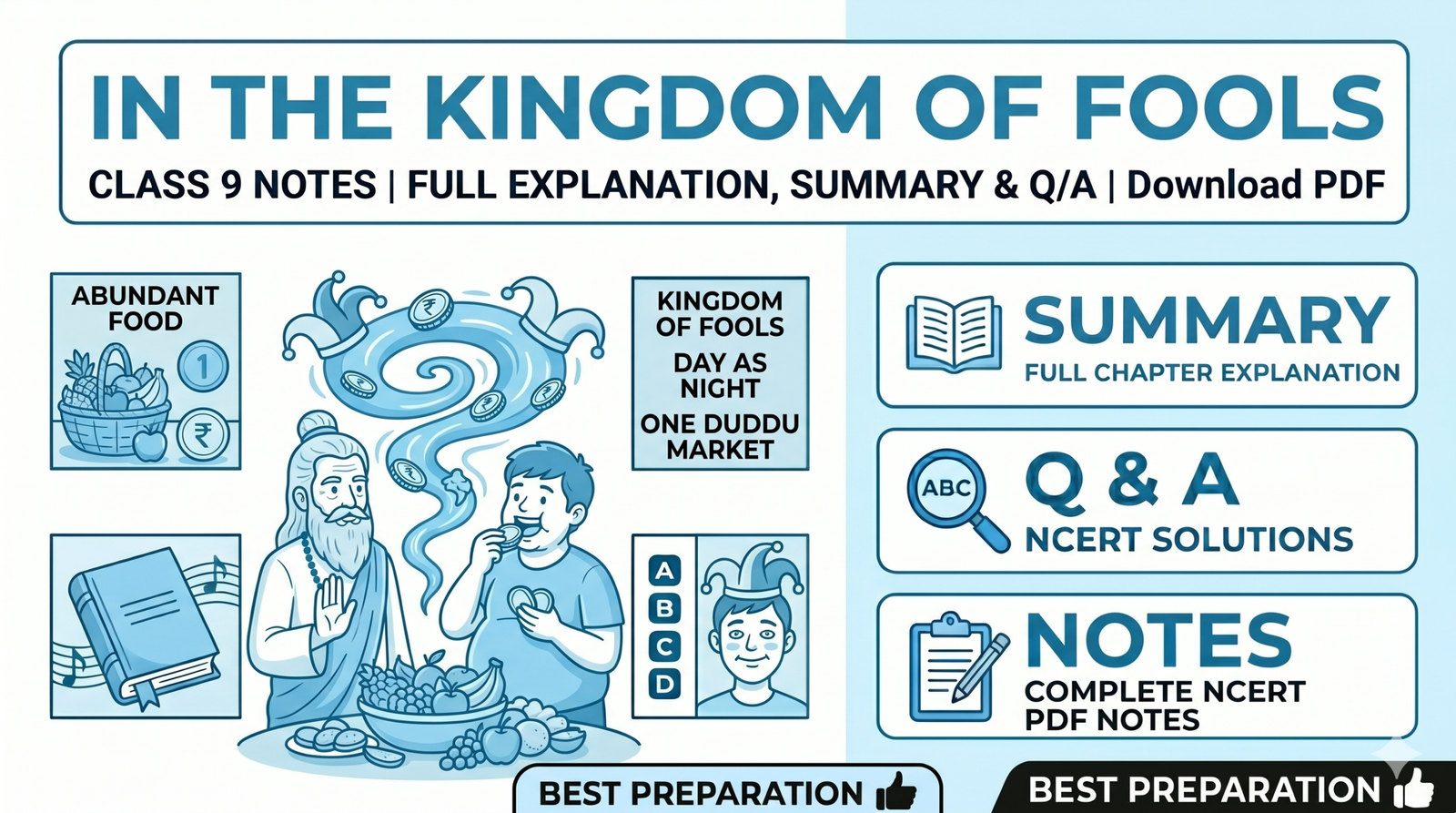
Hello students! Welcome to the notes for Class 9 English Moments Chapter 4: “In the Kingdom of Fools”. This interesting story is a popular Kannada folktale taken from A.K. Ramanujan’s Tales from India. The story revolves around a bizarre kingdom ruled by a foolish king and his equally foolish minister. They completely reverse the laws of nature—making night into day and day into night. The chapter provides a great moral lesson: it is extremely dangerous to stay in the company of fools, as their unpredictable behavior can cost you your life. Only wisdom can save you from the traps of foolishness!
2. Characters Detail
- The King & Minister: Utter fools who reversed day and night in their kingdom and ordered that everything should cost a single ‘dudu’.
- The Guru: A wise man who visits the kingdom, quickly realizes the danger of staying among fools, and eventually saves his disciple’s life.
- The Disciple: A greedy follower of the Guru who refuses to leave the kingdom because of the incredibly cheap food, which later lands him in deadly trouble.
- The Thief & His Brother: The thief dies when a merchant’s wall collapses on him. His brother demands justice from the king for his “innocent” brother’s death.
- The Merchant, Bricklayer, Dancing Girl & Goldsmith: The absurd chain of accused people in the king’s bizarre court trial.
3. Full Summary: In the Kingdom of Fools Class 9
A Strange Kingdom
In the Kingdom of Fools, both the king and the minister were idiots. They didn’t want to run things like other kings, so they decided to change night into day and day into night. They ordered everyone to stay awake, work, and do business at night, and go to sleep as soon as the sun came up. Anyone who disobeyed would be punished with death. Additionally, everything in the market, whether a measure of rice or a bunch of bananas, cost exactly the same—one single coin called a ‘dudu’.
Arrival of the Guru and the Disciple
One day, a Guru and his disciple arrived in this beautiful city in broad daylight, but found it completely deserted. Everyone, including the cattle, was asleep. As night fell, the whole city suddenly woke up and went about its business. The hungry travelers were delighted to find that they could buy a huge feast for just one dudu. However, the wise Guru realized this was a kingdom of fools and it wouldn’t last long. He advised his disciple to leave immediately. But the disciple, tempted by the cheap and plentiful food, refused. The Guru left him behind.
The Bizarre Trial
Days passed, and the disciple grew fat eating bananas, ghee, rice, and wheat. Meanwhile, a thief broke into a rich merchant’s house by making a hole in the wall. As he was leaving with his loot, the old wall collapsed and killed him instantly. The thief’s brother complained to the king, demanding justice. The foolish king summoned the merchant and blamed him for building a weak wall. The merchant blamed the bricklayer. The bricklayer blamed a dancing girl who distracted him years ago. The dancing girl blamed a goldsmith who made her walk up and down the street. Finally, the goldsmith blamed the merchant’s dead father, who had placed an urgent jewelry order. The king concluded that since the father was dead, the son (the merchant) must inherit his sins and be executed.
The Search for a Fat Man
A new execution stake was ordered to be built. However, when it was ready, the minister noticed that the merchant was too thin to properly fit the stake. The foolish king decided they needed a fat man to fit the stake instead! The king’s men searched the town and found the Guru’s disciple, who had grown very fat. Despite his protests of innocence, he was taken to the execution ground.
The Guru’s Rescue Plan
In his moment of despair, the disciple prayed to his Guru. The Guru, possessing magical powers, saw everything in a vision and arrived instantly. He whispered a plan to the disciple and then started a fake fight with him over who should be executed first. The confused king asked the Guru for the reason. The Guru tricked the king by saying that this was a holy stake, the stake of the god of justice. Whoever died on it first would be reborn as the King of the country, and the second would be reborn as the Minister.
The End of the Fools
The foolish king and minister didn’t want to lose their kingdom in the next life. They postponed the execution, disguised themselves as the Guru and the disciple, and secretly went to the prison. The executioners, following the king’s earlier orders, unknowingly executed the real King and the Minister. The next morning, the people realized what had happened. They begged the Guru and the disciple to become their new king and minister. The Guru agreed on the condition that all the old, foolish laws would be changed, restoring the kingdom to normal.
4. Multiple Choice Questions (10 MCQs)
Q1. From where is the story “In the Kingdom of Fools” taken?
(a) Panchatantra | (b) A Kannada folktale | (c) Jataka Tales | (d) The Arabian Nights
Answer: (b) A Kannada folktale
Q2. What did the king and the minister decide to do?
(a) Increase taxes | (b) Go to war | (c) Reverse day and night | (d) Build a new palace
Answer: (c) Reverse day and night
Q3. What was the local currency called in the kingdom?
(a) Rupee | (b) Dinar | (c) Dollar | (d) Dudu
Answer: (d) Dudu
Q4. Why did the Guru decide to leave the kingdom?
(a) It was too expensive | (b) He was afraid of fools | (c) He didn’t like the food | (d) The king banished him
Answer: (b) He was afraid of fools
Q5. Why did the disciple decide to stay back?
(a) He wanted to become king | (b) Because of cheap and abundant food | (c) He fell in love | (d) He was tired of traveling
Answer: (b) Because of cheap and abundant food
Q6. How did the thief die?
(a) He was executed | (b) The king’s guards shot him | (c) A wall collapsed on him | (d) He fell from a tree
Answer: (c) A wall collapsed on him
Q7. Who was finally blamed by the king for the murder originally?
(a) The bricklayer | (b) The rich merchant | (c) The dancing girl | (d) The goldsmith
Answer: (b) The rich merchant
Q8. Why was the merchant not executed on the stake?
(a) He bribed the minister | (b) He ran away | (c) He was too thin for the stake | (d) The Guru saved him
Answer: (c) He was too thin for the stake
Q9. Who did the execution stake fit perfectly?
(a) The goldsmith | (b) The thief’s brother | (c) The fat disciple | (d) The dancing girl
Answer: (c) The fat disciple
Q10. Who became the new King and Minister?
(a) The merchant and goldsmith | (b) The Guru and his disciple | (c) The thief’s brother and bricklayer | (d) Neighboring kings
Answer: (b) The Guru and his disciple
5. Short Answer Questions (30-40 Words)
Q1. What are the two strange things the guru and his disciple find in the Kingdom of Fools?
Ans. The two strange things were: First, the people slept during the day and worked at night. Second, everything in the market cost exactly the same amount—a single ‘dudu’—whether it was a measure of rice or a bunch of bananas.
Q2. Why did the disciple decide to stay in the Kingdom of Fools? Is it a good idea?
Ans. The disciple decided to stay because food was incredibly cheap and abundant. All he wanted was good, cheap food. No, it was not a good idea because, as the Guru warned, one can never predict what foolish people might do next.
Q3. Name all the people who were tried in the king’s court, and give the reasons for their trial.
Ans. The merchant was tried because his wall fell on the thief. The bricklayer was tried for building a weak wall. The dancing girl for distracting the bricklayer. The goldsmith for delaying the girl’s jewelry, and finally, the merchant again because his father ordered that jewelry.
Q4. Why did the king decide to execute the disciple instead of the merchant?
Ans. When the new execution stake was ready, the minister found that the merchant was too thin to fit it properly. The foolish king then ordered his men to find a fat man who could fit the stake, which turned out to be the disciple.
Q5. Who became the king and the minister of the kingdom in the end? What condition did they put?
Ans. The Guru became the new king and his disciple became the minister, as requested by the people. They accepted the positions on the condition that they could change all the old, foolish laws and restore normal day and night.
6. Long Answer Questions (60-80 Words)
Q1. Describe the bizarre trial that took place in the Kingdom of Fools.
Ans. A thief died when a merchant’s old wall collapsed on him. The king blamed the merchant for murder. The merchant blamed the bricklayer for building a weak wall. The bricklayer blamed a dancing girl whose jingling anklets distracted him years ago. The dancing girl blamed the goldsmith for making her walk up and down by delaying her jewelry. The goldsmith blamed the merchant’s dead father who gave a big order. Finally, the foolish king concluded the merchant inherited his father’s sins and ordered his execution.
Q2. How does the guru manage to save his disciple’s life?
Ans. The Guru arrived just in time and created a fake fight with the disciple over who should be executed first. When the confused king asked why, the Guru tricked him by saying that the new stake belonged to the god of justice. The first person to die on it would be reborn as the king, and the second as the minister. The greedy and foolish king, wanting to keep his kingdom in the next life, secretly took the disciple’s place and got himself executed.
Q3. “Fools cannot be trusted.” Justify this statement with reference to the story.
Ans. The story perfectly justifies this statement. The king and the minister were absolute fools who lacked basic logic. Their foolishness started with reversing day and night and keeping a flat price for everything. When it came to justice, they punished innocent people based on absurd logic. The ultimate proof of their untrustworthiness was when they almost executed an innocent disciple simply because he was fat enough to fit the stake. As the Guru rightly warned, one can never predict the danger a fool might pose.
Q4. What values do we learn from the character of the Guru?
Ans. The Guru represents wisdom, foresight, and presence of mind. Unlike his greedy disciple, he wasn’t tempted by the cheap food because he knew the dangers of living among fools. He had a strong sense of duty, which is why he returned to save his disciple’s life despite his previous disobedience. He also demonstrated great intelligence by exploiting the king’s greed and foolishness to save an innocent life and rid the kingdom of its tyrannical, idiotic rulers.