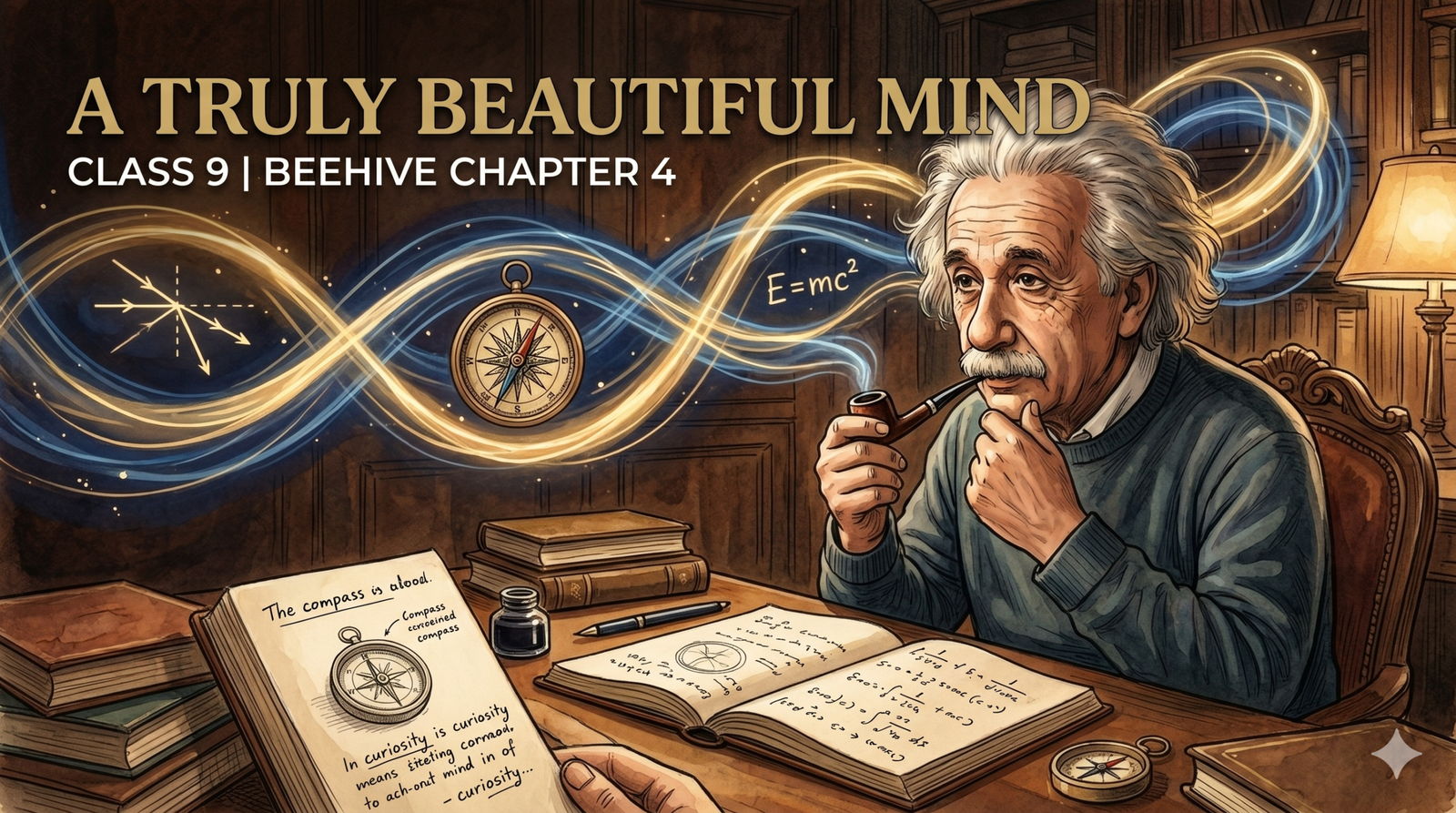
1. Chapter Introduction
Hello students! Today we are looking at Class 9 English Chapter 4: “A Truly Beautiful Mind”. When you hear the word “genius,” whose name comes to mind? For most of the world, it is Albert Einstein. This biographical chapter takes us through his incredible journey from being a seemingly “slow” child to becoming the greatest physicist of the 20th century. But more importantly, the title “A Truly Beautiful Mind” is given to him because of his deep love for humanity. He was not just a scientist; he was a visionary who tirelessly campaigned for world peace and democracy.
2. Characters Detail
- Albert Einstein: A world-renowned physicist. As a child, he was thought to be a slow learner, but he went on to revolutionize our understanding of space, time, and gravity. He was also a great humanitarian.
- Einstein’s Mother: She initially thought her son was a “freak” because his head seemed too large and he didn’t speak until he was two and a half years old.
- Mileva Maric: A clever Serbian student at the University of Zurich who shared his interest in science and arts. She became his first wife.
- The Headmaster: Einstein’s school headmaster in Munich who told his father that Albert would “never make a success at anything.”
3. Full Summary
A Different Kind of Childhood
Albert Einstein was born on March 14, 1879, in Ulm, Germany. He showed no signs of greatness in his early years. His mother thought he was a freak because of his unusually large head. He did not start speaking until he was two and a half, and when he finally did, he repeated everything twice. He didn’t know how to mix with other children, and his playmates called him “Brother Boring.” He loved playing with mechanical toys by himself.
School Days and Rebellion
Einstein was not a bad student; he scored good marks in almost every subject in Munich. However, he hated the school’s strict regimentation and discipline. He often clashed with his teachers. At the age of 15, feeling suffocated by the rigid environment, he left the school for good. He later persuaded his parents to let him continue his education in Switzerland, which had a much more liberal environment than Munich.
University Life and Marriage
Einstein enrolled at the University of Zurich. He was highly gifted in mathematics and physics. There, he met Mileva Maric, a Serbian student whom he found to be a “clever creature.” They fell in love and eventually got married in 1903, having two sons. Unfortunately, their marriage faltered as Mileva lost her scientific ambitions and became an unhappy housewife. They divorced in 1919, and Einstein married his cousin Elsa the same year.
The Genius at Work
In 1902, Einstein secured a job as a technical expert in the patent office in Bern. While he was supposed to be assessing other people’s inventions, he was secretly developing his own ideas. He playfully called his desk drawer the “bureau of theoretical physics.” In 1905, he published his Special Theory of Relativity, which gave the world the famous equation E=mc². In 1915, he published his General Theory of Relativity, providing a new interpretation of gravity. When a solar eclipse in 1919 proved his theory correct, he became an overnight global sensation. He was awarded the Nobel Prize in Physics in 1921.
A Champion for Peace
When the Nazis came to power in Germany in 1933, Einstein emigrated to the United States. Five years later, the discovery of nuclear fission in Berlin caused an uproar. Urged by a colleague, Einstein wrote a letter to the American President, Franklin D. Roosevelt, warning him of the destructive power of an atomic bomb. This led the Americans to develop their own bomb, which they dropped on Hiroshima and Nagasaki in 1945.
Einstein was deeply shaken by the extent of the destruction. He wrote a public missive to the United Nations proposing the formation of a world government to prevent future wars. For the rest of his life, he used his massive popularity to campaign for world peace and democracy. He died in 1955 at the age of 76, celebrated not only as a scientific genius but as a true world citizen.
4. Multiple Choice Questions (10 MCQs)
Q1. When was Albert Einstein born?
(a) 14 March 1879 | (b) 15 April 1880 | (c) 14 May 1879 | (d) 10 March 1885
Answer: (a) 14 March 1879
Q2. What did Einstein’s playmates call him?
(a) Little Genius | (b) Brother Boring | (c) The Freak | (d) The Silent Boy
Answer: (b) Brother Boring
Q3. Why did Einstein leave the school in Munich?
(a) He failed his exams | (b) He was expelled | (c) He hated the school’s regimentation | (d) His family moved to the USA
Answer: (c) He hated the school’s regimentation
Q4. Where did Einstein want to study after leaving Munich?
(a) London | (b) Switzerland | (c) Paris | (d) New York
Answer: (b) Switzerland
Q5. Who was Mileva Maric?
(a) Einstein’s teacher | (b) Einstein’s sister | (c) A clever Serbian student | (d) A famous scientist
Answer: (c) A clever Serbian student
Q6. What did Einstein playfully call his desk drawer at the patent office?
(a) Box of secrets | (b) Bureau of theoretical physics | (c) Magic box | (d) Drawer of inventions
Answer: (b) Bureau of theoretical physics
Q7. What famous equation was derived from his Special Theory of Relativity?
(a) a² + b² = c² | (b) F = ma | (c) E=mc² | (d) V = IR
Answer: (c) E=mc²
Q8. In which year did Einstein receive the Nobel Prize in Physics?
(a) 1905 | (b) 1915 | (c) 1921 | (d) 1933
Answer: (c) 1921
Q9. To whom did Einstein write a letter warning about the atomic bomb?
(a) Winston Churchill | (b) Franklin D. Roosevelt | (c) Mahatma Gandhi | (d) Adolf Hitler
Answer: (b) Franklin D. Roosevelt
Q10. What did Einstein campaign for in his later years?
(a) More scientific funding | (b) Building a new university | (c) World peace and democracy | (d) Space exploration
Answer: (c) World peace and democracy
5. Short Answer Questions (30-40 Words)
Q1. Why did Einstein’s playmates call him “Brother Boring”?
Ans. Einstein was an introverted child who didn’t know what to do with other children. Since he preferred to play by himself, mostly with mechanical toys, his playmates found him uninteresting and called him “Brother Boring.”
Q2. Why did Einstein leave his school in Munich for good?
Ans. Einstein hated the strict discipline and regimentation of his school in Munich. He felt stifled and often clashed with his teachers. At the age of 15, feeling totally suffocated, he left the school permanently.
Q3. Why did Einstein want to study in Switzerland rather than Munich?
Ans. After leaving Munich, Einstein wanted to continue his education in Switzerland because the environment there was much more liberal, free-thinking, and less rigid compared to the strict discipline of Munich.
Q4. Why did Einstein write a letter to Franklin Roosevelt?
Ans. In 1939, with the discovery of nuclear fission in Berlin, Einstein wrote to President Roosevelt to warn him that Nazi Germany could build a highly destructive atomic bomb that could destroy an entire port and its surroundings.
Q5. How did Einstein react to the bombing of Hiroshima and Nagasaki?
Ans. Einstein was deeply shaken and horrified by the massive destruction caused by the atomic bombs. In response, he wrote a public missive to the United Nations, urging the formation of a world government to stop such destruction.
6. Long Answer Questions (60-80 Words)
Q1. Describe Albert Einstein’s childhood. Why did people think he would never succeed?
Ans. Albert Einstein had a highly unusual childhood. His head was unusually large, making his mother think he was a “freak.” He was a late talker, not speaking until he was two and a half, and when he did, he repeated words twice. He loved mechanical toys but couldn’t mix with other children, earning him the nickname “Brother Boring.” His headmaster thought so poorly of him that he told his father that whatever profession Albert chose, he would never make a success at anything.
Q2. What were Einstein’s major scientific achievements mentioned in the chapter?
Ans. While working as a technical expert in Bern, Einstein secretly developed his own ideas. In 1905, he published the “Special Theory of Relativity,” establishing the relationship between mass and energy with the formula E=mc². In 1915, he published the “General Theory of Relativity,” which completely changed the world’s understanding of gravity. A solar eclipse in 1919 proved his theory accurate. For his groundbreaking work, he was awarded the Nobel Prize in Physics in 1921.
Q3. Justify the title of the chapter, “A Truly Beautiful Mind”.
Ans. The title “A Truly Beautiful Mind” is absolutely justified. While Einstein was undoubtedly a scientific genius, a “beautiful mind” refers to his heart and his concern for humanity. He was deeply disturbed by the use of atomic weapons and the massive destruction they caused. For the later part of his life, he shifted his focus from science to politics. He became a global citizen, actively campaigning for an end to the arms race, advocating for world peace, and promoting democracy.