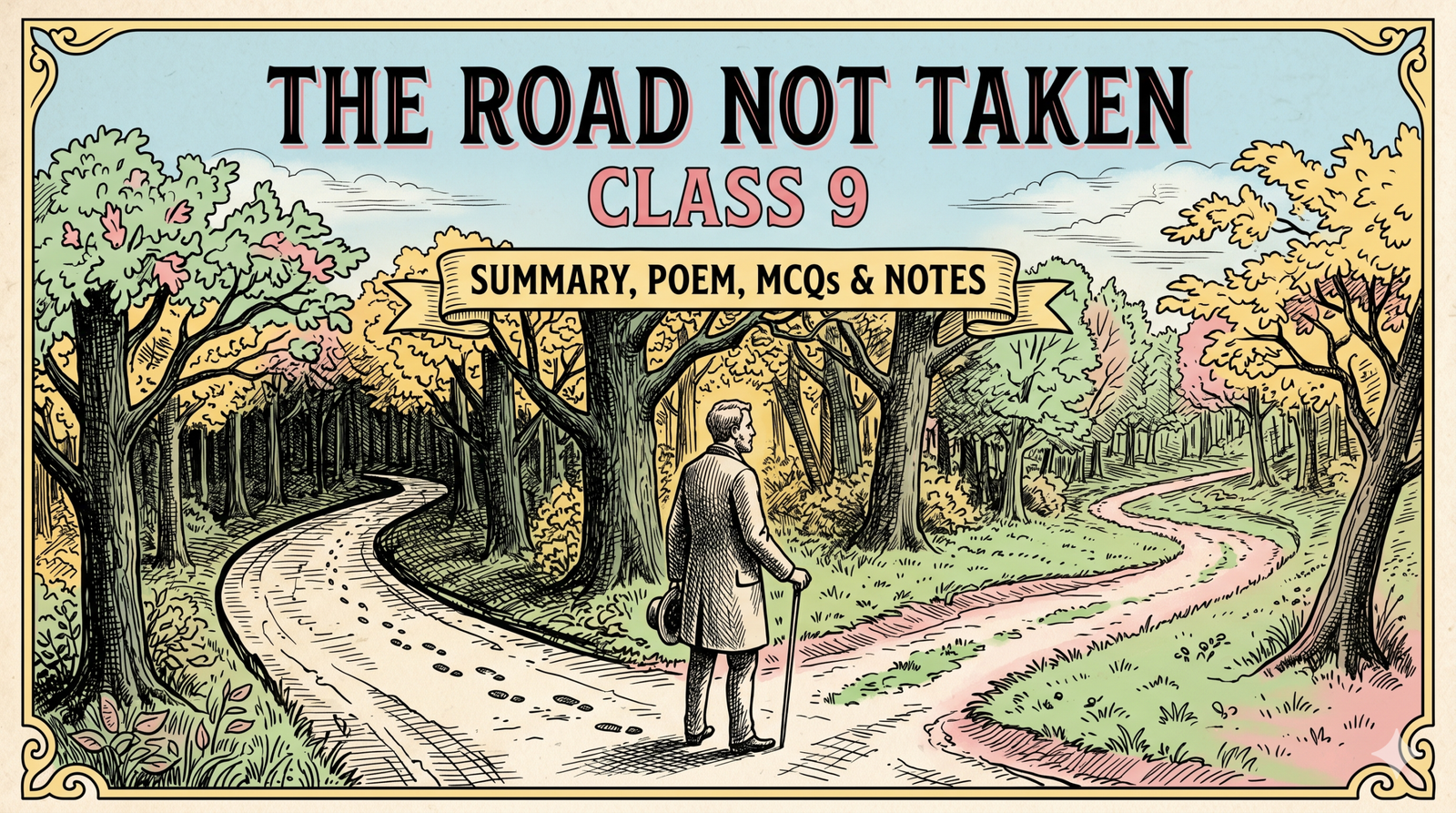
The Road Not Taken Class 9: Full Notes, Poem & MCQs
Welcome to the complete study guide for Class 9 English Beehive chapter, “The Road Not Taken”. Written by the famous American poet Robert Frost, this poem is a profound metaphor for the choices we make in life, the dilemmas we face, and how our decisions shape our ultimate destiny.
The Poem: “The Road Not Taken” by Robert Frost
Two roads diverged in a yellow wood,
And sorry I could not travel both
And be one traveler, long I stood
And looked down one as far as I could
To where it bent in the undergrowth;
Then took the other, as just as fair,
And having perhaps the better claim,
Because it was grassy and wanted wear;
Though as for that the passing there
Had worn them really about the same,
And both that morning equally lay
In leaves no step had trodden black.
Oh, I kept the first for another day!
Yet knowing how way leads on to way,
I doubted if I should ever come back.
I shall be telling this with a sigh
Somewhere ages and ages hence:
Two roads diverged in a wood, and I—
I took the one less traveled by,
And that has made all the difference.
Complete Summary of The Road Not Taken
The poem is a beautifully crafted narrative about making choices in life, represented by a traveler facing a fork in the road.
Stanza 1: The Dilemma
The poet is walking through an autumn forest (a yellow wood) and comes to a point where the road divides into two. Being a single traveler, he cannot travel both roads. He stands there for a long time, contemplating his choice, and looks down one road as far as his eyes can see, until it disappears into the dense bushes (undergrowth).
Stanza 2: The Choice
After examining the first road, the poet decides to take the second one. He feels it is just as beautiful and perhaps a better choice because it is full of grass and seems like not many people have walked on it (“wanted wear”). However, as he walks on it, he realizes that both roads are actually worn out equally by the people who have traveled them.
Stanza 3: The Reality of Choices
On that particular morning, both roads were covered with autumn leaves that had not been crushed or turned black by footsteps. The poet decides to save the first road for another day. However, deep down, he knows that in life, one path leads to another, and he doubts he will ever get a chance to come back and walk the first road.
Stanza 4: The Future Impact
In the final stanza, the poet imagines himself in the distant future. He says he will be looking back at this moment with a “sigh” (which could be of regret or relief). He will tell the story of how he stood in the woods and chose the road “less traveled by,” and how that single decision shaped his entire life and made all the difference.
Important Word Meanings
| Word/Phrase |
Meaning in English |
| Diverged |
Separated and took a different direction. |
| Yellow wood |
A forest during the autumn season when leaves turn yellow. |
| Undergrowth |
Dense growth of plants, shrubs, and bushes in a forest. |
| Fair |
As good, beautiful, or promising as the other one. |
| Wanted wear |
Had not been used or walked upon much; required to be used. |
| Trodden |
Walked over or stepped upon. |
| Sigh |
A deep, long audible breath expressing sadness, relief, or reflection. |
Important Multiple Choice Questions (MCQs)
Test your understanding with these exam-oriented MCQs covering key themes and poetic devices.
1. Who is the poet of ‘The Road Not Taken’?
- A) William Wordsworth
- B) Robert Frost
- C) W.B. Yeats
- D) John Keats
Answer: B) Robert Frost
2. What do the two roads in the poem symbolize?
- A) Two different cities
- B) The choices and decisions we make in life
- C) Two different forests
- D) The difficulties of traveling
Answer: B) The choices and decisions we make in life
3. What does “yellow wood” signify?
- A) Trees painted yellow
- B) The spring season
- C) A forest during the autumn season
- D) A forest catching fire
Answer: C) A forest during the autumn season
4. Why did the poet choose the second road?
- A) Because it was shorter
- B) Because it was grassy and wanted wear
- C) Because it was perfectly paved
- D) Because it was completely empty
Answer: B) Because it was grassy and wanted wear
5. What does the poet mean by “wanted wear”?
- A) The road needed to be repaired
- B) The road was worn out
- C) The road had not been walked over by many people
- D) The road was full of clothes
Answer: C) The road had not been walked over by many people
6. What is the rhyme scheme of the poem?
- A) ababcd
- B) abbaa
- C) aabb
- D) abaab
Answer: D) abaab
7. Did the poet think he would ever return to take the first road?
- A) Yes, he planned to return the next day
- B) No, he doubted if he should ever come back
- C) He was completely certain he would return
- D) He did not care about returning
Answer: B) No, he doubted if he should ever come back
8. What has “made all the difference” in the poet’s life?
- A) Taking the road less traveled by
- B) Traveling the world
- C) Walking in the yellow wood
- D) Leaving his friends behind
Answer: A) Taking the road less traveled by
9. “In leaves no step had trodden black.” What does this mean?
- A) The leaves were painted green
- B) People had crushed the leaves
- C) No one had walked on those leaves that morning to turn them black
- D) The road was covered in mud
Answer: C) No one had walked on those leaves that morning to turn them black
10. What does the “sigh” in the last stanza indicate?
- A) Deep reflection, which could be regret or satisfaction regarding his choice
- B) Anger at the road
- C) Physical tiredness from walking
- D) Joy of reaching a destination
Answer: A) Deep reflection, which could be regret or satisfaction regarding his choice
Top Exam Questions and Answers (FAQs)
Q1: Where does the traveler find himself? What problem does he face?
Answer: The traveler finds himself in a yellow wood (an autumn forest) standing at a fork where the road diverges into two different paths. His problem is the dilemma of choice—being a single traveler, he cannot travel both roads at the same time and must choose one path over the other.
Q2: Is there any difference between the two roads as the poet describes them in stanzas two and three?
Answer: Initially, in stanza two, the poet feels the second road is better because it is “grassy and wanted wear,” suggesting fewer people have traveled it. However, upon closer observation in stanza three, he realizes that both roads were actually worn “really about the same,” and that morning, both were covered in fresh leaves with no black footmarks. So, realistically, there was no major difference between them.
Q3: What do you think the last two lines of the poem mean? (Looking back, does the poet regret his choice or accept it?)
Answer: The last two lines—“I took the one less traveled by, And that has made all the difference”—mean that the choice he made in the past shaped his entire life and destiny. The word “sigh” is ambiguous. It can indicate a sigh of relief and satisfaction at having made a unique, successful choice, or a sigh of regret for the things he missed out on by not taking the other road. Ultimately, it shows acceptance that life choices are irreversible.