1. Poem Introduction
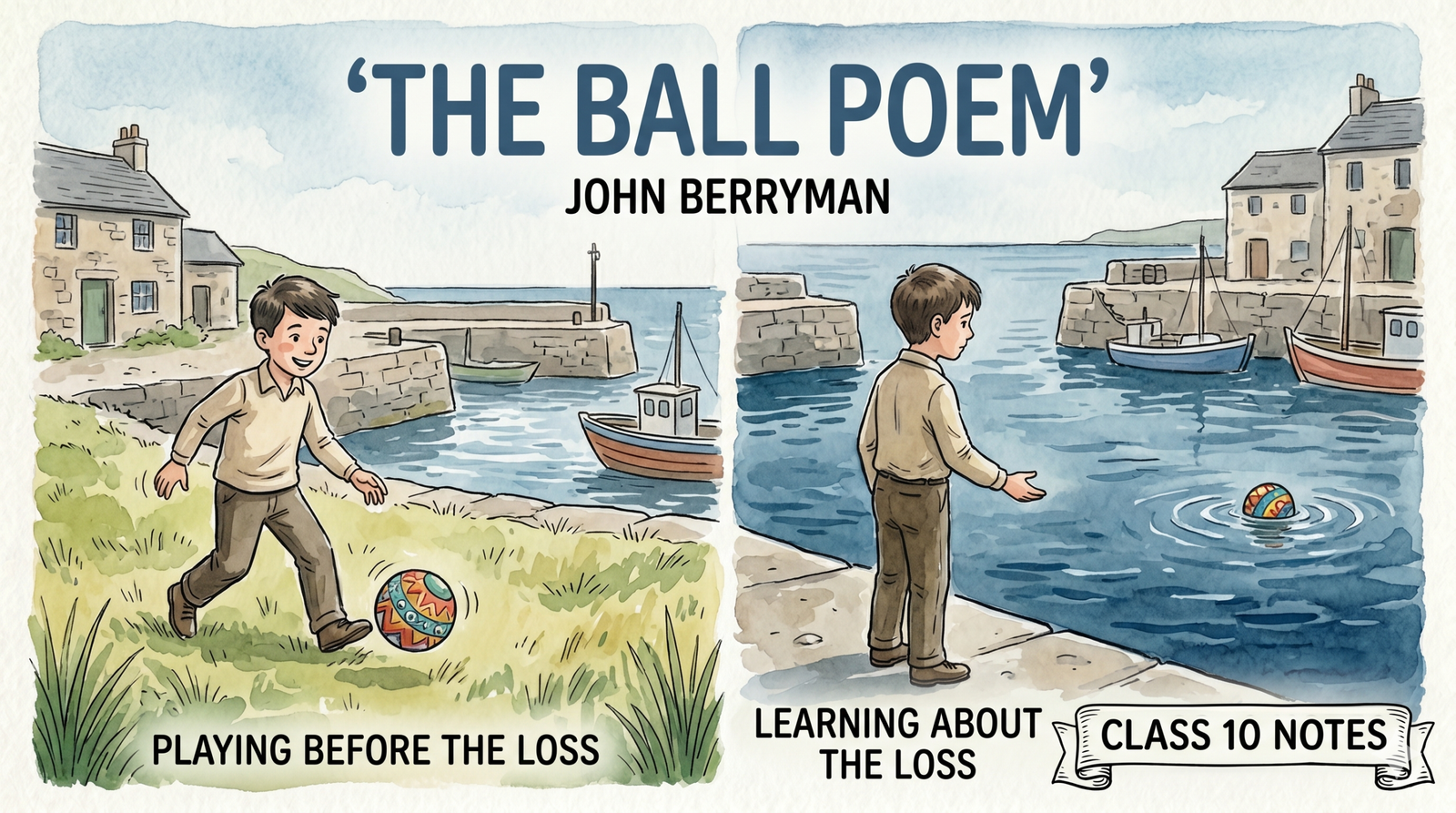
“The Ball Poem” by John Berryman is a deeply philosophical poem that deals with the theme of growing up and facing the harsh realities of life. On the surface, it is a simple story about a little boy who loses his bouncing ball in the water. However, metaphorically, the ball represents the boy’s lost childhood, innocence, and happy memories. Through this incident, the poet teaches us about the “epistemology of loss”—how to understand, accept, and survive the pain of losing something or someone we love in this materialistic world.
2. The Poem
What is the boy now, who has lost his ball,
What, what is he to do? I saw it go
Merrily bouncing, down the street, and then
Merrily over — there it is in the water!
No use to say ‘O there are other balls’:
An ultimate shaking grief fixes the boy
As he stands rigid, trembling, staring down
All his young days into the harbour where
His ball went. I would not intrude on him;
A dime, another ball, is worthless. Now
He senses first responsibility
In a world of possessions. People will take
Balls, balls will be lost always, little boy.
And no one buys a ball back. Money is external.
He is learning, well behind his desperate eyes,
The epistemology of loss, how to stand up
Knowing what every man must one day know
And most know many days, how to stand up.
– John Berryman
3. Word Meanings (Vocabulary)
- Merrily: खुशी से (Happily/Cheerfully)
- Grief: गहरा दुख (Sorrow/Sadness)
- Rigid: कठोर / बिना हिले-डुले (Stiff/Unmoving)
- Trembling: कांपना (Shivering/Shaking with emotion)
- Harbour: बंदरगाह / पानी की जगह (A place where ships are docked; here, the water body)
- Intrude: दखल देना (To interfere or enter where uninvited)
- Dime: 10 सेंट का सिक्का / थोड़े से पैसे (A US coin worth 10 cents; here, it means money)
- Possessions: भौतिक वस्तुएं / संपत्ति (Material things that people own)
- Epistemology: ज्ञान मीमांसा / किसी चीज़ को समझने का विज्ञान (The study of knowledge/understanding)
- Desperate: निराश (Hopeless/Sad)
4. Key Elements & Symbols
- The Lost Ball: It is not just a toy. It symbolizes the boy’s childhood, his innocence, and the precious memories attached to his early days.
- The Water (Harbour): It represents the dark, harsh, and unchangeable reality of life where time and youth disappear forever.
- World of Possessions: This refers to our materialistic society where people are obsessed with buying, owning, and replacing physical things, ignoring emotional values.
5. Full Summary
The Loss of the Ball
The poem starts with the poet observing a young boy who was playing with his ball. The ball bounces happily down the street and finally falls into the water. The poet asks what the boy will do now since he has lost his beloved toy. Though losing a ball seems trivial to adults, for the little boy, it is a devastating event.
The Boy’s Extreme Grief
The poet notes that it is completely useless to tell the boy, “Don’t worry, there are other balls.” The boy is entirely paralyzed by sorrow. He stands stiff (rigid) and shakes (trembles) with sadness as he continuously stares down into the dark water where his ball went. For him, the ball is irreplaceable because his precious childhood memories went into the water along with it.
The Poet’s Decision Not to Interfere
The poet decides not to console the boy or offer him a ‘dime’ (money) to buy a new ball. He realizes that offering money is ‘worthless’. A new ball can be bought, but the memories attached to the old ball cannot be brought back. The poet wants the boy to face this emotional pain alone because it is a crucial learning moment in his life.
Learning the Epistemology of Loss
This loss is the boy’s first real experience with grief. He is learning his first lesson of responsibility in a materialistic “world of possessions.” The poet explains that in life, “balls” (meaning our loved ones, youth, or cherished things) will always be lost, and money (“external”) cannot buy them back. Behind his sad eyes, the boy is learning the “epistemology of loss”—understanding the nature of loss and learning how to stand up, move on, and survive, which is a harsh truth every human being must eventually learn.
6. Multiple Choice Questions (10 MCQs)
Q1. Who is the poet of “The Ball Poem”?
(a) Robert Frost | (b) John Berryman | (c) Leslie Norris | (d) Walt Whitman
Answer: (b) John Berryman
Q2. Where did the boy’s ball go?
(a) Into the fire | (b) Down the street and into the water | (c) Into a house | (d) Into a forest
Answer: (b) Down the street and into the water
Q3. What does the ball symbolize in the poem?
(a) The boy’s money | (b) The boy’s friends | (c) The boy’s lost childhood and innocent days | (d) The poet’s memories
Answer: (c) The boy’s lost childhood and innocent days
Q4. How does the boy react to the loss of his ball?
(a) He laughs | (b) He runs to buy another one | (c) He stands rigid, trembling, and staring down | (d) He starts playing another game
Answer: (c) He stands rigid, trembling, and staring down
Q5. Why does the poet say “No use to say ‘O there are other balls'”?
(a) Because the boy is deaf | (b) Because other balls are expensive | (c) Because the lost ball had emotional memories attached to it | (d) Because the poet doesn’t care
Answer: (c) Because the lost ball had emotional memories attached to it
Q6. Why does the poet not offer the boy money (a dime)?
(a) The poet is poor | (b) The poet wants the boy to learn the lesson of loss | (c) The boy doesn’t want money | (d) The poet hates the boy
Answer: (b) The poet wants the boy to learn the lesson of loss
Q7. What does the phrase “world of possessions” mean?
(a) A world full of ghosts | (b) A materialistic world where people value physical things | (c) A world of poor people | (d) A world without emotions
Answer: (b) A materialistic world where people value physical things
Q8. What does the poet mean when he says “Money is external”?
(a) Money is everything | (b) Money comes from outside | (c) Money can only buy physical things, not lost memories or emotions | (d) Money is hard to earn
Answer: (c) Money can only buy physical things, not lost memories or emotions
Q9. What is the boy learning?
(a) Mathematics | (b) How to play football | (c) The epistemology (nature) of loss | (d) How to swim
Answer: (c) The epistemology (nature) of loss
Q10. What does the word “intrude” mean?
(a) To help | (b) To interfere in a situation | (c) To buy something | (d) To cry
Answer: (b) To interfere in a situation
7. Short Answer Questions (30-40 Words)
Q1. Why does the poet say, “I would not intrude on him”?
Ans. The poet does not want to interfere because he wants the boy to experience the pain of loss independently. Intervening or consoling him would stop the boy from learning the crucial life lesson of coping with grief.
Q2. What is the boy’s state of mind after losing the ball?
Ans. The boy is completely devastated. He is paralyzed with grief, standing rigid and trembling. He constantly stares into the water where the ball went, feeling a deep sense of sorrow over losing his childhood companion.
Q3. Why are “other balls” or a “dime” worthless to the boy?
Ans. They are worthless because money (a dime) can only buy a new physical ball, but it cannot buy back the lost memories, emotions, and the innocent childhood days that the boy associated with that specific lost ball.
Q4. What does “in the world of possessions” mean?
Ans. It refers to our modern, materialistic world where people are deeply attached to owning physical things (possessions). In such a world, losing things is natural, and one must learn to detach and survive.
Q5. Explain the phrase: “Money is external”.
Ans. The poet means that money has limitations. It is an external physical tool that can replace material goods, but it has no power to bring back internal emotional values, lost relationships, or the beautiful days of the past.
8. Long Answer Questions (60-70 Words)
Q1. What is the “epistemology of loss”? How does the boy learn it?
Ans. The “epistemology of loss” means understanding the true nature and reality of losing something. The boy learns this painful lesson when he loses his favorite ball in the water. Nobody replaces it for him. Left alone with his grief, his desperate eyes slowly realize that in life, things will inevitably be lost, and he must find the inner strength to stand up, accept the reality, and move forward.
Q2. Why is it important for everyone to experience loss, according to the poem?
Ans. According to the poem, experiencing loss is a fundamental and necessary part of growing up. If we are always protected from sadness, we will never become emotionally strong. Loss teaches us responsibility. It shatters our childish illusions that everything lasts forever, preparing us for the harsh realities of the adult world. Knowing how to cope with grief is what eventually teaches us “how to stand up” in life.
Q3. How is the lost ball a metaphor for the boy’s lost childhood?
Ans. The ball is not merely a toy; it is deeply connected to the boy’s early, happy days. When the ball bounces away into the dark, unreachable water, it symbolizes the boy’s innocence and childhood slipping away into the past, never to return. Just as a new ball cannot bring back the old memories, growing up is an irreversible process. The loss marks his transition from a carefree child to a responsible individual.
Q4. Contrast the boy’s reaction with the poet’s attitude in the poem.
Ans. The boy is overwhelmed by intense emotions. He is rigid, trembling, and utterly shattered by the loss of his ball, unable to accept what has happened. In contrast, the poet is calm, mature, and observant. He feels sympathy for the boy but deliberately remains distant. He acts as a silent, wise observer who knows that pain is a necessary teacher, and interfering would only block the boy’s emotional growth.