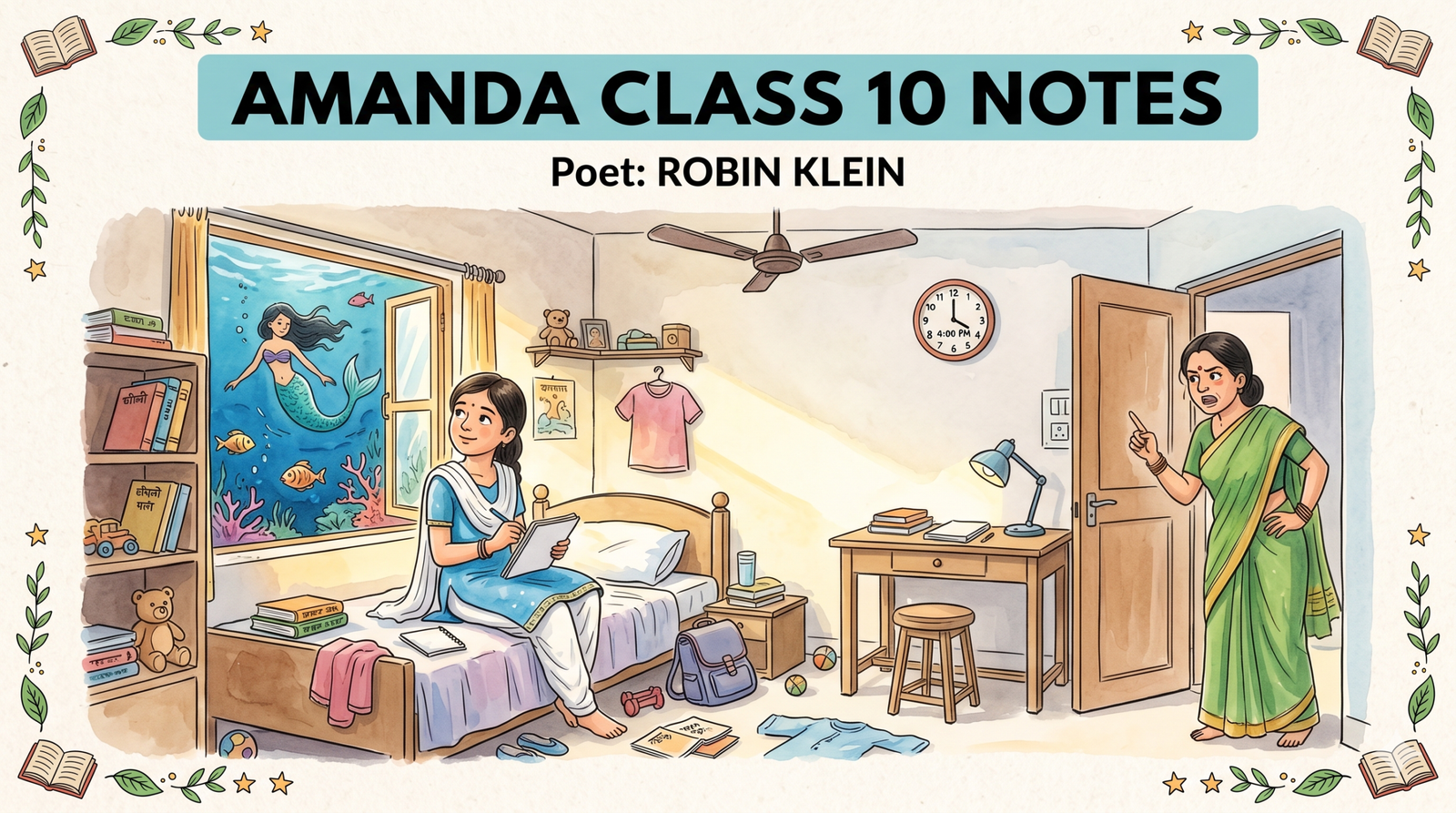
Amanda Class 10 Notes: Summary, Q&A, MCQs & Word Meanings

Amanda – Chapter Notes

1. Poem Introduction

“Amanda” by Robin Klein is a relatable and psychological poem that focuses on the upbringing of a young girl. The poem highlights the constant nagging and instructions given by a parent (most likely the mother) and how it affects the child’s mind. Fed up with the continuous scolding and restrictions, Amanda constantly escapes into her own imaginary world where she is completely free, lonely, and at peace. The poem beautifully contrasts the harsh reality of parental control with the dreamy world of a child’s imagination.

2. The Poem

Don’t bite your nails, Amanda!
Don’t hunch your shoulders, Amanda!
Stop that slouching and sit up straight,
Amanda!

(There is a languid, emerald sea,
where the sole inhabitant is me—
a mermaid, drifting blissfully.)

Did you finish your homework, Amanda?
Did you tidy your room, Amanda?
I thought I told you to clean your shoes,
Amanda!

(I am an orphan, roaming the street.
I pattern soft dust with my hushed, bare feet.
The silence is golden, the freedom is sweet.)

Don’t eat that chocolate, Amanda!
Remember your acne, Amanda!
Will you please look at me when I’m speaking to you,
Amanda!

(I am Rapunzel, I have not a care;
life in a tower is tranquil and rare;
I’ll certainly never let down my bright hair!)

Stop that sulking at once, Amanda!
You’re always so moody, Amanda!
Anyone would think that I nagged at you,
Amanda!

– Robin Klein

3. Word Meanings (Vocabulary)

  • Hunch: झुक कर बैठना (To bend one’s back/shoulders)
  • Slouching: सुस्त तरीके से बैठना (Sitting or standing lazily)
  • Languid: शांत / आलस भरा (Relaxed, slow, and peaceful)
  • Emerald: गहरे हरे रंग का (Bright green color)
  • Inhabitant: निवासी (A person or animal that lives in or occupies a place)
  • Drifting: पानी के बहाव के साथ बहना (Moving slowly with the water)
  • Blissfully: आनंद से (Happily and peacefully)
  • Hushed: शांत (Silent/Quiet)
  • Tranquil: शांत / तनावमुक्त (Peaceful/Calm)
  • Rare: दुर्लभ (Uncommon/Unique)
  • Sulking: रूठना / मुँह फुलाना (Being silently angry or upset)
  • Moody: चिड़चिड़ा (Having unpredictable changes of mood)
  • Nagged: बार-बार डांटना या टोकना (Constantly scolded or harassed)

4. Key Characters & Escapes

  • The Parent (Speaker): Overly protective, dominating, and constantly instructing Amanda. She cares more about social appearance (posture, acne, not looking sulky) than Amanda’s mental peace.
  • Amanda: A teenage girl who feels suffocated. Instead of arguing, she ignores the nagging and escapes into three different imaginary worlds.
  • The Mermaid Escape: She imagines herself as a lonely mermaid in a calm green sea to escape the noise and instructions of her house.
  • The Orphan Escape: She wishes to be an orphan walking barefoot in the dust, just to experience the “sweet freedom” and “golden silence” without anyone ordering her around.
  • The Rapunzel Escape: She wants to live in a high tower like Rapunzel, far away from humans, but decides she will never let her hair down so nobody can come up and disturb her peace.

5. Full Summary

Instructions on Posture

The poem begins with a parent continuously instructing Amanda. The parent scolds her for biting her nails and hunching her shoulders. She is strictly told to stop sitting lazily (slouching) and to sit up straight. While hearing this, Amanda mentally drifts away. She imagines herself as a mermaid, the only resident of a calm, beautiful, green (emerald) sea, moving peacefully with the water.

Questions about Chores

In the next stanza, the parent starts interrogating Amanda about her daily chores. She asks if Amanda has finished her homework, tidied her room, and cleaned her shoes as instructed. Amanda, who is completely ignoring these questions, retreats into her second fantasy. She imagines she is an orphan roaming the streets freely. She visualizes herself walking barefoot, making patterns in the soft dust. For her, the silence of being an orphan is ‘golden’, and the freedom is ‘sweet’ compared to her noisy house.

Restrictions and Scolding

The nagging continues as the parent orders Amanda not to eat chocolate, reminding her that it causes acne (pimples). The parent gets frustrated because Amanda is lost in her thoughts and demands, “Look at me when I’m speaking to you!” Amanda, however, imagines herself as Rapunzel. She dreams of living alone in a high, peaceful tower where life is calm and rare. Unlike the real Rapunzel, Amanda vows that she will never drop her bright hair down because she doesn’t want any prince (or anyone else) to enter her life and ruin her peace.

The Final Irony

In the final stanza, the mother tells Amanda to stop sulking and looking moody. The mother is highly concerned about society. She worries that if other people see Amanda looking so sad and upset, they will think that the mother has been nagging and harassing her. The supreme irony of the poem is that the mother is, in fact, nagging Amanda continuously, yet she only cares about her own image.

6. Multiple Choice Questions (10 MCQs)

Q1. Who is the poet of the poem “Amanda”?
(a) John Berryman | (b) Robin Klein | (c) Robert Frost | (d) Walt Whitman
Answer: (b) Robin Klein
Q2. What is Amanda doing to her nails?
(a) Painting them | (b) Cutting them | (c) Biting them | (d) Growing them
Answer: (c) Biting them
Q3. What does Amanda imagine herself to be in the emerald sea?
(a) A fish | (b) A mermaid | (c) A sailor | (d) An octopus
Answer: (b) A mermaid
Q4. Why does Amanda want to be an orphan?
(a) Because she has no parents | (b) To roam freely in the streets | (c) To avoid going to school | (d) Because she is poor
Answer: (b) To roam freely in the streets
Q5. What does the speaker ask Amanda not to eat?
(a) Ice cream | (b) Chocolate | (c) Candy | (d) Chips
Answer: (b) Chocolate
Q6. Why is Amanda asked not to eat chocolate?
(a) It is expensive | (b) Because of her acne (pimples) | (c) It causes tooth decay | (d) It will make her fat
Answer: (b) Because of her acne (pimples)
Q7. What will Amanda NOT do if she is Rapunzel?
(a) Sing songs | (b) Cook food | (c) Let down her bright hair | (d) Clean the tower
Answer: (c) Let down her bright hair
Q8. How does the speaker describe Amanda’s behavior at the end?
(a) Happy and active | (b) Sulking and moody | (c) Obedient and quiet | (d) Angry and violent
Answer: (b) Sulking and moody
Q9. What does the speaker worry about in the last stanza?
(a) Amanda’s health | (b) Amanda’s future | (c) What people will think (that she nagged Amanda) | (d) Amanda’s studies
Answer: (c) What people will think (that she nagged Amanda)
Q10. What does the word “tranquil” mean?
(a) Noisy | (b) Peaceful | (c) Fast | (d) Dangerous
Answer: (b) Peaceful

7. Short Answer Questions (30-40 Words)

Q1. How old do you think Amanda is? How do you know this?
Ans. Amanda is probably a teenager (around 13-15 years old). We know this because she gets acne (pimples) which is common during teenage years. Also, she is given homework and scolded for sulking, which are typical teenage traits.
Q2. Why does Amanda wish to be a mermaid?
Ans. Amanda wishes to be a mermaid because she wants to escape the constant nagging of her mother. As a mermaid, she would be the sole inhabitant of a peaceful, green sea, drifting blissfully without anyone giving her instructions.
Q3. Is Amanda an orphan? Why does she say so?
Ans. No, Amanda is not an orphan. She is just a frustrated child who wishes she were one. She feels that orphans are lucky because they have the freedom to roam the streets quietly and aren’t constantly scolded by parents.
Q4. Why does Amanda say, “I’ll certainly never let down my bright hair”?
Ans. Amanda imagines herself as Rapunzel living in a high tower, enjoying complete peace and isolation. Unlike the real Rapunzel, she vows never to drop her hair because she wants to live alone and doesn’t want anyone to enter and disturb her tranquility.
Q5. What is the mother’s main concern at the end of the poem?
Ans. At the end, the mother is highly concerned about society’s opinion. She scolds Amanda for sulking because she fears that other people will see Amanda’s sad face and think that the mother has been nagging and harassing her.

8. Long Answer Questions (60-70 Words)

Q1. Write a character sketch of the speaker (Amanda’s mother).
Ans. Amanda’s mother is a well-intentioned but overly dominating and nagging parent. She is obsessed with Amanda’s physical posture, habits, cleanliness, and diet. Instead of understanding her daughter’s mental state, she constantly fires instructions at her. She is also deeply concerned about her social image, fearing that society will judge her if Amanda looks moody. Her constant interference creates a suffocating environment for the child.
Q2. What is the central theme of the poem “Amanda”?
Ans. The central theme is the conflict between parental control and a child’s desire for freedom. The poem highlights how continuous nagging, scolding, and over-instructions from parents can frustrate a child. It shows child psychology beautifully: when reality becomes too restrictive, a child like Amanda retreats into an imaginary world of silence, loneliness, and peace to find the freedom she lacks in real life.
Q3. Discuss the significance of the parenthetical stanzas (the lines in brackets) in the poem.
Ans. The stanzas in brackets represent Amanda’s inner thoughts and her imaginary world, which run parallel to her mother’s loud instructions. While the unbracketed lines are harsh, real, and full of commands, the bracketed lines are calm, dreamy, and poetic. They show Amanda’s mental escape mechanism. Every time her mother scolds her, Amanda’s mind shuts out the noise and transports her to a peaceful world as a mermaid, an orphan, or Rapunzel.
Q4. Explain the irony in the last stanza of the poem.
Ans. The last stanza is deeply ironic. Throughout the poem, the mother has been constantly scolding, ordering, and criticizing Amanda about her nails, posture, homework, shoes, and acne. This continuous harassment naturally makes Amanda sad and “sulky”. However, the mother fails to see her own fault. She ironically tells Amanda to stop sulking because she doesn’t want people to think she “nagged” her, entirely ignoring the fact that she has been doing exactly that.

Leave a Comment