1. Poem Introduction
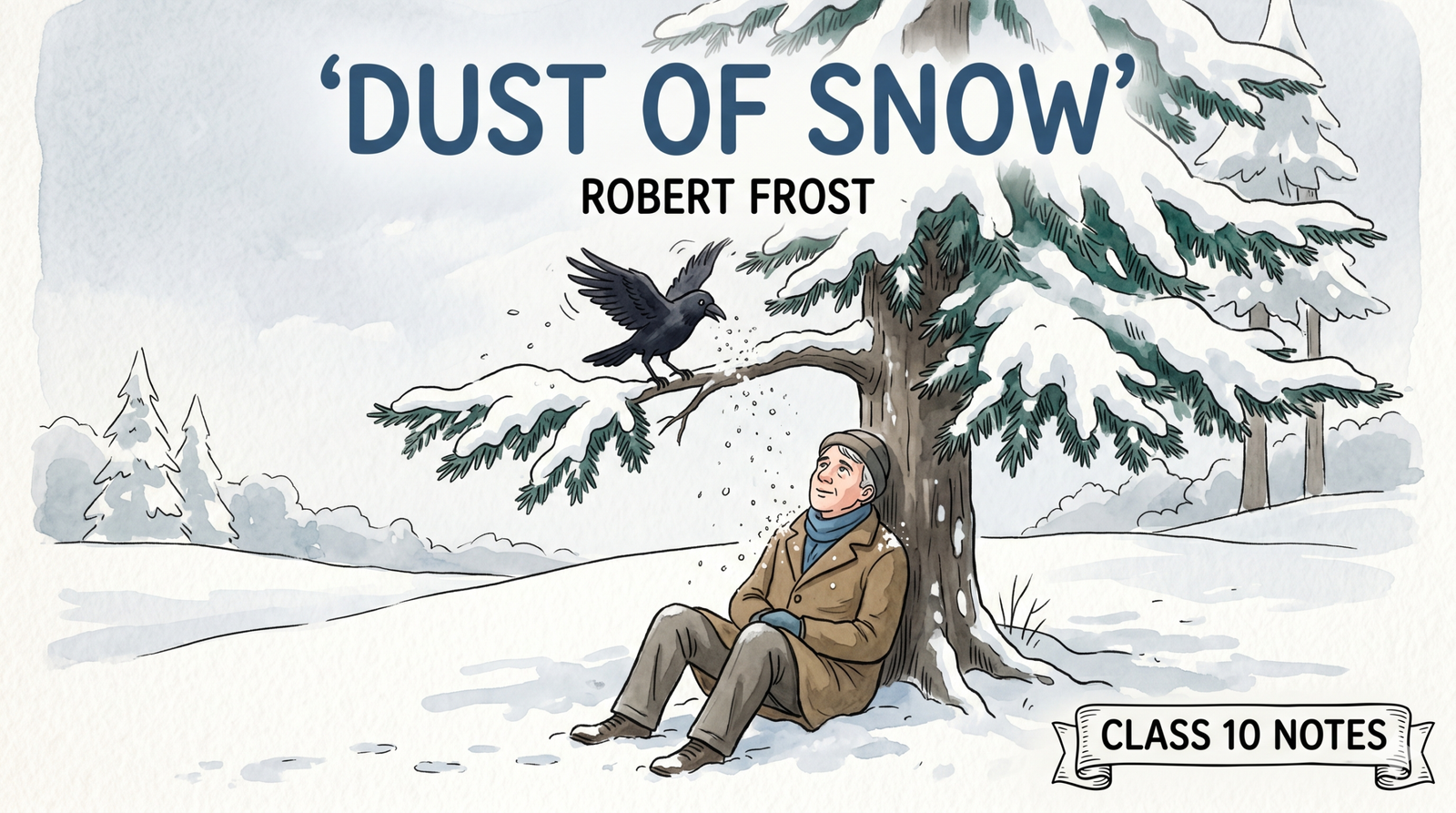
“Dust of Snow” is a beautiful and highly symbolic poem written by the famous American poet, Robert Frost. Despite being a very short poem of just eight lines, it carries a deep and profound meaning. The poem highlights the immense healing power of nature and shows how even a seemingly insignificant, everyday incident can entirely change a person’s mood. It beautifully presents the idea that nature has a cure for human sadness and depression.
2. The Poem
The way a crow
Shook down on me
The dust of snow
From a hemlock tree
Has given my heart
A change of mood
And saved some part
Of a day I had rued.
– Robert Frost
3. Word Meanings (Vocabulary)
- Shook down: हिलाकर नीचे गिराना (To shake off)
- Dust of snow: बर्फ के छोटे-छोटे कण (Fine particles of snow)
- Hemlock tree: एक विषैला पेड़ जिस पर सफेद फूल आते हैं (A poisonous plant with small white flowers)
- Mood: मनोदशा / मन की स्थिति (State of mind)
- Rued: पछतावा करना / दुखी रहना (Held in regret)
4. Key Elements & Symbols
- The Poet (Robert Frost): He starts the poem in a highly depressed and sorrowful state of mind. He feels that his day has been completely ruined until a small act of nature changes his perspective.
- The Crow: Generally, a crow is considered a symbol of bad omen, gloom, and sorrow. However, the poet uses it ironically as the agent that brings happiness into his life.
- The Hemlock Tree: A poisonous plant with small white flowers. Like the crow, it usually represents sadness and death. Yet, in this poem, it becomes the very source of joy.
- Dust of Snow: Fine, powdery particles of snow that fall on the poet. It represents the pure, soothing, and healing energy of nature.
5. Full Summary
The Poet’s Gloomy Mood
The poem begins with the poet experiencing a very bad day. He is in a sorrowful, depressed, and hopeless mood. Feeling down, he is walking outdoors in the cold, snowy weather. He happens to pass under or stand near a hemlock tree, which is a poisonous tree often associated with toxicity and sadness. His mind is full of negative thoughts, and he regrets that his entire day has been a waste.
The Sudden Incident
As the poet is lost in his pessimistic thoughts, a crow suddenly comes and sits on a branch of the hemlock tree (or flies out of it). The sudden movement of the crow causes a shower of fine, powdery snow—referred to as “dust of snow”—to fall directly onto the poet.
The Change of Heart
This simple, unexpected shower of cold, soft snow startles the poet out of his gloomy thoughts. The physical touch of the cold snow immediately lifts his spirits. His depressive mood vanishes, replaced by a sudden feeling of joy and freshness. He realizes that the beauty of nature is far more powerful than his petty sorrows.
A Day Saved
The poet concludes that this tiny incident has “saved some part” of his day. Earlier, he believed that his entire day was ruined (“rued”). However, the falling snow brings a positive energy that rescues the remainder of his day, leaving him feeling grateful and uplifted. Frost wonderfully turns dark symbols (crow and hemlock) into carriers of joy.
6. Multiple Choice Questions (10 MCQs)
Q1. Who is the poet of the poem “Dust of Snow”?
(a) Sylvia Plath | (b) W.B. Yeats | (c) Robert Frost | (d) Walt Whitman
Answer: (c) Robert Frost
Q2. What fell on the poet?
(a) Leaves | (b) Dust of snow | (c) Raindrops | (d) A branch
Answer: (b) Dust of snow
Q3. Which tree is mentioned in the poem?
(a) Oak | (b) Pine | (c) Maple | (d) Hemlock
Answer: (d) Hemlock
Q4. What was the poet’s mood in the beginning of the poem?
(a) Joyful | (b) Sorrowful | (c) Excited | (d) Angry
Answer: (b) Sorrowful
Q5. What does the crow generally symbolize?
(a) Joy | (b) Good luck | (c) Bad omen and sorrow | (d) Peace
Answer: (c) Bad omen and sorrow
Q6. What does ‘dust of snow’ represent in the poem?
(a) Dirt | (b) Healing power of nature | (c) Extreme cold | (d) Death
Answer: (b) Healing power of nature
Q7. What did the poet save?
(a) Some part of the day | (b) Some money | (c) A bird | (d) The tree
Answer: (a) Some part of the day
Q8. What is the rhyme scheme of the poem?
(a) abba cddc | (b) abab cdcd | (c) aabb ccdd | (d) abcd abcd
Answer: (b) abab cdcd
Q9. The word ‘rued’ means:
(a) Enjoyed | (b) Ruined | (c) Held in regret | (d) Celebrated
Answer: (c) Held in regret
Q10. Name the poetic device used in the line “Has given my heart”.
(a) Simile | (b) Metaphor | (c) Alliteration | (d) Personification
Answer: (c) Alliteration (Repetition of ‘h’ sound)
7. Short Answer Questions (30-40 Words)
Q1. Where was the poet standing and what was his state of mind?
Ans. The poet was standing under or near a hemlock tree. He was in a very sad, gloomy, and depressive state of mind, regretting something that had happened earlier in the day.
Q2. What is a ‘dust of snow’?
Ans. ‘Dust of snow’ refers to the extremely fine, soft, and powdery particles of snow that settle on objects. In the poem, it represents the pure, soothing, and healing touch of nature.
Q3. What is a hemlock tree? Why did the poet choose it instead of a beautiful tree?
Ans. A hemlock tree is a poisonous tree with small white flowers. Frost chose it, along with a crow, to represent his sad and dark mood, breaking the tradition of using only beautiful elements of nature.
Q4. How did the poet’s mood change?
Ans. The poet’s mood changed instantly when a crow shook the branches of a hemlock tree, causing a shower of soft snow to fall on him. This simple natural act replaced his sorrow with happiness.
Q5. Why does the poet say that he had “rued” the day?
Ans. The poet says he had “rued” (regretted) the day because he was feeling depressed and felt that his entire day was wasted in sadness, until the falling snow saved the rest of it.
8. Long Answer Questions (60-70 Words)
Q1. What is the central idea or theme of the poem “Dust of Snow”?
Ans. The central idea of “Dust of Snow” is the incredible healing power of nature. Robert Frost brilliantly illustrates how a small, seemingly insignificant natural event can dramatically shift human emotions. The poem teaches us that nature can cure our sorrow, and that one should always be open to positive changes in life, no matter how bad a situation seems.
Q2. How has the poet used unconventional symbols to convey a positive message?
Ans. Usually, poets use symbols like nightingales, doves, or beautiful trees like oak and pine to depict positivity. Frost, however, chooses a crow (a symbol of bad omen) and a hemlock tree (a poisonous plant) which represent gloom and death. Ironically, he uses these dark symbols to bring joy and happiness into his life, showing that nothing in nature is inherently bad.
Q3. Explain the significance of the lines: “And saved some part / Of a day I had rued”.
Ans. These lines are highly significant as they show the climax of the poet’s emotional shift. Before the snow fell, he was depressed, feeling that his entire day was ruined and filled with regret. The gentle touch of the snow instantly uplifted his spirit. It salvaged the remaining hours of his day, turning his negative thoughts into positive, joyful energy.
Q4. “Small things in life can make significant changes.” Justify this statement with reference to the poem.
Ans. The poem perfectly justifies this statement. The falling of snow from a tree is a very ordinary, minor incident. Yet, for the poet who was lost in despair, this tiny physical sensation acted as a powerful catalyst. It broke his chain of negative thoughts, completely transformed his gloomy mindset, and saved his day. It proves that joy can be found in the smallest of things.
Q5. Nature has the power to lift our spirits. Do you agree? Answer based on your reading of the poem.
Ans. Yes, I strongly agree. Nature possesses immense therapeutic qualities. In the modern world, humans often get tangled in stress and sadness, just like the poet. However, stepping outside and connecting with nature—whether it’s feeling a cool breeze, watching an animal, or experiencing a light snowfall—can refresh the mind. The poem beautifully demonstrates how nature silently heals our emotional wounds and restores our inner peace.