1. Poem Introduction
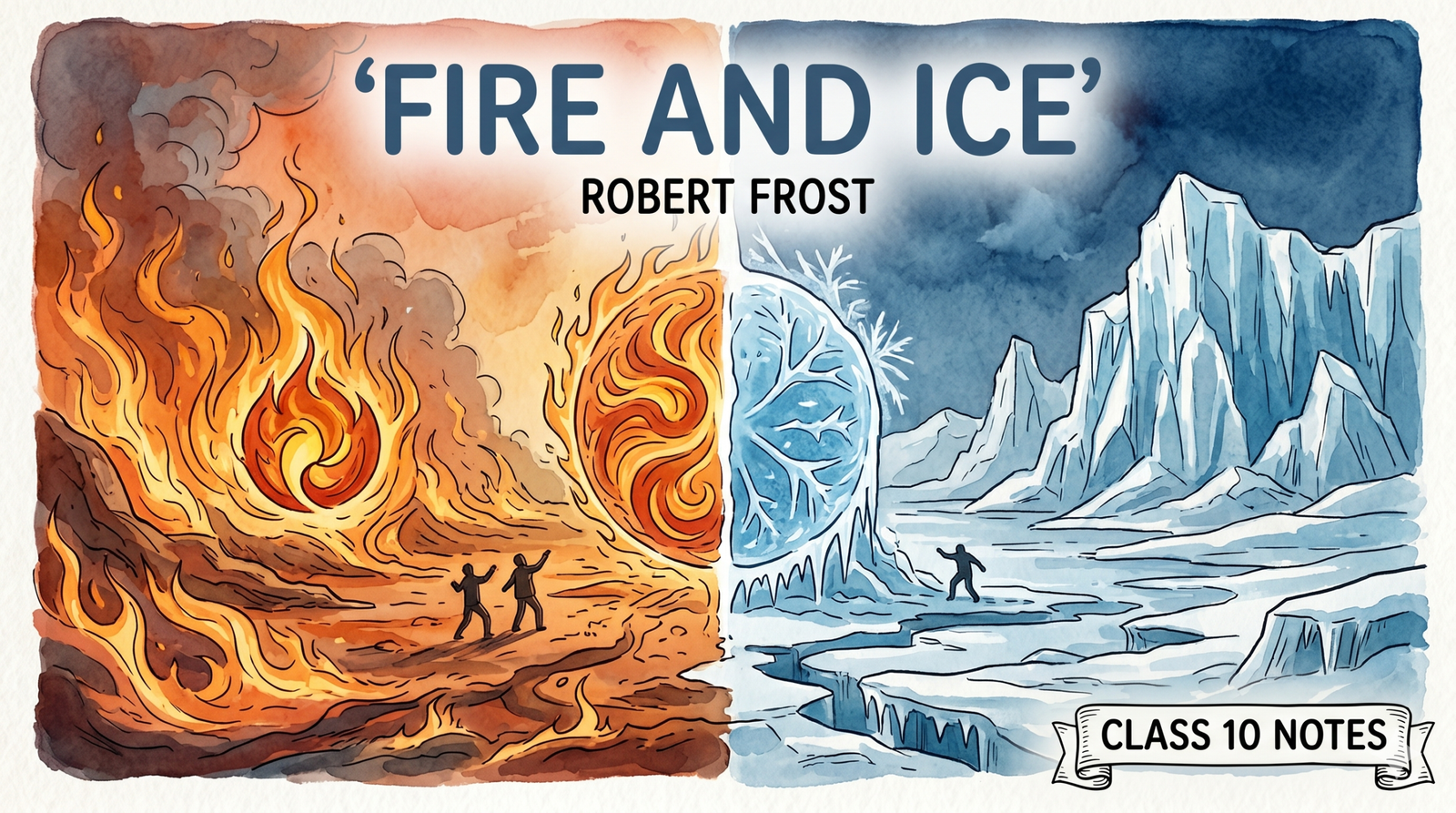
“Fire and Ice” is a highly symbolic poem by Robert Frost. In this nine-line poem, the poet discusses the two possible ways the world will come to an end: by fire or by ice. He uses these natural elements as powerful metaphors for human emotions. ‘Fire’ represents human desire, greed, and lust, while ‘Ice’ represents hatred, coldness, and intolerance. The poem gives a deep warning about how negative human emotions have the power to destroy the world.
2. The Poem
Some say the world will end in fire,
Some say in ice.
From what I’ve tasted of desire
I hold with those who favor fire.
But if it had to perish twice,
I think I know enough of hate
To say that for destruction ice
Is also great
And would suffice.
– Robert Frost
3. Word Meanings (Vocabulary)
- Desire: तीव्र इच्छा, वासना या लालच (Strong wish, greed, lust)
- Hold with: सहमत होना / समर्थन करना (To agree with or support)
- Favor: पक्ष लेना (To approve or prefer)
- Perish: नष्ट होना या मरना (To die or be destroyed)
- Suffice: पर्याप्त होना (To be sufficient/enough)
4. Key Elements & Symbols
- Fire: It is a symbol of human desires, greed, conflict, and lust. Just like fire spreads quickly and destroys everything in its path, endless human desires can ruin lives and eventually the world.
- Ice: It is a symbol of hatred, coldness, rigidity, and insensitivity. Unlike fire, ice destroys things slowly and silently. Hatred freezes human empathy and is equally capable of ending the world.
5. Full Summary
Two Views on the End of the World
The poem begins with the poet stating two different opinions about how the world will end. Some scientists and people believe that the earth will be destroyed by ‘fire’ (maybe the core will heat up or the sun will expand). Others believe it will freeze to death and end in ‘ice’. The poet uses these scientific theories to talk about human emotions.
The Destructive Power of ‘Fire’ (Desire)
Based on his own personal experiences, the poet relates ‘fire’ to human desires, greed, and passions. He has seen how uncontrolled desires can make people destructive. Because he knows the danger of human greed, he initially agrees with those who say that “fire” will be the reason for the world’s end. Fire represents the rapid, burning destruction caused by human conflict.
The Silent Killer: ‘Ice’ (Hatred)
In the second stanza, the poet presents an alternative. He says that if the world had to be destroyed twice (perish twice), ‘ice’ would be just as effective as fire. He compares ‘ice’ to hatred, coldness, and a lack of empathy among people. While fire brings quick destruction, hatred acts like ice—it makes relationships numb and destroys humanity slowly from the inside.
Conclusion
The poet concludes that both desire (fire) and hatred (ice) are equally powerful and destructive. Either of them is “great” and “sufficient” to bring a complete end to the world. Frost gives a warning that if we do not control our negative emotions, humanity will destroy itself.
6. Multiple Choice Questions (10 MCQs)
Q1. Who is the poet of the poem “Fire and Ice”?
(a) Leslie Norris | (b) Robert Frost | (c) Carolyn Wells | (d) Walt Whitman
Answer: (b) Robert Frost
Q2. What does ‘Fire’ symbolize in the poem?
(a) Love and peace | (b) Hatred and coldness | (c) Desire, greed, and lust | (d) Honesty
Answer: (c) Desire, greed, and lust
Q3. What does ‘Ice’ symbolize in the poem?
(a) Hatred and coldness | (b) Human desire | (c) Happiness | (d) Water
Answer: (a) Hatred and coldness
Q4. What is the rhyme scheme of the poem?
(a) aabb ccdd | (b) aba abc bcb | (c) abab cdcd | (d) abca bcab
Answer: (b) aba abc bcb
Q5. According to the poet, what is ‘enough’ to destroy the world for the second time?
(a) Fire | (b) Ice (Hatred) | (c) Nuclear weapons | (d) Asteroids
Answer: (b) Ice (Hatred)
Q6. What does the word ‘perish’ mean?
(a) To give birth | (b) To grow | (c) To die or be destroyed | (d) To shine
Answer: (c) To die or be destroyed
Q7. Who does the poet side with initially?
(a) Those who favor ice | (b) Those who favor fire | (c) Those who favor both | (d) None of them
Answer: (b) Those who favor fire
Q8. What does the poet ‘taste’ in the first stanza?
(a) Food | (b) Hatred | (c) Ice | (d) Desire
Answer: (d) Desire
Q9. Which word from the poem means ‘sufficient’?
(a) Perish | (b) Suffice | (c) Favor | (d) Taste
Answer: (b) Suffice
Q10. What is the core message of the poem?
(a) Save the environment | (b) Global warming is dangerous | (c) Negative human emotions can destroy the world | (d) Fire is better than ice
Answer: (c) Negative human emotions can destroy the world
7. Short Answer Questions (30-40 Words)
Q1. What are the two different views about the end of the world?
Ans. There is a debate about how the world will end. Some people believe that the world will end in fire (heat and passion), while others believe it will end in ice (freezing cold and hatred).
Q2. Why does the poet hold with those who favor fire?
Ans. The poet favors fire because he equates it with human desires. From his personal experience, he knows that unlimited human desires, greed, and lust are spreading fast like fire and have enough power to ruin the world.
Q3. How will the world end twice?
Ans. If the world survives the destruction caused by ‘fire’ (desire and greed), the poet believes that ‘ice’ (hatred, intolerance, and coldness) is equally powerful to destroy the world for a second time.
Q4. What is the meaning of ‘suffice’ in the poem?
Ans. ‘Suffice’ means to be enough or adequate. The poet uses it to say that the hatred present in the human heart is sufficient to bring complete destruction to humanity and the earth.
Q5. Briefly explain the symbols ‘Fire’ and ‘Ice’.
Ans. ‘Fire’ stands for violent desires, greed, cruelty, and lust. ‘Ice’ stands for coldness, hatred, insensitivity, and rigidity. Both are negative human emotions capable of destroying the world.
8. Long Answer Questions (60-70 Words)
Q1. Discuss how extreme behaviour can hasten the end of the world with respect to ‘Fire and Ice’.
Ans. The poem “Fire and Ice” is a strong warning against human extremes. ‘Fire’ represents the heat of human passions—unending desire, greed, and lust. When people blindly chase their desires, it leads to conflicts and wars. On the other hand, ‘Ice’ represents the freezing of human empathy—hatred, coldness, and intolerance. When humans stop caring for each other, society breaks down silently. Thus, extreme negativity in either form will certainly cause the destruction of the world.
Q2. Which age-old question does the poem revolve around? What is the poet’s conclusion?
Ans. The poem revolves around the age-old question of how the universe will come to an end: will it be consumed by intense heat (fire) or will it freeze to death (ice)? Robert Frost uses this scientific debate to explore human psychology. His conclusion is that we don’t need a natural disaster to end the world. The destructive emotions of humans—desire (fire) and hatred (ice)—are more than enough to wipe out humanity.
Q3. Compare and contrast ‘Fire’ and ‘Ice’ as depicted in the poem.
Ans. In the poem, ‘Fire’ and ‘Ice’ are contrasting elements, yet they share the same destructive capability. Fire is hot, aggressive, and spreads quickly; Frost equates it to human desire, greed, and passion, which cause sudden and massive conflicts. Ice is cold, rigid, and slow; it is equated to hatred, insensitivity, and indifference. While fire ruins things with a loud explosion of emotions, ice destroys silently by freezing love and empathy.
Q4. “I think I know enough of hate”. What does this statement tell us about the poet’s perspective on humanity?
Ans. This powerful line indicates that the poet is deeply observant of human nature. He doesn’t just see the loud destruction caused by greed (fire), but he has also witnessed the silent, deadly nature of hatred (ice) in society. He understands that people can be incredibly cold, indifferent, and cruel to one another. It shows his somewhat pessimistic but highly realistic view that human intolerance is strong enough to destroy the world.
Q5. What is the central idea of the poem “Fire and Ice”?
Ans. The central idea is that negative human emotions are the greatest threat to our existence. Frost masterfully uses the metaphor of fire to represent unbridled desires and ice to represent deeply rooted hatred. The poem serves as a philosophical warning that if humanity allows these two negative forces to grow unchecked, the world will eventually face its doom, either through violent conflict or through cold indifference.