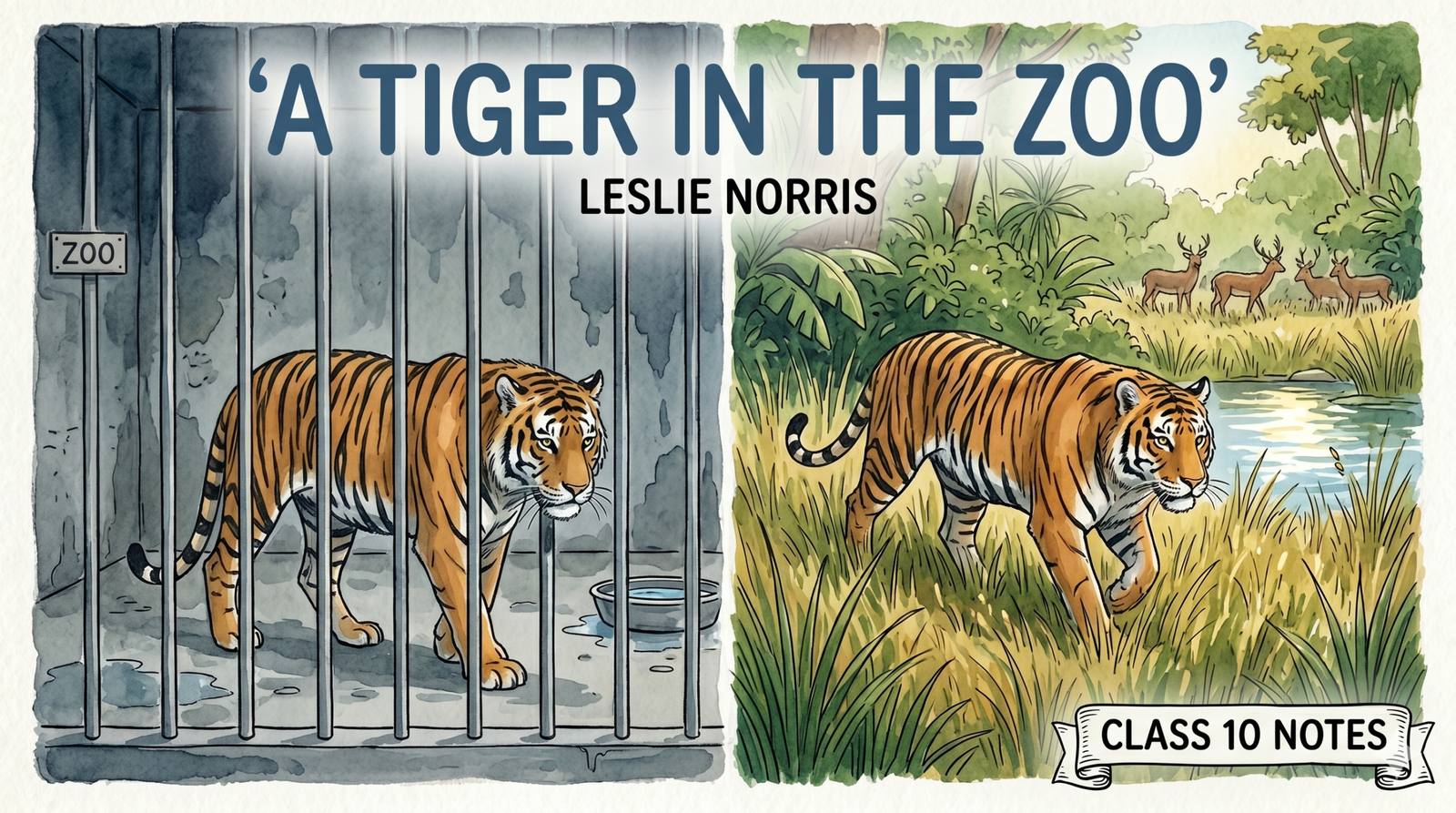
1. Poem Introduction
“A Tiger in the Zoo” is a brilliant poem by Leslie Norris that beautifully contrasts a tiger’s life in captivity (a zoo) with his life in his natural habitat (the jungle). The poem highlights the theme of freedom and shows the cruelty of keeping majestic, wild animals locked up in small concrete cells just for human entertainment. The poet makes the reader feel the helpless anger and silent agony of the caged tiger.
2. The Poem
He stalks in his vivid stripes
The few steps of his cage,
On pads of velvet quiet,
In his quiet rage.
He should be lurking in shadow,
Sliding through long grass
Near the water hole
Where plump deer pass.
He should be snarling around houses
At the jungle’s edge,
Baring his white fangs, his claws,
Terrorising the village!
But he’s locked in a concrete cell,
His strength behind bars,
Stalking the length of his cage,
Ignoring visitors.
He hears the last voice at night,
The patrolling cars,
And stares with his brilliant eyes
At the brilliant stars.
– Leslie Norris
3. Word Meanings (Vocabulary)
- Stalks: अकड़ कर चलना / पीछा करना (Walks with stiff, measured steps)
- Vivid: चमकीला / स्पष्ट (Bright-colored)
- Pads of velvet: मखमली गद्देदार पैर (Soft soles of the tiger’s feet)
- Rage: भारी गुस्सा / क्रोध (Violent, uncontrollable anger)
- Lurking: छिपकर घात लगाना (Waiting secretly to attack)
- Plump: मोटा-ताजा (Chubby / Fat)
- Snarling: गुर्राना (Growling with bared teeth)
- Fangs: लंबे तीखे दांत (Long, sharp teeth)
- Patrolling: गश्त लगाना / पहरा देना (Keeping watch over an area)
4. Key Elements & Contrasts
- The Tiger in the Zoo: He is powerless, frustrated, and confined to a small cage. His strength is locked behind bars. He is angry but stays quiet because he knows he can’t do anything. He ignores human visitors out of disgust.
- The Tiger in the Jungle: In his natural habitat, he is a fierce and majestic predator. He hunts freely near water bodies, slides through tall grass, and uses his roaring and sharp teeth to terrify the nearby villagers.
5. Full Summary
Life Inside the Cage
The poem begins with a description of a tiger locked in a small zoo cage. The tiger looks beautiful with his bright, vivid stripes. He walks up and down his cage on his soft, velvet-like footpads without making a sound. However, despite his quiet walk, he is full of intense anger (“quiet rage”). He is angry because his freedom has been taken away, but he remains silent as he is completely helpless inside the cage.
The Tiger’s Life in the Wild
In the second and third stanzas, the poet imagines how the tiger should be living if he were free in the forest. He should be hiding in the dark shadows and sliding silently through the long grass near a water hole, waiting to hunt a fat, plump deer. Furthermore, the poet says he should be at the edge of the jungle, growling (snarling) around human houses, showing his sharp white teeth (fangs) and his terrible claws to terrorize the villagers. This is the true, majestic nature of the wild beast.
The Reality of Captivity
Coming back to reality, the poet describes the tiger’s actual situation. Instead of being free in the jungle, the mighty animal is locked up in a strong concrete cell. His immense physical strength is useless behind the iron bars. Feeling defeated and depressed, he just walks the short length of his cage and completely ignores the visitors who come to look at him as a piece of entertainment.
The Silent Night
In the final stanza, the poet describes the tiger’s lonely nights. The tiger does not get peace even at night. He hears the sounds of the zoo guards’ patrolling cars. In his sad state, he stares at the bright, shining stars with his equally brilliant eyes. Looking at the stars is his only connection to the vast, free world outside, showing his unspoken longing for freedom.
6. Multiple Choice Questions (10 MCQs)
Q1. Who is the poet of “A Tiger in the Zoo”?
(a) Robert Frost | (b) Leslie Norris | (c) John Berryman | (d) Robin Klein
Answer: (b) Leslie Norris
Q2. Where should the tiger be lurking?
(a) Behind the bars | (b) In the shadow / long grass | (c) On the trees | (d) Inside a house
Answer: (b) In the shadow / long grass
Q3. What describes the tiger’s anger in the cage?
(a) Loud roar | (b) Snarling | (c) Quiet rage | (d) Weeping
Answer: (c) Quiet rage
Q4. What does the tiger stare at in the night?
(a) Visitors | (b) Patrolling cars | (c) The moon | (d) Brilliant stars
Answer: (d) Brilliant stars
Q5. Whom does the tiger ignore?
(a) Other animals | (b) Visitors | (c) The guards | (d) The poet
Answer: (b) Visitors
Q6. What does ‘velvet quiet’ refer to?
(a) The tiger’s beautiful skin | (b) The soft grass | (c) The tiger’s soft footpads | (d) The silent night
Answer: (c) The tiger’s soft footpads
Q7. What sound does the tiger hear at night?
(a) Wind blowing | (b) Birds chirping | (c) Patrolling cars | (d) People talking
Answer: (c) Patrolling cars
Q8. Where does the tiger wait for the plump deer?
(a) Near the village | (b) Near the water hole | (c) In the cage | (d) On a mountain
Answer: (b) Near the water hole
Q9. How does the tiger terrify the villagers?
(a) By baring his white fangs and claws | (b) By killing their cattle | (c) By hiding in the dark | (d) By attacking them
Answer: (a) By baring his white fangs and claws
Q10. What is locked behind the bars?
(a) The tiger’s family | (b) The tiger’s food | (c) The tiger’s strength | (d) The tiger’s toys
Answer: (c) The tiger’s strength
7. Short Answer Questions (30-40 Words)
Q1. Why is the tiger in a “quiet rage”?
Ans. The tiger is in a “quiet rage” because he is extremely angry at being locked up in a small cage and losing his freedom. However, he is quiet because he knows his anger is useless behind the strong iron bars.
Q2. How does the tiger behave in the cage?
Ans. Inside the cage, the tiger behaves in a helpless and frustrated manner. He silently paces back and forth across the short length of his cage. He ignores the visitors who come to watch him.
Q3. What should the tiger be doing if he were in the jungle?
Ans. If he were in the jungle, he should be freely hunting. He would be sliding through the long grass near a water hole, waiting to catch a plump deer for his meal.
Q4. How does the tiger frighten the villagers?
Ans. The free tiger frightens the villagers living at the edge of the jungle by moving around their houses, growling fiercely (snarling), and showing his scary sharp white teeth (fangs) and huge claws.
Q5. Why does the tiger stare at the brilliant stars?
Ans. Staring at the brilliant stars is the tiger’s way of escaping his caged reality. The stars belong to the open sky, reminding him of his lost freedom and natural habitat. It reflects his deep longing for liberty.
8. Long Answer Questions (60-70 Words)
Q1. Contrast the life of the tiger in the zoo with his life in the forest.
Ans. In the forest, the tiger is a free, majestic, and powerful king of the jungle. He hunts deer near water holes and terrifies villagers with his fierce roars and sharp fangs. In contrast, the tiger in the zoo is a helpless prisoner. He is locked in a small concrete cell where his immense strength is useless. He is reduced to pacing silently, ignoring visitors, and staring hopelessly at the stars.
Q2. Freedom is a universal right. How does the poem “A Tiger in the Zoo” highlight this theme?
Ans. The poem powerfully highlights the value of freedom by showing the misery of a captive animal. The mighty tiger, meant to roam freely and rule the jungle, is reduced to a depressed creature pacing a small concrete cell for human entertainment. His “quiet rage” and his hopeless staring at the stars clearly show that living in captivity goes against nature. It teaches us that freedom is precious for animals just as it is for humans.
Q3. Notice the use of the word ‘brilliant’ in the last stanza. Why has the poet used it twice?
Ans. The poet uses the word ‘brilliant’ twice to draw a contrast and create a deeper meaning. The “brilliant stars” represent the vast, beautiful, and free world of nature that is out of the tiger’s reach. The tiger’s “brilliant eyes” show his inner fire, his majestic true nature, and his burning hope for freedom. The brilliance of his eyes meeting the brilliance of the stars highlights his longing to be free under the open sky.
Q4. Do you agree that keeping wild animals in zoos is an act of cruelty? Give reasons based on the poem.
Ans. Yes, the poem strongly suggests that keeping wild animals in zoos is cruel. The tiger is stripped of his natural instincts like hunting and roaming freely in the grass. Instead, he is confined to a tiny concrete cell, becoming an object of mere exhibition. His “quiet rage” and the fact that he “ignores visitors” prove that he is unhappy and frustrated. It shows human selfishness in capturing wildlife for entertainment.