
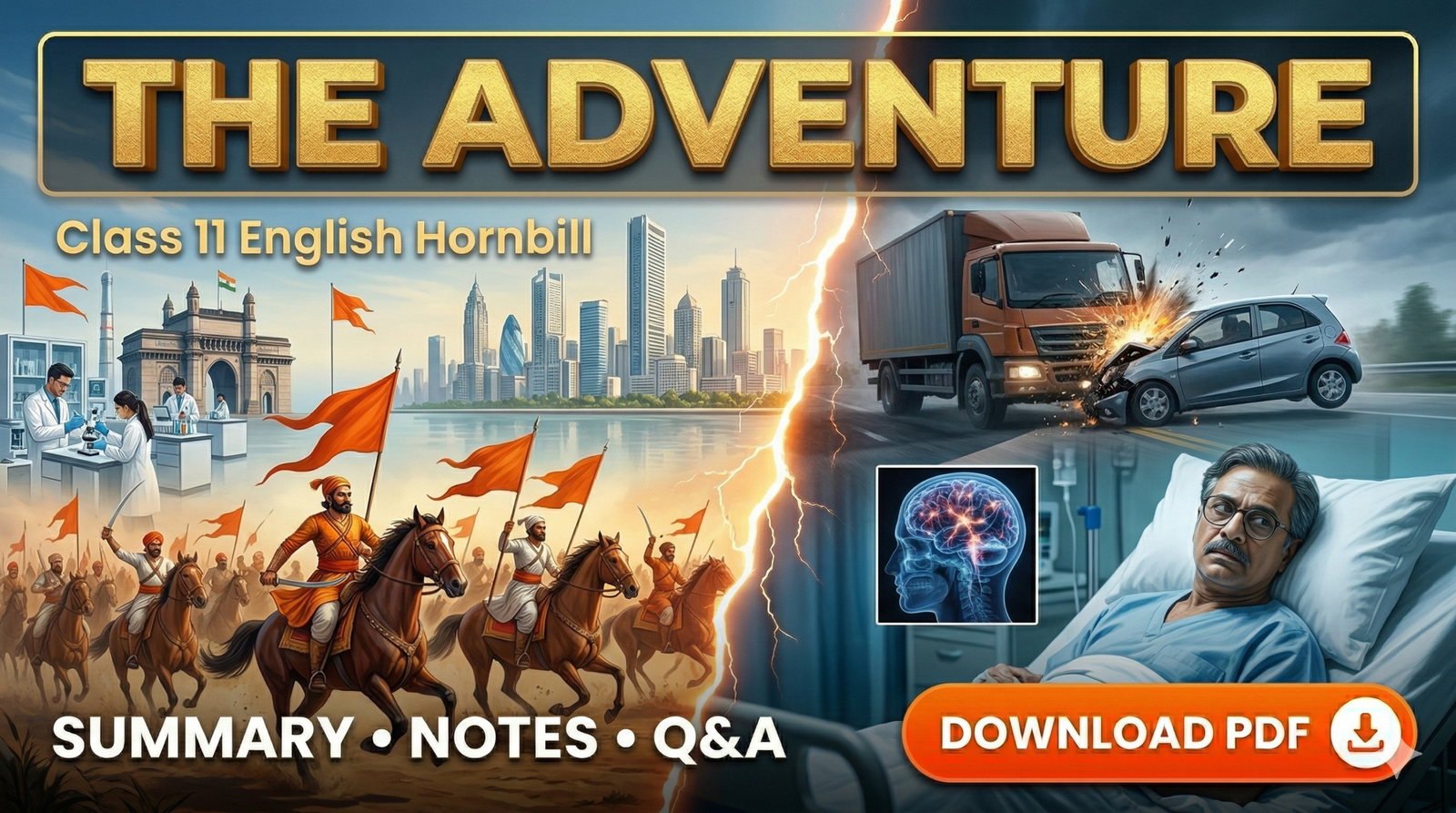
1. Chapter Introduction: The Adventure
“The Adventure” by Jayant Narlikar is a fascinating science-fiction story that blends history with advanced scientific concepts. The chapter explores the idea of parallel universes and alternate realities. In The Adventure, the protagonist experiences a world where history took a different turn during the Battle of Panipat, resulting in a completely different, uncolonized, and self-reliant India. The story beautifully connects the Catastrophe Theory and Quantum Mechanics to explain this mind-bending historical time travel.
2. Characters Detail in The Adventure
- Professor Gangadharpant Gaitonde: A prominent historian from Pune who has written five volumes on Indian history. After a collision with a truck, he slips into a coma and his consciousness travels to a parallel universe where history is completely different.
- Rajendra Deshpande: A physicist and a rational thinker. He is Professor Gaitonde’s friend who uses scientific theories (Catastrophe Theory and Quantum Mechanics) to explain Gaitonde’s bizarre experience in the alternate reality.
- Khan Sahib: A passenger Gaitonde meets on the Jijamata Express. He provides Gaitonde with a glimpse of how this alternate India functions, especially the British presence in Bombay.
3. Full Summary of The Adventure
The Journey to an Alternate Bombay
The story of The Adventure begins with Professor Gaitonde traveling on the Jijamata Express from Pune to Bombay. However, the world he is observing is slightly different. The train passes through regions that don’t match his historical knowledge. When he arrives in Bombay, he finds that the city is a British outpost, leased to the East India Company, which still exists in this timeline. The buildings, shops, and atmosphere are completely anglicized, which shocks the historian.
Discovering a New History
Determined to find out what happened, Gaitonde goes to the Town Hall library and reads his own written history books. He discovers that in this parallel universe, the turning point was the Third Battle of Panipat (1761). Instead of losing, the Marathas, led by Sadashivrao Bhau, won the battle. Because of this victory, India never fell under British rule. The country became a wealthy, democratic, and technologically advanced nation, only allowing the British to keep Bombay for commercial purposes.
The Incident at Azad Maidan
After reading the books, Gaitonde visits Azad Maidan, where a public lecture is going on. Accustomed to presiding over such meetings, he notices the president’s chair is empty. When he tries to occupy it and speak, the modern crowd, which hates the outdated concept of a “president,” throws tomatoes and eggs at him and physically physically throws him off the stage. At this exact moment of trauma, he wakes up in a hospital bed in his real world.
Rajendra’s Scientific Explanation
In the conclusion of The Adventure, Gaitonde narrates his two-day experience to his scientist friend, Rajendra Deshpande. He even produces a torn page from an alternate history book as proof. Rajendra explains this using two theories. First, the Catastrophe Theory: a small change in circumstances (a bullet missing the Maratha leader) completely altered the course of history. Second, Quantum Theory: Gaitonde’s consciousness made a “transition” into a parallel universe that existed simultaneously, triggered by the fact that he was thinking about the Battle of Panipat right when a truck hit him.
4. Multiple Choice Questions (10 MCQs)
Q1. Who is the author of “The Adventure”?
(a) Khushwant Singh | (b) Jayant Narlikar | (c) A.R. Williams | (d) Gordon Cook
Answer: (b) Jayant Narlikar
Q2. What is Professor Gangadharpant Gaitonde’s profession?
(a) Scientist | (b) Doctor | (c) Historian | (d) Physicist
Answer: (c) Historian
Q3. Which historical event is the main focus of “The Adventure”?
(a) The Revolt of 1857 | (b) Battle of Plassey | (c) Third Battle of Panipat | (d) Battle of Buxar
Answer: (c) Third Battle of Panipat
Q4. What was the outcome of the Battle of Panipat in the parallel universe?
(a) The Marathas lost | (b) The British won | (c) The Marathas won | (d) It ended in a peace treaty
Answer: (c) The Marathas won
Q5. Who explains Gaitonde’s bizarre experience scientifically?
(a) Khan Sahib | (b) Rajendra Deshpande | (c) Bhausaheb | (d) Vishwasrao
Answer: (b) Rajendra Deshpande
Q6. Where did Professor Gaitonde go in Bombay to check historical facts?
(a) Azad Maidan | (b) Victoria Terminus | (c) The Town Hall library | (d) The Gateway of India
Answer: (c) The Town Hall library
Q7. What solid evidence did Gaitonde bring back from his adventure?
(a) A British coin | (b) A torn page from the ‘Bhausahebanchi Bakhar’ | (c) A newspaper | (d) A ticket
Answer: (b) A torn page from the ‘Bhausahebanchi Bakhar’
Q8. What happened to Gaitonde at Azad Maidan?
(a) He was garlanded | (b) The crowd threw objects at him and pushed him off the stage | (c) He gave a successful speech | (d) He was arrested
Answer: (b) The crowd threw objects at him and pushed him off the stage
Q9. Which scientific theory does Rajendra use to explain history changing direction?
(a) Theory of Relativity | (b) Big Bang Theory | (c) Catastrophe Theory | (d) String Theory
Answer: (c) Catastrophe Theory
Q10. Why did Gaitonde’s mind make a transition to that specific parallel world?
(a) He was reading a sci-fi book | (b) He was dreaming | (c) He was thinking about the Battle of Panipat at the time of his accident | (d) He wanted to meet Khan Sahib
Answer: (c) He was thinking about the Battle of Panipat at the time of his accident
5. Short Answer Type Questions (35 Words)
Q1. Who is Professor Gaitonde, and what happens to him at the beginning of the story?
Ans. Professor Gaitonde is an eminent historian. While taking a walk in Pune, his mind is occupied with the Battle of Panipat. He is hit by a truck, slips into a coma, and his consciousness travels to a parallel universe.
Q2. What did Professor Gaitonde notice about Bombay in the alternate world?
Ans. He noticed that Bombay looked like a British town. The East India Company was still alive, the headquarters were anglicized, and the city was a British lease in an otherwise independent India.
Q3. How was the outcome of the Battle of Panipat different in “The Adventure”?
Ans. In the real world, the Marathas lost the battle. However, in Gaitonde’s alternate reality, the Marathas won the battle because a crucial bullet missed their leader, Vishwasrao, changing the entire course of Indian history.
Q4. What physical evidence convinced Rajendra Deshpande that Gaitonde wasn’t just dreaming?
Ans. Gaitonde showed Rajendra a torn page from the *Bhausahebanchi Bakhar* that he had kept in his pocket from the alternate world’s library. It recorded the Maratha victory, which proved his experience was real.
Q5. What humiliating experience did Gaitonde face at Azad Maidan?
Ans. At Azad Maidan, Gaitonde tried to sit in an empty presidential chair during a public lecture. The modern crowd, rejecting the old custom of presidents, threw tomatoes and eggs at him and pushed him off the stage.
6. Long Answer Type Questions (60-70 Words)
Q1. How does Rajendra Deshpande use the Catastrophe Theory to explain Professor Gaitonde’s experience in “The Adventure”?
Ans. Rajendra applies the Catastrophe Theory to the Third Battle of Panipat. In reality, the Maratha leader Vishwasrao was killed by a bullet, causing his army to lose morale and the battle. However, a small variation—the bullet missing him by an inch—would completely alter the outcome. This minor “catastrophe” shifted the battle’s result in the parallel universe, leading to a victorious Maratha empire and a completely different future for India.
Q2. Describe the alternate India that Professor Gaitonde visited in his parallel universe transition.
Ans. The alternate India Gaitonde visited had a completely different history. Since the Marathas won the Battle of Panipat, India never fell under British subjugation. It became a self-reliant, democratic, and prosperous nation. The East India Company was restricted only to Bombay for commercial purposes. The country confidently engaged with western nations from a position of strength, blending its rich traditional values with modern science and technology.
Q3. Explain the role of Quantum Theory in transitioning Gaitonde into a parallel world.
Ans. Rajendra uses the lack of determinism in Quantum Theory to explain Gaitonde’s transition. Just as an electron can exist in multiple states and make a sudden transition to another energy level, human consciousness can also transition between parallel realities that exist simultaneously. Since Gaitonde was deeply thinking about the Battle of Panipat right when the truck collided with him, his consciousness made a transition into that specific alternate history.
*Click the button above to download the PDF notes.