
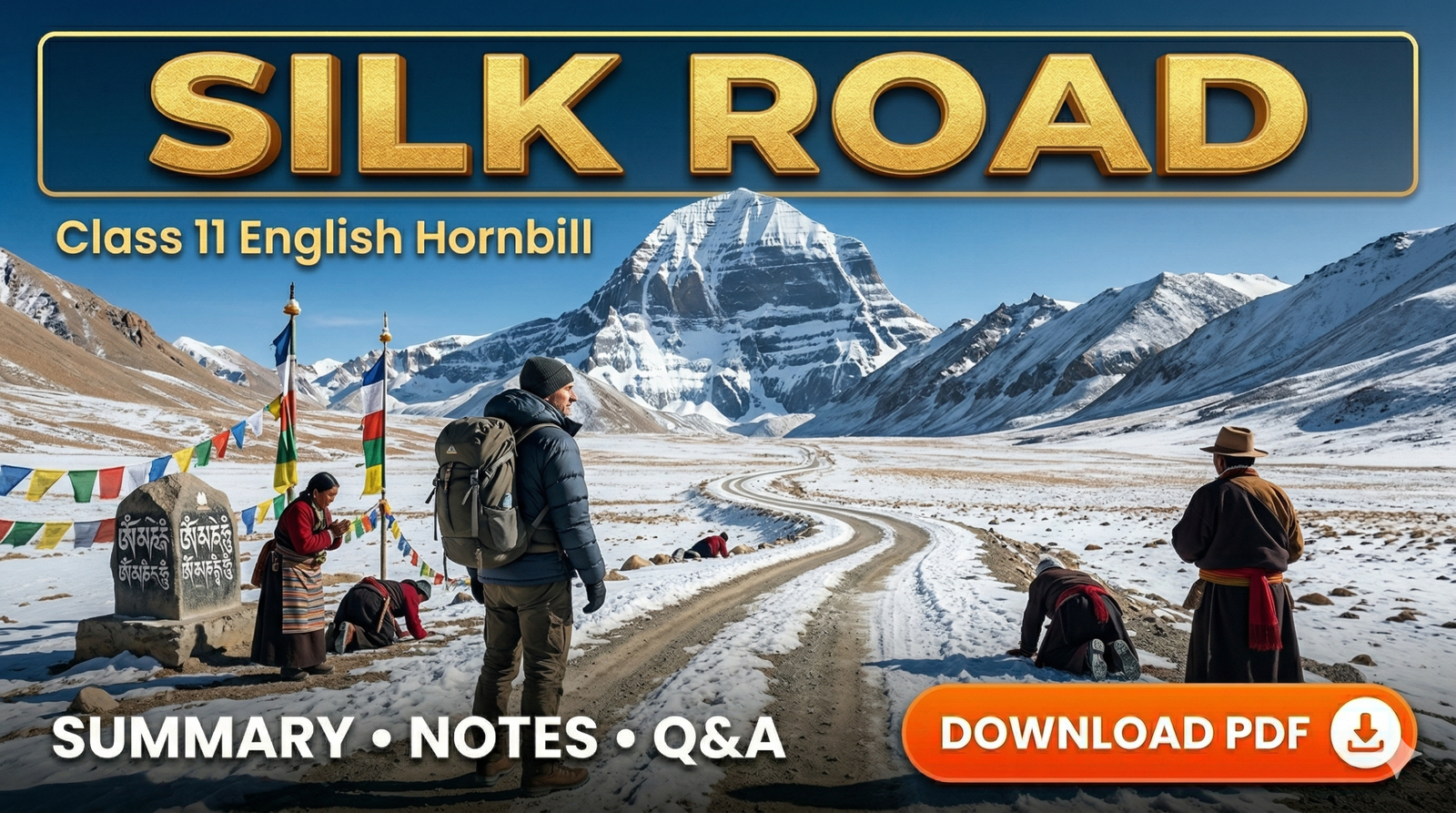
1. Chapter Introduction: Silk Road
“Silk Road” by Nick Middleton is a captivating travelogue that describes the author’s challenging journey to Mount Kailash to complete the sacred Kora. The chapter vividly captures the breathtaking landscapes, the physical hardships of high altitudes, and the unique culture of Tibet. By recounting his experiences on the ancient Silk Road, the author provides readers with a fascinating mix of adventure, endurance, and spiritual quest.
2. Characters Detail in Silk Road
- Nick Middleton (The Author): An adventurous traveler and writer determined to complete the Kora at Mount Kailash. He faces severe physical discomfort but remains resilient.
- Tsetan: The highly skilled local driver who navigates the treacherous, icy terrains. He is practical, knowledgeable, and genuinely cares for the author’s health.
- Daniel: The author’s companion and interpreter who accompanies him up to the town of Hor before returning to Lhasa.
- Norbu: A Tibetan academic working in Beijing. He meets the author in Darchen and, like the author, wishes to complete the Kora but lacks the physical stamina to do it alone.
- Lhamo: A local woman who gifts the author a traditional, long-sleeved sheepskin coat (drokba) as a farewell present to keep him warm.
3. Full Summary of Silk Road
The Departure and Lhamo’s Gift
The journey on the Silk Road begins at Ravu. Before leaving, a local woman named Lhamo gives the author a long-sleeved sheepskin coat because they are heading towards the freezing Mount Kailash. The author, accompanied by Daniel and driven by Tsetan, starts driving across the vast, open plains of Tibet. Along the way, they pass by dark tents of nomads guarded by huge, ferocious Tibetan mastiffs, which were once highly valued as guard dogs in China’s imperial courts.
Battling the Terrain and Reaching Hor
As they gain altitude, the journey becomes extremely difficult. The roads are blocked by snow and ice, forcing Tsetan to drive off-road carefully. The author experiences severe pressure in his head due to the high altitude. They eventually reach the small, dusty town of Hor, located on the shores of Lake Manasarovar. The author finds Hor gloomy and miserable, completely lacking the spiritual beauty he had expected from historical accounts. Here, Daniel leaves them to return to Lhasa.
Medical Emergency in Darchen
They continue their journey on the Silk Road and arrive at Darchen. The author’s health deteriorates sharply; his sinuses block up, he struggles to breathe, and he is unable to sleep out of fear of dying. Tsetan takes him to the Darchen Medical College, where a Tibetan doctor diagnoses him with a cold and altitude sickness. He gives the author some brown powders and pills, which successfully cure him. After ensuring the author is safe, Tsetan leaves him to return to Lhasa.
Meeting Norbu and the Kora
Left alone in Darchen, the author feels lonely as there are no pilgrims yet. Fortunately, he meets Norbu in a local café. Norbu is a Tibetan working at the Chinese Academy of Social Sciences in Beijing. He has also come to do the Kora but is out of shape and cannot walk easily. They strike up a friendship over their shared inability to do a traditional pilgrimage and decide to hire yaks to carry their luggage. This meeting brings relief and a positive end to the author’s struggles.
4. Multiple Choice Questions (10 MCQs)
Q1. Who is the author of the travelogue “Silk Road”?
(a) Khushwant Singh | (b) Nick Middleton | (c) Shirley Toulson | (d) Gordon Cook
Answer: (b) Nick Middleton
Q2. What did Lhamo give the author as a farewell gift?
(a) A Tibetan mastiff | (b) A long-sleeved sheepskin coat | (c) A map of Mount Kailash | (d) Herbal medicines
Answer: (b) A long-sleeved sheepskin coat
Q3. Who was the driver in the story?
(a) Daniel | (b) Norbu | (c) Tsetan | (d) Lhamo
Answer: (c) Tsetan
Q4. Which fierce animals guarded the nomads’ tents?
(a) Snow leopards | (b) Tibetan mastiffs | (c) Wild yaks | (d) Wolves
Answer: (b) Tibetan mastiffs
Q5. How did the author feel about the town of Hor?
(a) He found it spiritually uplifting | (b) He thought it was beautiful | (c) He found it grim, miserable, and dusty | (d) He wanted to settle there
Answer: (c) He found it grim, miserable, and dusty
Q6. Why did the author go to Darchen Medical College?
(a) To meet a friend | (b) Because he had a severe cold and couldn’t breathe or sleep | (c) To study Tibetan medicine | (d) Because Tsetan was sick
Answer: (b) Because he had a severe cold and couldn’t breathe or sleep
Q7. Who did the author meet in the café at Darchen?
(a) Daniel | (b) Tsetan | (c) Norbu | (d) A monk
Answer: (c) Norbu
Q8. What was Norbu’s profession?
(a) A local guide | (b) A doctor | (c) A driver | (d) An academic working in Beijing
Answer: (d) An academic working in Beijing
Q9. Why were the Tibetan mastiffs popular in China’s imperial courts?
(a) For their beauty | (b) As hunting dogs | (c) As hunting and guard dogs brought along the Silk Road | (d) As pets for children
Answer: (c) As hunting and guard dogs brought along the Silk Road
Q10. What was the ultimate destination of the author’s journey?
(a) Lhasa | (b) Mount Kailash to complete the Kora | (c) Lake Manasarovar | (d) Beijing
Answer: (b) Mount Kailash to complete the Kora
5. Short Answer Type Questions (35 Words)
Q1. Why did Lhamo give the author a sheepskin coat?
Ans. Lhamo knew that the author was heading towards Mount Kailash, where the weather would be freezing cold. Therefore, she gifted him a traditional, long-sleeved sheepskin coat to keep him warm.
Q2. Describe the Tibetan mastiffs seen on the Silk Road.
Ans. The Tibetan mastiffs were huge, black dogs that guarded the nomads’ tents. They were ferocious, fearless, and would chase vehicles at high speeds. Historically, they were brought to China as tribute.
Q3. Why was the author’s experience in Hor disappointing?
Ans. The author had read romanticized accounts of Lake Manasarovar. However, he found Hor to be a grim, miserable, dusty place with no vegetation and scattered rubbish, which deeply disappointed him.
Q4. What physical problems did the author face in Darchen?
Ans. In Darchen, the author suffered from a severe cold and altitude sickness. One of his nostrils got blocked, he struggled to breathe, and he couldn’t sleep because he felt his chest was heavy.
Q5. How did the Tibetan doctor cure the author?
Ans. The Tibetan doctor diagnosed his condition as an effect of cold and high altitude. He gave the author a five-day course of Tibetan medicine, consisting of brown powders and pills, which cured him.
6. Long Answer Type Questions (60-70 Words)
Q1. Describe the difficulties and obstacles the author faced during his journey on the Silk Road.
Ans. The author faced extreme physical and environmental challenges. The high altitude caused intense headaches and breathing issues. The terrain was treacherous, with sharp turns, bumpy tracks, and roads blocked by deep snow and ice. Tsetan had to carefully maneuver the car off-road to avoid slipping. Later, in Darchen, the author suffered a severe sinus blockage, leaving him gasping for air and sleepless out of fear of dying, requiring urgent medical attention.
Q2. Who was Norbu, and how did meeting him change the author’s mood?
Ans. Norbu was a Tibetan academic working in Beijing who had come to Darchen to complete the Kora. When the author arrived in Darchen, he was physically weak, lonely, and disappointed by the lack of pilgrims. Meeting Norbu in a café was a great relief. Since both spoke English and lacked the physical stamina to do the pilgrimage the traditional way, they decided to team up and hire yaks, filling the author with optimism.
Q3. Contrast the author’s expectations of Lake Manasarovar with the reality he witnessed in Hor.
Ans. The author had read ancient travelogues praising Lake Manasarovar for its supreme spiritual beauty and life-giving waters. He expected a divine and uplifting atmosphere. However, the reality in Hor was a stark contrast. He found it to be a grim, miserable, and depressing place. There was no vegetation, just dust, rocks, and heaps of accumulated rubbish. The stark reality of the town completely shattered his romanticized expectations of the holy lake.
*Click the button above to download the PDF notes.