
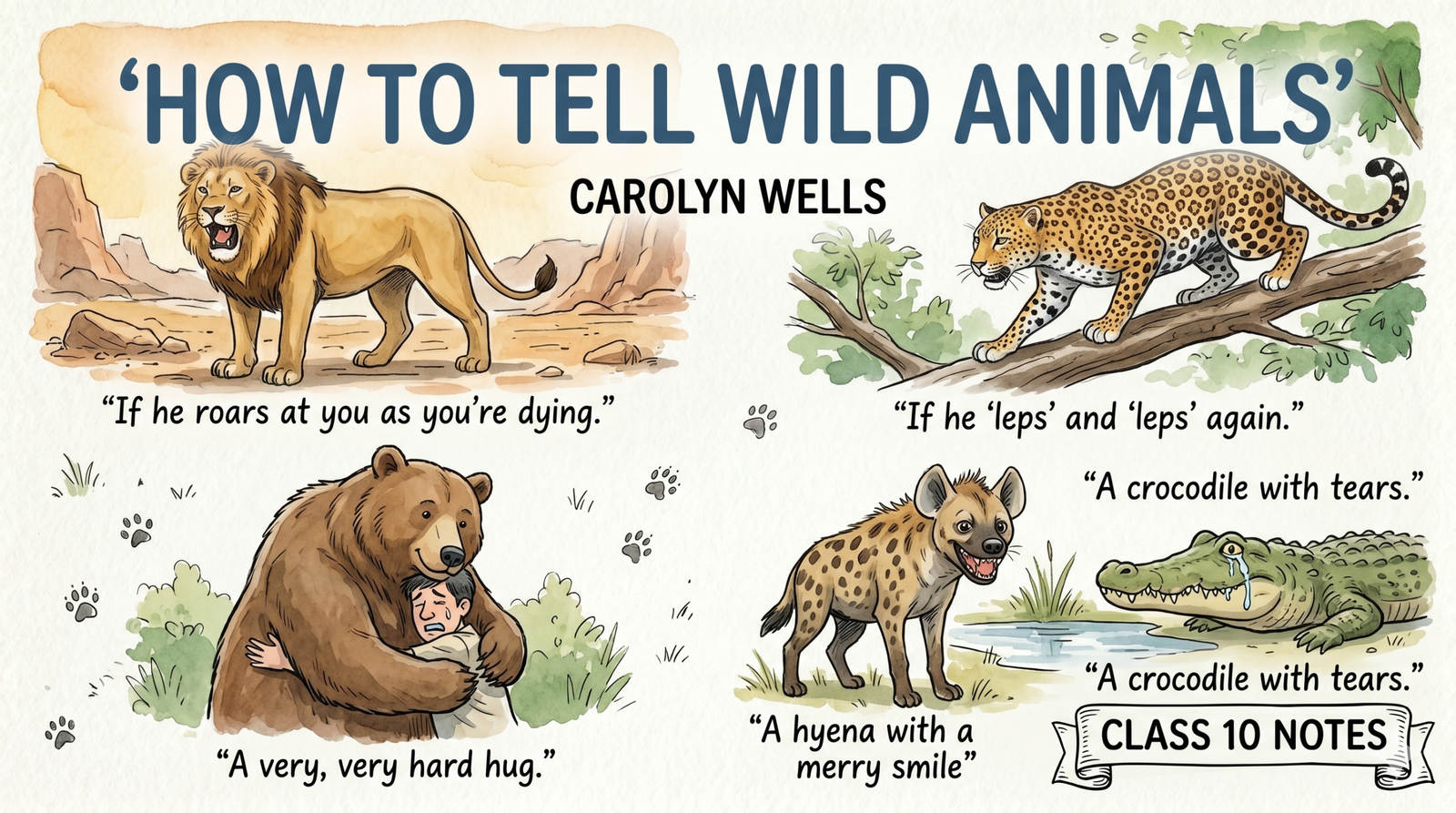
1. Poem Introduction
“How to Tell Wild Animals” is a highly humorous and entertaining poem written by Carolyn Wells. In this poem, the poet suggests some very dangerous, weird, and funny ways to identify (tell) various wild animals. Instead of giving scientific facts, she uses dark humor, telling the readers that they will know an animal’s identity only when it is about to kill or eat them. The poem plays with language and creates a comical contrast between deadly beasts and the light-hearted way they are described.
2. The Poem
If ever you should go by chance
To jungles in the east;
And if there should to you advance
A large and tawny beast,
If he roars at you as you’re dyin’
You’ll know it is the Asian Lion…
Or if some time when roaming round,
A noble wild beast greets you,
With black stripes on a yellow ground,
Just notice if he eats you.
This simple rule may help you learn
The Bengal Tiger to discern.
If strolling forth, a beast you view,
Whose hide with spots is peppered,
As soon as he has leapt on you,
You’ll know it is the Leopard.
’Twill do no good to roar with pain,
He’ll only lep and lep again.
If when you’re walking round your yard
You meet a creature there,
Who hugs you very, very hard,
Be sure it is a Bear.
If you have any doubts, I guess
He’ll give you just one more caress.
Though to distinguish beasts of prey
A novice might nonplus,
The Crocodile you always may
Tell from the Hyena thus:
Hyenas come with merry smiles;
But if they weep they’re Crocodiles.
The true Chameleon is small,
A lizard sort of thing;
He hasn’t any ears at all,
And not a single wing.
If there is nothing on the tree,
’Tis the chameleon you see.
– Carolyn Wells
3. Word Meanings (Vocabulary)
- Tell: पहचानना (To identify or distinguish)
- Tawny: पीला-भूरा रंग (Brownish-yellow color)
- Noble: शाही / शानदार (Royal or impressive)
- Discern: पहचानना / समझना (To recognize)
- Peppered: धब्बेदार (Covered with spots)
- Lep (Leap): उछलना (Jump)
- Caress: प्यार से छूना या गले लगाना (A gentle, loving touch)
- Novice: नौसिखिया (A beginner; someone new to a job)
- Nonplus: भ्रमित होना / चकरा जाना (To be confused or surprised)
4. Key Animals Identified in the Poem
- The Asian Lion: A large, brownish-yellow beast found in eastern jungles. Its roar is so terrifying that it can make you feel like you are dying.
- The Bengal Tiger: A “noble” beast with black stripes on a yellow background. The poet humorously says you’ll identify him only when he starts eating you.
- The Leopard: His skin is covered with dark spots. You will know it’s a leopard when it continuously jumps on you. Crying in pain won’t help.
- The Bear: It gives you a very tight, crushing hug. The poet ironically calls this deadly grip a loving “caress.”
- Hyena & Crocodile: Hyenas look like they are smiling while attacking, whereas Crocodiles shed fake tears before eating their prey.
- The Chameleon: A small lizard-like creature with no ears or wings. It can camouflage. If you look at a tree and see nothing, a chameleon is probably sitting there.
5. Full Summary
Identifying the Lion and the Tiger
The poet starts by giving humorous advice on how to identify wild animals. If you go to the jungles of the East and a huge, yellowish-brown animal comes towards you and roars so loudly that you almost die of fear, it is the Asian Lion. Similarly, if you are roaming and meet a “noble” royal beast with black stripes on a yellow body, and he starts eating you, then congratulations! You have successfully identified the Bengal Tiger.
Encountering the Leopard and the Bear
Next, the poet talks about the Leopard. If an animal whose skin is covered (peppered) with spots jumps on you suddenly, it’s a leopard. Crying in pain will be useless because it will keep jumping on you again and again. If you are walking in your yard and a creature comes and gives you an extremely tight and hard hug, it is a Bear. If you are still confused, the bear will give you another tight “caress” (hug) to kill you.
The Smiling Hyena and the Weeping Crocodile
The poet notes that a beginner (novice) might get confused while trying to identify beasts of prey. She gives a funny trick: If an animal comes towards you with a big, merry smile, it is a Hyena. But if the animal is shedding tears while attacking, it is a Crocodile. (This is based on the famous phrase “crocodile tears”).
The Invisible Chameleon
Finally, the poet describes the chameleon. It is a small creature that looks like a lizard. It does not have any ears or wings. The funniest part of identifying a chameleon is its ability to camouflage (blend in with its surroundings). The poet says that if you are looking at a tree and see absolutely “nothing” on it, it means you are looking at a chameleon.