1. Chapter Introduction
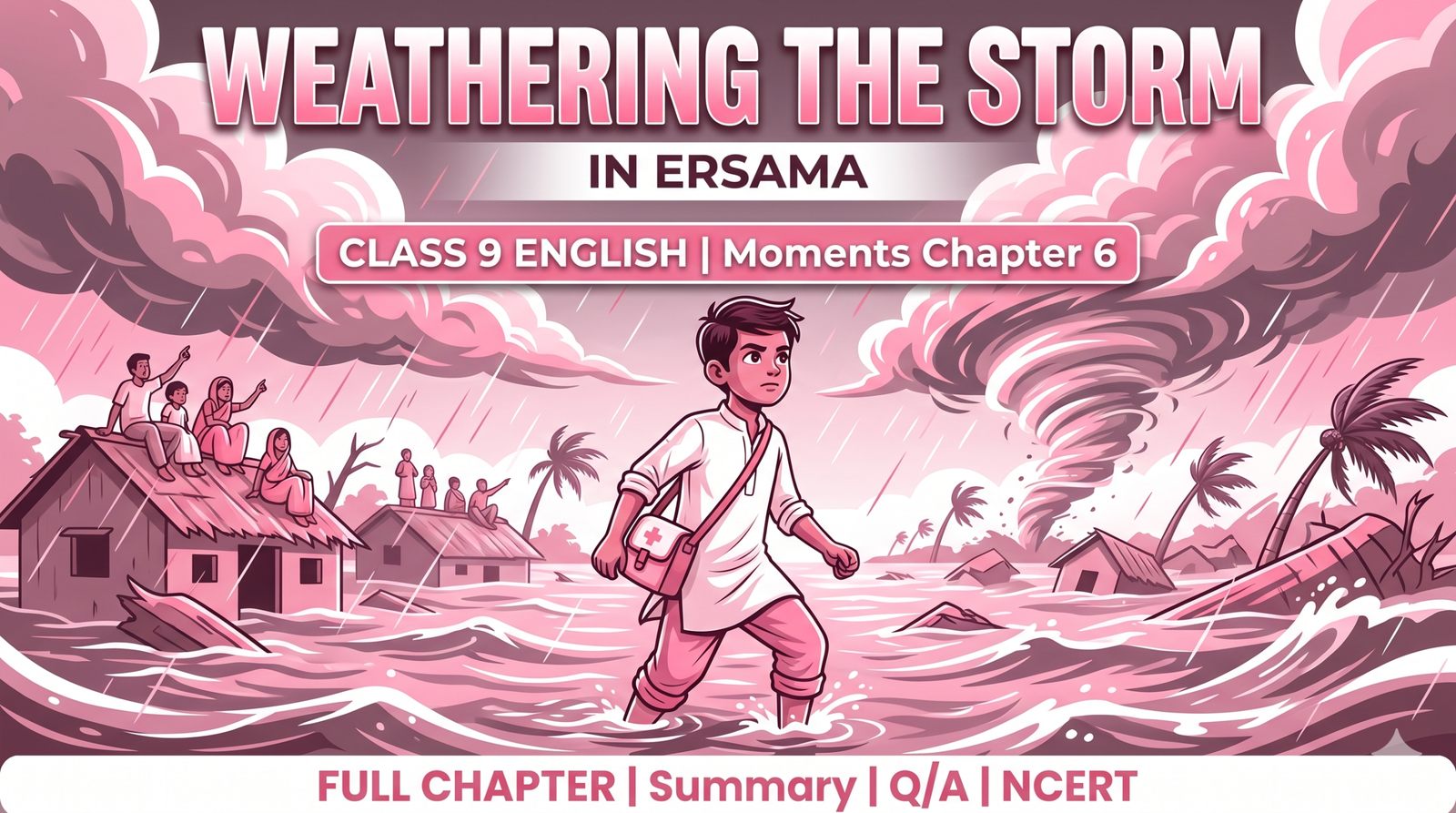
Hello students! Today we are studying Chapter 6 of the Moments book: “Weathering the Storm in Ersama” by Harsh Mander. This chapter is a gripping, real-life account of the devastating super cyclone that struck Orissa (now Odisha) in October 1999. It focuses on the remarkable courage, resilience, and leadership of a 19-year-old boy named Prashant. Instead of giving up in the face of unimaginable destruction, Prashant steps up to lead his village, helping them survive, rebuild, and overcome their grief. It’s a powerful lesson in community service and human spirit.
2. Characters Detail
- Prashant: A 19-year-old brave and compassionate boy from Kalikuda village. He becomes the un-elected leader of his village after the cyclone, organizing relief work and helping orphans and widows rebuild their lives.
- Prashant’s Family: They survived the storm by taking shelter in the Red Cross compound. Prashant’s grandmother was the first to recognize him when he returned.
- The Villagers: The victims of the super cyclone who lost their homes and loved ones but later united under Prashant’s leadership to survive the aftermath.
3. Full Summary: Weathering the Storm in Ersama Class 9
The Super Cyclone Strikes
On October 27, 1999, exactly seven years after his mother’s death, 19-year-old Prashant went to Ersama, a small town in coastal Orissa, to spend the day with a friend. In the evening, a dark and menacing storm quickly gathered. A super cyclone hit the area with heavy rains and violent winds uprooting trees and destroying houses. The waters flooded his friend’s house neck-deep.
Surviving on the Roof
To escape the rising water, Prashant and his friend’s family took refuge on the roof of the house. They remained completely frozen in the cold and continuous rain. They spent two terrifying nights on the roof. Fortunately, two coconut trees had fallen on the roof. The tender coconuts from these trees kept them alive and saved them from starving during those days.
The Treacherous Journey Home
After two days, the rain stopped and the water began to recede slightly. Prashant was desperately worried about his family in his village, Kalikuda, which was 18 kilometers away. Despite his friend’s family asking him to stay, Prashant took a stout stick and started his dangerous journey through the floodwaters. He had to wade through deep water, moving floating human corpses and animal carcasses away to make his path. He feared his family had not survived.
Reunion at the Red Cross Shelter
When Prashant finally reached his village, his heart sank; his house was washed away. He went to the Red Cross shelter to look for his family. Miraculously, the first person he saw was his maternal grandmother. Soon, he found his extended family—brother, sister, uncles, and aunts. They were overjoyed as they had given him up for dead.
Prashant Becomes a Leader
Prashant saw that the crowd at the shelter was grieving and starving. Realizing someone had to take charge, the 19-year-old organized a group of youths and elders. They pressured the local merchant to give them rice. For the first time in four days, the survivors had a full meal. Next, Prashant organized volunteers to clean the shelter of filth, urine, and vomit, and to tend to the wounds of the injured.
Rebuilding Lives: Helping Orphans and Widows
To get the attention of military helicopters dropping food, Prashant made children lie on the ground with empty utensils on their stomachs. The trick worked, and food drops became regular. He then focused on the long-term recovery. Instead of sending orphans to institutions, he resettled them in their own community by creating new foster families made up of childless widows and orphaned children. Because of his selfless efforts, Prashant became the ultimate symbol of hope and healing for the widows and children of his village.
4. Multiple Choice Questions (10 MCQs)
Q1. Who is the author of the story “Weathering the Storm in Ersama”?
(a) Harsh Mander | (b) Ruskin Bond | (c) R.K. Laxman | (d) Oscar Wilde
Answer: (a) Harsh Mander
Q2. In which state did the super cyclone hit?
(a) West Bengal | (b) Orissa (Odisha) | (c) Andhra Pradesh | (d) Tamil Nadu
Answer: (b) Orissa (Odisha)
Q3. How old was Prashant?
(a) 17 years | (b) 18 years | (c) 19 years | (d) 20 years
Answer: (c) 19 years
Q4. How did Prashant and his friend’s family survive on the roof for two days?
(a) By eating biscuits | (b) By drinking rainwater | (c) By eating tender coconuts | (d) By eating fish
Answer: (c) By eating tender coconuts
Q5. What was the distance between Ersama and Prashant’s village, Kalikuda?
(a) 10 km | (b) 15 km | (c) 18 km | (d) 20 km
Answer: (c) 18 km
Q6. What did Prashant use to find the road hidden under the water?
(a) A compass | (b) A long, stout stick | (c) A rope | (d) A boat
Answer: (b) A long, stout stick
Q7. Where did Prashant find his family?
(a) At the village temple | (b) At the Red Cross shelter | (c) On a tree | (d) At the merchant’s house
Answer: (b) At the Red Cross shelter
Q8. How did the youth task force get the attention of the military helicopters?
(a) By waving flags | (b) By lighting a fire | (c) By making children lie with empty utensils on their stomachs | (d) By shouting loudly
Answer: (c) By making children lie with empty utensils on their stomachs
Q9. Who were mobilized to work in the food-for-work programme run by an NGO?
(a) The men | (b) The youth | (c) The widows (women) | (d) The orphans
Answer: (c) The widows (women)
Q10. Why did Prashant reject the idea of setting up separate institutions for orphans and widows?
(a) It was too expensive | (b) The government opposed it | (c) Children would grow up without love and widows would suffer from stigma | (d) There was no space
Answer: (c) Children would grow up without love and widows would suffer from stigma
5. Short Answer Questions (30-40 Words)
Q1. What havoc has the super cyclone wreaked in the life of the people of Orissa?
Ans. The super cyclone caused massive destruction. It uprooted ancient trees, washed away houses, and flooded the area. Thousands of people lost their lives, and animal carcasses and human corpses floated everywhere. Many became homeless orphans and widows.
Q2. How did Prashant and his friend’s family survive the two days of the cyclone?
Ans. To escape the rising water, they took shelter on the roof of the house. Fortunately, two coconut trees had fallen on the roof. They survived by eating the tender coconuts from those trees for two days.
Q3. Describe Prashant’s journey back to his village.
Ans. Prashant undertook a dangerous 18 km journey through deep floodwaters. He used a long, stout stick to locate the road. Along the way, he had to push away floating human corpses and animal carcasses, making the journey deeply traumatizing.
Q4. What were the first two things Prashant did after reaching the Red Cross shelter?
Ans. First, Prashant formed a group of youths and elders to pressure the local merchant to give them rice, ensuring everyone had food. Second, he organized volunteers to clean the shelter of filth and tend to the wounds of the injured.
Q5. How did the people get the military helicopters to drop food?
Ans. The helicopters dropped some food and didn’t return. Prashant deputed the children to lie in the sand with empty utensils on their stomachs. This signaled the helicopters that they were starving, prompting them to drop food regularly.
6. Long Answer Questions (60-80 Words)
Q1. How did Prashant act as a true leader in the face of disaster?
Ans. Prashant emerged as an extraordinary leader at the age of just 19. Instead of sitting and crying over the destruction, he took charge. He organized the youth to arrange food from the merchant and clean the shelter. He made clever plans to attract military helicopters for food drops. Furthermore, he didn’t stop at immediate relief; he planned for the long-term rehabilitation of his community by engaging women in work and creating foster families for orphans. His selflessness gave hope to thousands.
Q2. How were the orphans and widows rehabilitated in Kalikuda?
Ans. Initially, the government planned to set up separate institutions for orphans and widows. Prashant and his group strongly resisted this. They believed that in institutions, children would grow up without love, and widows would suffer from stigma and loneliness. Instead, Prashant helped create foster families within their own community. Childless widows were paired with orphaned children, ensuring that everyone received the love, care, and family environment they desperately needed to heal from the trauma.
Q3. “A true leader is born out of adversity.” Discuss this statement with reference to Prashant.
Ans. This statement perfectly fits Prashant. Before the cyclone, he was just a normal 19-year-old boy. However, the catastrophic disaster awakened his inner strength and leadership qualities. When he saw the victims paralyzed by grief at the Red Cross shelter, he forgot his own trauma and took responsibility. He managed food, sanitation, and emotional rehabilitation. The adversity of the super cyclone transformed him into a savior, proving that true leaders rise during the toughest crises to guide others.