
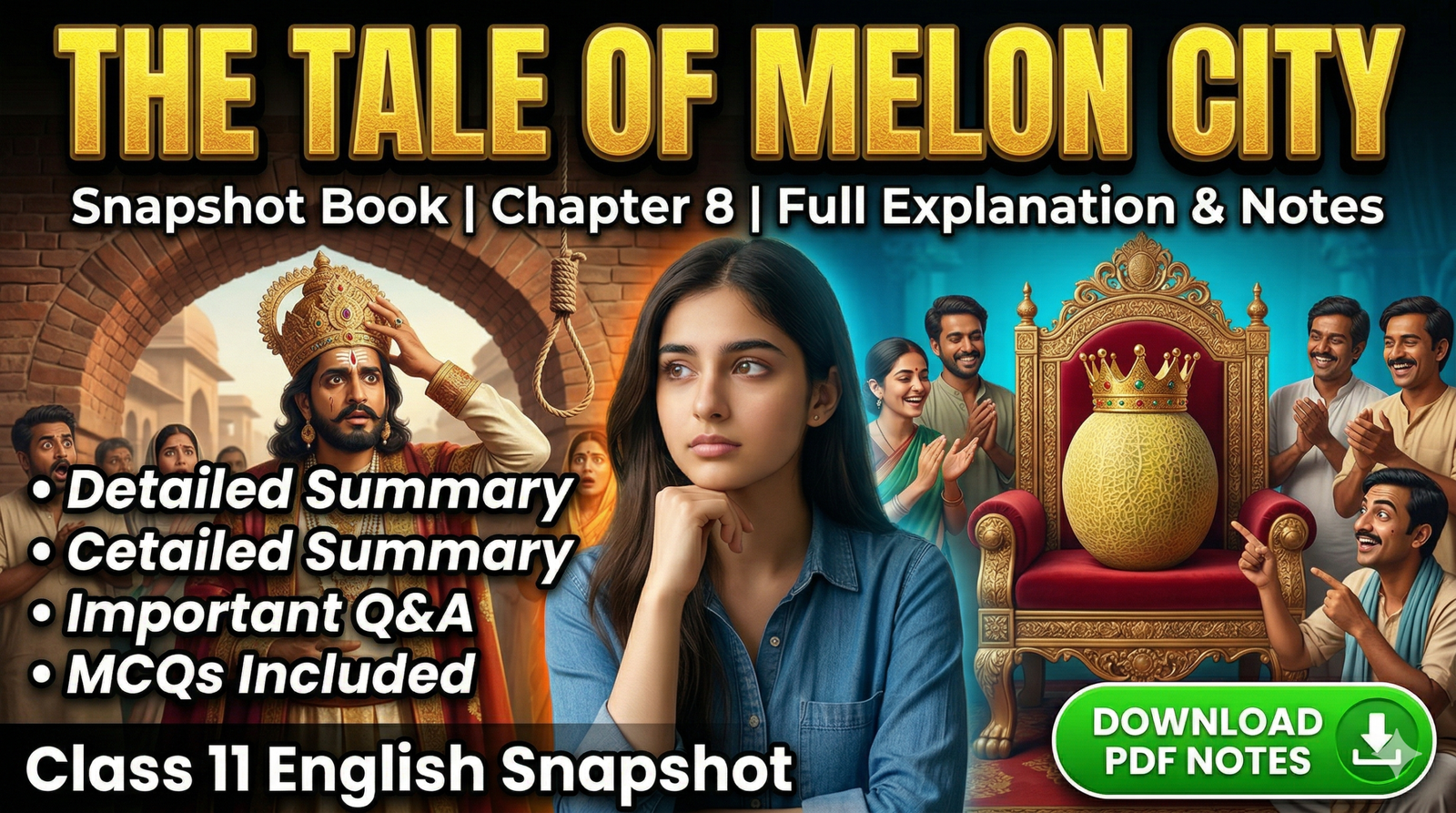
1. Chapter Introduction: The Tale of Melon City
“The Tale of Melon City” by Vikram Seth is a brilliant narrative poem that serves as a sharp satire on foolish rulers and blind administrative systems. The chapter humorously narrates how a seemingly “just and placid” king ends up ordering his own execution due to his inability to make rational decisions. The story of The Tale of Melon City beautifully highlights how the public is often indifferent to who rules them, as long as they are left in peace, even if their king is a literal melon.
2. Characters Detail in The Tale of Melon City
- The King: Described ironically as “just and placid” (calm and fair). In reality, he is foolish, easily swayed by others, and lacks the basic logic required to rule. His foolishness ultimately leads to his own death.
- The Architect: A clever man who manages to pass the blame back onto the King, proving the King’s own order was faulty.
- The Wisest Man: The oldest man in the city who is carried to the court. He gives a bizarre suggestion to hang the arch itself, showing the absurdity of the kingdom’s wisdom.
- The Idiot: A fool who wanders the streets. When asked who the next king should be, he simply says “A melon” because it is his standard answer to every question.
3. Full Summary of The Tale of Melon City
The Arch and The Blame Game
The events of The Tale of Melon City begin when the “just and placid” King orders an arch to be built over the main street to inspire viewers. However, when the King rides under the newly built arch, his crown gets knocked off because the arch is built too low. Angered by this “disgrace,” the King orders the Chief of Builders to be hanged. The Chief pleads for mercy, blaming the workmen. The King then orders the workmen to be hanged. The workmen blame the masons, who in turn blame the architect. The clever architect turns the tables by reminding the King that the King himself had made amendments to the original plans.
The Advice of the Wisest Man
Confused and trapped by his own amendments, the King asks for the wisest man in the country to solve the issue. They bring an extremely old man who can barely see or walk. The old man declares that the true culprit is the arch itself, as it knocked off the crown, so the arch must be hanged. However, a councillor argues that they cannot hang something that touched the royal head. The King agrees, but the crowd becomes restless and demands a hanging.
The Royal Execution and The New King
To calm the angry mob, the King orders a noose to be set up somewhat high. Whoever fits the noose perfectly will be hanged. Ironically, the only man tall enough to fit the noose is the King himself. Thus, the King is hanged by his own royal decree. Following a strange old custom, the ministers declare that the first person to pass the city gates will choose the next king. An idiot passes by, and when asked, he replies “A melon,” as he loves melons. The ministers respectfully place a melon on the throne, ending The Tale of Melon City on a highly satirical note where the public is happy because their “Melon King” doesn’t interfere in their lives.
4. Multiple Choice Questions (10 MCQs)
Q1. Who is the poet of “The Tale of Melon City”?
(a) William Wordsworth | (b) Vikram Seth | (c) Khushwant Singh | (d) Shirley Toulson
Answer: (b) Vikram Seth
Q2. How is the King described at the beginning of the poem?
(a) Cruel and angry | (b) Just and placid | (c) Brave and heroic | (d) Weak and poor
Answer: (b) Just and placid
Q3. What did the King order to be constructed?
(a) A palace | (b) A bridge | (c) An arch | (d) A temple
Answer: (c) An arch
Q4. Why did the King lose his crown?
(a) A thief stole it | (b) It fell while he was fighting | (c) It struck against the low-built arch | (d) He gave it away
Answer: (c) It struck against the low-built arch
Q5. Whom did the Chief of Builders blame?
(a) The King | (b) The workmen | (c) The masons | (d) The architect
Answer: (b) The workmen
Q6. How did the architect save himself?
(a) By running away | (b) By blaming the King for amending the plans | (c) By paying a fine | (d) By blaming the workmen
Answer: (b) By blaming the King for amending the plans
Q7. What was the advice of the “wisest man”?
(a) To hang the architect | (b) To hang the King | (c) To hang the arch itself | (d) To forgive everyone
Answer: (c) To hang the arch itself
Q8. Who was eventually hanged in the story?
(a) The Chief Builder | (b) The Architect | (c) The Wisest Man | (d) The King
Answer: (d) The King
Q9. Who decided the next King of the city?
(a) The ministers | (b) An idiot passing the city gate | (c) The Queen | (d) The army
Answer: (b) An idiot passing the city gate
Q10. Why did the people of the city not care that their king was a melon?
(a) Because they liked fruits | (b) Because the melon was wise | (c) Because they enjoyed peace, liberty, and no interference | (d) Because they were afraid of the ministers
Answer: (c) Because they enjoyed peace, liberty, and no interference
5. Short Answer Type Questions (35 Words)
Q1. Why did the King order an arch to be built?
Ans. The “just and placid” King ordered a grand arch to be constructed spanning the main thoroughfare. He believed it would visually inspire the spectators and improve the moral atmosphere of his city.
Q2. How did the blame shift from the Chief of Builders to the King himself?
Ans. The Chief Builder blamed the workmen, the workmen blamed the masons, and the masons blamed the architect. Finally, the architect pointed out that the King himself had made faulty amendments to the original plans, shifting the blame entirely to the King.
Q3. Why was the “wisest man” called, and what was his verdict?
Ans. The King was trapped by his own amendments and needed guidance, so he called the oldest and “wisest” man. The old man bizarrely declared that the arch was the real culprit for knocking off the crown and should be hanged.
Q4. How did the King end up being hanged?
Ans. To calm the angry and rebellious mob, the King ordered that whoever fit the high-set noose perfectly would be hanged. Ironically, only the King was tall enough to fit the noose, leading to his own execution.
Q5. How was the new King chosen?
Ans. According to an old custom, the first person to pass the city gates would choose the new king. An idiot passed by, and when asked, he replied “A melon.” Thus, a melon was crowned as the new king.
6. Long Answer Type Questions (60-70 Words)
Q1. Describe the satirical nature of “The Tale of Melon City”.
Ans. The poem is a sharp satire on foolish administration and blind justice. The King is ironically called “just and placid” but is actually a foolish puppet who executes himself to please an angry mob. The “wisest man” gives the absurd advice of hanging a lifeless arch. Finally, the ultimate satire is the crowning of a melon. The public is entirely indifferent to who sits on the throne, as long as they get to live in peace without royal interference.
Q2. How did the architect turn the tables on the King?
Ans. When the King ordered the architect to be hanged for the faulty low arch, the clever architect did not panic. Instead, he respectfully reminded the King that the original plans he had drafted were changed. It was the King himself who had made amendments to the plans. This brilliant argument completely trapped the foolish King in his own trap, transferring the guilt from the architect to the ruler himself.
Q3. Justify the title of the poem “The Tale of Melon City”.
Ans. The title is highly appropriate because the entire story builds up to the climax where a melon becomes the king of the city. Due to the foolishness of the previous King, he gets himself hanged. Following a senseless custom, an idiot chooses a melon as the successor. The city becomes known as “Melon City” because the people happily accept a non-interfering fruit as their ruler, symbolizing that for the common man, the nature of the ruler matters little if they have liberty.