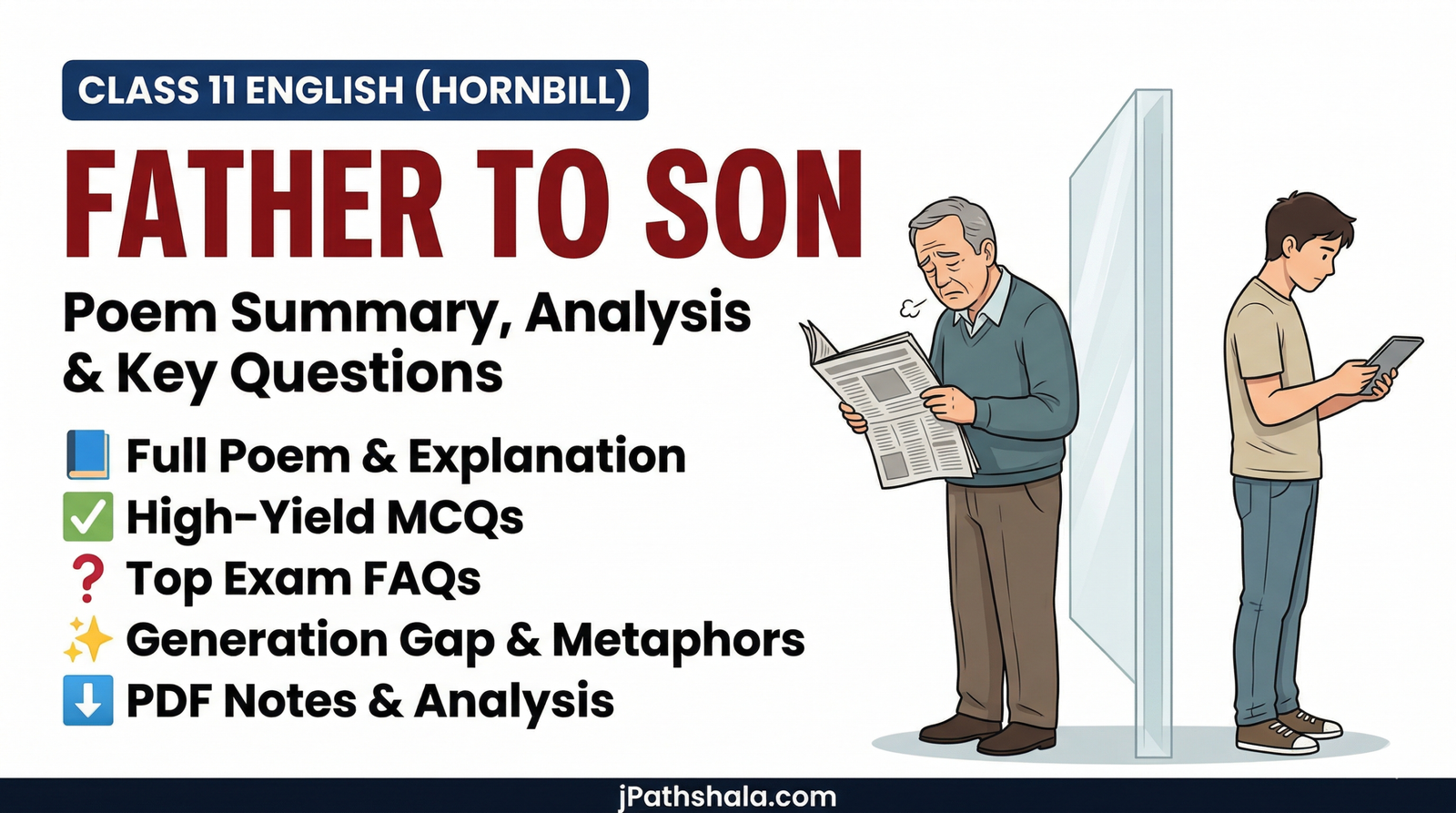
1. Poem Introduction
“Father to Son” by Elizabeth Jennings is a highly emotional and introspective poem that deals with the universal theme of the generation gap. It highlights the deeply strained relationship between a father and his grown-up son. Despite living in the same house for years, they act like strangers and share no understanding. The poem expresses the father’s agony, his longing to bridge the communication gap, and his desperate wish to forgive his son and rebuild their relationship.
2. The Poem
I do not understand this child
Though we have lived together now
In the same house for years. I know
Nothing of him, so try to build
Up a relationship from how
He was when small. Yet have I killed
The seed I spent or sown it where
The land is his and none of mine?
We speak like strangers, there’s no sign
Of understanding in the air.
This child is built to my design
Yet what he loves I cannot share.
Silence surrounds us. I would have
Him prodigal, returning to
His father’s house, the home he knew,
Rather than see him make and move
His world. I would forgive him too,
Shaping from sorrow a new love.
Father and son, we both must live
On the same globe and the same land,
He speaks: I cannot understand
Myself, why anger grows from grief.
We each put out an empty hand,
Longing for something to forgive.
– Elizabeth Jennings
3. Word Meanings (Vocabulary)
- Sown: बोया (Planted the seed/instilled values).
- Prodigal: भटका हुआ / खर्चीला बेटा (A biblical reference to a son who leaves home, wastes his money, but is welcomed back and forgiven by his father).
- Design: रूप-रेखा (Physical appearance or structure).
- Grief: गहरा दुःख (Intense sorrow).
- Globe: दुनिया (Here, it refers to sharing the same house or mental space).
- Empty hand: खाली हाथ (A gesture showing readiness to compromise, but lacking the words or means to do so).
4. Key Elements & Concepts
- The Generation Gap: The primary theme of the poem. It shows how the passage of time creates an emotional distance between two generations.
- Lack of Communication: Despite living under the same roof, the father and son speak “like strangers.” Silence surrounds them, destroying their bond.
- The Biblical Allusion: The poet uses the reference of the “Prodigal Son” from the Bible. The father is ready to accept his wandering son back into his house, forgiving all his faults.
- Mutual Helplessness: It is not just the father who is hurting. The final stanza reveals that the son is also frustrated, and both are extending an “empty hand” to patch things up, but neither knows how.
5. Full Summary
The Father’s Helplessness
The poem begins with a father expressing his deep anguish over his estranged relationship with his son. He admits that he does not understand his own child, even though they have lived in the same house for many years. He feels that he knows absolutely nothing about his son’s likes, dislikes, or inner thoughts. Out of desperation, the father wishes to rebuild their relationship by recalling the time when his son was a small, innocent child, hoping to start afresh from those memories.
Alienation and Distant Worlds
In the second stanza, the father wonders where things went wrong. He uses a metaphor of planting a “seed” (bringing up the child). He wonders if he sowed the seed on land that did not belong to him, meaning his son has grown up to have a completely different mindset. Although the son physically looks like the father (built to his design), their interests are completely different. The father complains that they speak like complete strangers and there is no understanding between them.
Desire for the ‘Prodigal’ Return
An uncomfortable silence surrounds the father and the son. The father expresses a strong desire to see his son return to his roots. Using the biblical reference of the ‘Prodigal Son’, the father says he would rather have his son return to his old home, even if he has wasted his life, than see him move away and build a separate world. The father is ready to forgive his son’s mistakes and create a new bond of love born out of their current sorrow.
The Unspoken Longing for Reconciliation
In the final stanza, the father acknowledges that both of them must live on the same earth and share the same space. However, their internal frustration is high. The son’s grief transforms into anger because he too cannot understand himself or the situation. In the end, both the father and the son put out an “empty hand” towards each other. This symbolizes that both desperately want to forgive each other and reconcile, but neither knows how to bridge the gap.
6. Multiple Choice Questions (10 MCQs)
Q1. Who is the poet of the poem “Father to Son”?
(a) Shirley Toulson | (b) Walt Whitman | (c) Elizabeth Jennings | (d) Markus Natten
Answer: (c) Elizabeth Jennings
Q2. What is the central theme of the poem?
(a) Childhood memories | (b) Generation gap and lack of communication | (c) Nature’s beauty | (d) War and peace
Answer: (b) Generation gap and lack of communication
Q3. How long have the father and son lived in the same house?
(a) A few months | (b) For years | (c) Since yesterday | (d) They do not live together
Answer: (b) For years
Q4. How do the father and son speak to each other?
(a) Like friends | (b) Like strangers | (c) Like brothers | (d) Like enemies
Answer: (b) Like strangers
Q5. “This child is built to my design.” What does ‘design’ mean here?
(a) Physical appearance | (b) Career path | (c) Mental thoughts | (d) Clothing style
Answer: (a) Physical appearance
Q6. What does the father mean by the word ‘prodigal’?
(a) Intelligent | (b) A son who wanders off but returns | (c) Obedient | (d) Hardworking
Answer: (b) A son who wanders off but returns
Q7. What surrounds the father and the son in the house?
(a) Happiness | (b) Laughter | (c) Silence | (d) Music
Answer: (c) Silence
Q8. What is the father ready to do if the son returns?
(a) Punish him | (b) Forgive him | (c) Kick him out | (d) Ignore him
Answer: (b) Forgive him
Q9. What does the son’s grief turn into?
(a) Joy | (b) Sadness | (c) Anger | (d) Silence
Answer: (c) Anger
Q10. What does the phrase “empty hand” symbolize in the last stanza?
(a) Poverty | (b) A desire to compromise and forgive | (c) Refusal to talk | (d) Physical fight
Answer: (b) A desire to compromise and forgive
7. Short Answer Questions (30-40 Words)
Q1. Why does the father say he does not understand his own child?
Ans. The father says so because despite living under the same roof for years, there is no emotional connection or communication between them. He knows nothing about his grown-up son’s thoughts, interests, or feelings.
Q2. What does the father mean by “the seed I spent or sown it where the land is his and none of mine”?
Ans. The ‘seed’ refers to the upbringing and values the father gave his son. The father feels his efforts were wasted because the son has grown up with a completely different mindset (‘his land’) and they share no common interests.
Q3. Why does the father want his son to be ‘prodigal’?
Ans. The father uses the biblical allusion of the ‘prodigal son’. He wants his son to return to his home and roots, even if he has made mistakes. The father is ready to forgive everything to avoid permanent separation.
Q4. How do the father and son behave when they are together?
Ans. When they are together, there is total silence between them. They speak to each other like complete strangers. There is a complete lack of understanding and emotional warmth in their relationship.
Q5. Explain the significance of the phrase “We each put out an empty hand.”
Ans. The “empty hand” symbolizes helplessness and a mutual desire for reconciliation. Both the father and the son want to forgive each other and mend their broken relationship, but neither knows how to take the first step.
8. Long Answer Questions (60-70 Words)
Q1. Discuss the central theme of the poem “Father to Son”.
Ans. The central theme of the poem is the generation gap and the resulting breakdown of communication between a father and his grown-up son. It highlights how the passage of time can turn close relatives into strangers. The poem beautifully portrays the pain, helplessness, and longing of the father who desperately wishes to bridge this emotional distance, forgive his son, and rebuild their lost connection.
Q2. Does the poem only reflect the father’s helplessness, or does the son suffer too? Give reasons.
Ans. The poem primarily voices the father’s helplessness, but the final stanza clearly shows that the son suffers equally. The line, “he speaks: I cannot understand myself, why anger grows from grief,” reveals the son’s internal frustration. His sorrow at the broken relationship manifests as anger. Both are trapped in a situation they dislike, extending an “empty hand,” longing to forgive but unable to communicate.
Q3. How does the poet use the metaphor of ‘strangers’ and ‘silence’ to describe the relationship?
Ans. The poet uses ‘strangers’ and ‘silence’ to emphasize the extreme emotional alienation between the father and son. Despite sharing a house for years, they lack basic familiarity and understanding, just like strangers. The “silence surrounds us” represents the death of conversation. It shows a tense, awkward atmosphere in the house where words have failed, and neither knows how to break the invisible wall separating them.
Q4. “Shaping from sorrow a new love.” What does the father mean by this? How does he plan to do it?
Ans. The father is deeply grieved by the emotional distance between him and his son. By “shaping from sorrow a new love,” he means he wants to use their current pain as a foundation to rebuild their relationship. He plans to achieve this by acting unconditionally. He is willing to accept his son back (like a prodigal son) and forgive all his past actions, hoping this forgiveness will restart their bond.