
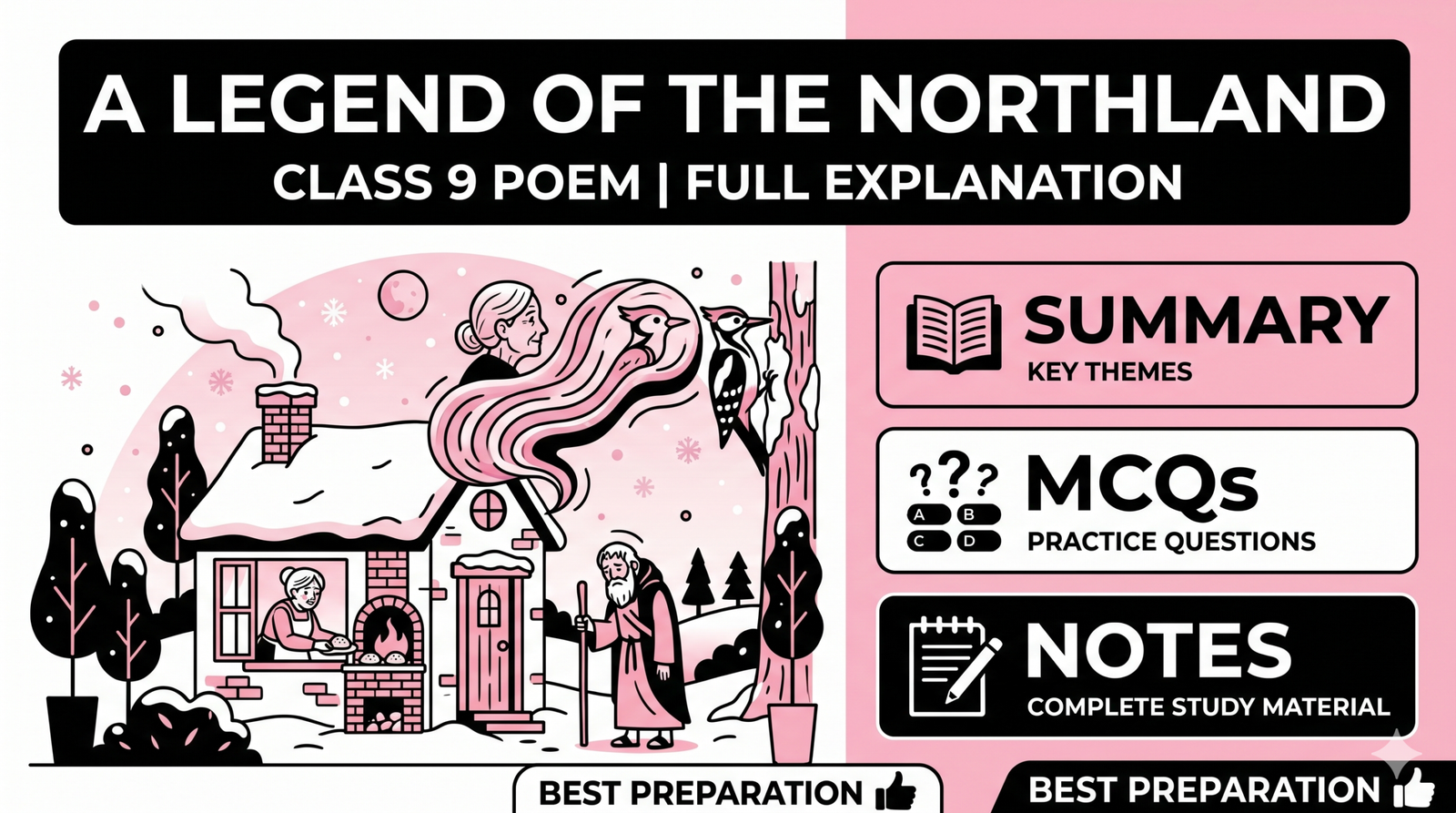
A Legend of the Northland Class 9: Full Notes, Poem & MCQs
Welcome to the complete study guide for Class 9 English Beehive poem, “A Legend of the Northland”. Written by Phoebe Cary, this poem is a ‘ballad’ (a song or poem that tells a story). It narrates the legend of an old, greedy woman who angered Saint Peter and was cursed for her selfishness, teaching us a timeless moral about generosity.
The Poem: “A Legend of the Northland”
(Scroll inside the box to read the full poem)
Where the hours of the day are few,
And the nights are so long in winter
That they cannot sleep them through;
Where they harness the swift reindeer
To the sledges, when it snows;
And the children look like bear’s cubs
In their funny, furry clothes:
They tell them a curious story —
I don’t believe ’tis true;
And yet you may learn a lesson
If I tell the tale to you.
Once, when the good Saint Peter
Lived in the world below,
And walked about it, preaching,
Just as he did, you know,
He came to the door of a cottage,
In traveling round the earth,
Where a little woman was making cakes,
And baking them on the hearth;
And being faint with fasting,
For the day was almost done,
He asked her, from her store of cakes,
To give him a single one.
So she made a very little cake,
But as it baking lay,
She looked at it, and thought it seemed
Too large to give away.
Therefore she kneaded another,
And still a smaller one;
But it looked, when she turned it over,
As large as the first had done.
Then she took a tiny scrap of dough,
And rolled and rolled it flat;
And baked it thin as a wafer —
But she couldn’t part with that.
For she said, “My cakes that seem too small
When I eat of them myself
Are yet too large to give away.”
So she put them on the shelf.
Then good Saint Peter grew angry,
For he was hungry and faint;
And surely such a woman
Was enough to provoke a saint.
And he said, “You are far too selfish
To dwell in a human form,
To have both food and shelter,
And fire to keep you warm.
Now, you shall build as the birds do,
And shall get your scanty food
By boring, and boring, and boring,
All day in the hard, dry wood.”
Then up she went through the chimney,
Never speaking a word,
And out of the top flew a woodpecker,
For she was changed to a bird.
She had a scarlet cap on her head,
And that was left the same;
But all the rest of her clothes were burned
Black as a coal in the flame.
And every country schoolboy
Has seen her in the wood,
Where she lives in the trees till this very day,
Boring and boring for food.
Complete Summary of A Legend of the Northland
This poem is a legend from the cold region of the Northland. It is a story told to children to teach them the value of sharing and the dangers of greed.
Part 1: The Setting of the Northland
The poem is set in the extreme cold region of the Northland (near the North Pole). The days are very short, and the winter nights are so long and freezing that people cannot sleep through them. People travel using sledges pulled by fast reindeer, and children wearing heavy furry winter clothes look like little bear cubs.
Part 2: Saint Peter Arrives at a Cottage
The story goes back to the time when Saint Peter lived on earth as a human and traveled around preaching. One day, after fasting for the whole day, he was feeling extremely hungry, weak, and faint. He reached the door of a cottage where a little old woman was baking cakes in her fireplace (hearth). Saint Peter requested her to give him just a single cake from her store to save him from starving.
Part 3: The Woman’s Extreme Greed
The woman was very greedy. Instead of giving a cake from her store, she decided to bake a new, very small one for him. However, when it was baked, she felt it was too big to give away for free. She kneaded the dough again and made an even smaller one, but her greed made her feel it was still too big. Finally, she took a tiny scrap of dough and rolled it as thin as a wafer. Yet, her selfish heart did not allow her to give even that paper-thin cake away. She put it on the shelf, saying her cakes seem small when she eats them but too large to give away.
Part 4: The Curse and Transformation
Seeing her extreme selfishness, the usually calm Saint Peter grew very angry. He told her that she was too selfish to live as a human being who enjoys the comforts of food, shelter, and a warm fire. He cursed her, turning her into a bird (a woodpecker). As a bird, she would have to work extremely hard (“boring, and boring, and boring” into hard, dry wood) all day just to get a scanty (very little) amount of food.
Part 5: The Conclusion
Immediately, the woman flew up the chimney without saying a word and came out of the top as a woodpecker. The red cap she was wearing remained on her head (as the red crest of the woodpecker), but her clothes were burnt black as coal. The poet concludes that even today, schoolboys can see her in the forests, boring into trees for food, serving as a reminder not to be greedy.
Important Word Meanings
| Word/Phrase | Meaning in English |
|---|---|
| Legend | An old traditional story, sometimes not completely true. |
| Sledges | Vehicles used for traveling over snow, usually pulled by animals. |
| Hearth | The floor of a fireplace where fires are lit. |
| Faint | Weak and dizzy from hunger. |
| Kneaded | Worked the dough with hands to make bread or cake. |
| Provoke | To make someone angry. |
| Scanty | Very small in quantity; insufficient. |
| Boring | Making a hole in something hard (like wood) with a beak or tool. |
| Scarlet | A brilliant red color. |