
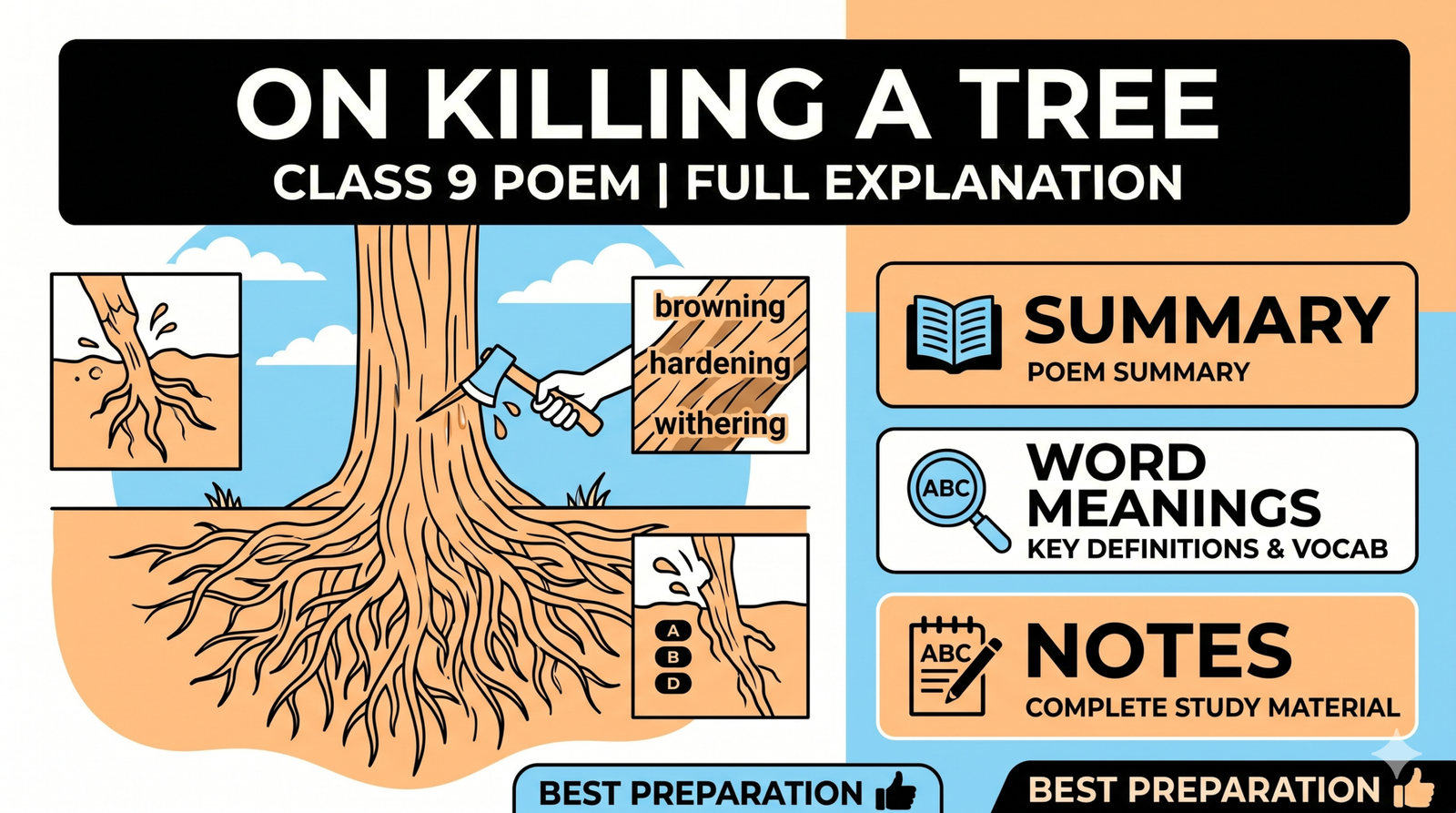
On Killing a Tree Class 9: Full Notes, Poem & MCQs
Welcome to the complete study guide for Class 9 English Beehive poem, “On Killing a Tree”. Written by Gieve Patel, this powerful poem describes the slow, painful process of destroying a tree. It highlights the resilience of nature and acts as a strong criticism of human cruelty towards the environment (deforestation).
The Poem: “On Killing a Tree” by Gieve Patel
Not a simple jab of the knife
Will do it. It has grown
Slowly consuming the earth,
Rising out of it, feeding
Upon its crust, absorbing
Years of sunlight, air, water,
And out of its leprous hide
Sprouting leaves.
So hack and chop
But this alone won’t do it.
Not so much pain will do it.
The bleeding bark will heal
And from close to the ground
Will rise curled green twigs,
Miniature boughs
Which if unchecked will expand again
To former size.
No,
The root is to be pulled out —
Out of the anchoring earth;
It is to be roped, tied,
And pulled out — snapped out
Or pulled out entirely,
Out from the earth-cave,
And the strength of the tree exposed,
The source, white and wet,
The most sensitive, hidden
For years inside the earth.
Then the matter
Of scorching and choking
In sun and air,
Browning, hardening,
Twisting, withering,
And then it is done.
Complete Summary of On Killing a Tree
The poem is a dark, step-by-step manual on how to kill a tree, cleverly used by the poet to show how deeply connected a tree is to the Earth and how difficult it is to destroy life completely.
Stanza 1: The Resilience of the Tree
The poet starts by saying that killing a tree takes a lot of time. A simple, quick cut (“jab”) with a knife will not kill it. This is because the tree has grown very slowly over the years. It has consumed nutrients from the earth, fed on the soil’s crust, and absorbed years of sunlight, air, and water. Its bark looks rough, discolored, and diseased (described as “leprous hide”), yet fresh green leaves sprout from it, showing its strong will to live.
Stanza 2: The Failure of Hacking and Chopping
Even if a person hacks and chops the tree into pieces, it will not die. Hacking causes a lot of pain to the tree, and its bark bleeds (sap comes out like human blood), but it will heal over time. From the stump left close to the ground, small, curled green twigs and miniature branches (“boughs”) will start growing again. If left alone, they will expand and the tree will regain its former size.
Stanza 3: Exposing the Root
The poet then explains that to truly kill a tree, the “No” must be implemented. One must pull out the root. The earth holds the tree firmly like an anchor (“anchoring earth”). The tree must be tied with a rope and forcefully pulled entirely out of its deep “earth-cave.” When this happens, the true strength of the tree—the root—is exposed. The root is white, wet, and the most sensitive part of the tree because it has remained safely hidden inside the earth for years.
Stanza 4: The Final Death
Once the root is completely uprooted and separated from the earth, the final death process begins. Left in the scorching sun and choking air, the root can no longer absorb water or nutrients. It starts turning brown, becoming hard, twisting out of shape, and finally withering (drying up completely). Once this process is complete, the tree is finally “done” or fully dead.
Important Word Meanings
| Word/Phrase | Meaning in English |
|---|---|
| Jab | A sudden rough blow or quick poke with a sharp object. |
| Leprous hide | The rough, discolored bark of the tree (compared to the skin of a leprosy patient). |
| Hack | To cut with heavy, rough blows. |
| Bleeding bark | The sap flowing out of the tree where it has been cut, resembling blood. |
| Miniature boughs | Very small branches. |
| Anchoring earth | The soil that holds the roots tightly and keeps the tree secure. |
| Earth-cave | The deep hole in the ground where the roots were holding on. |
| Withering | Drying up, shrinking, and dying. |