
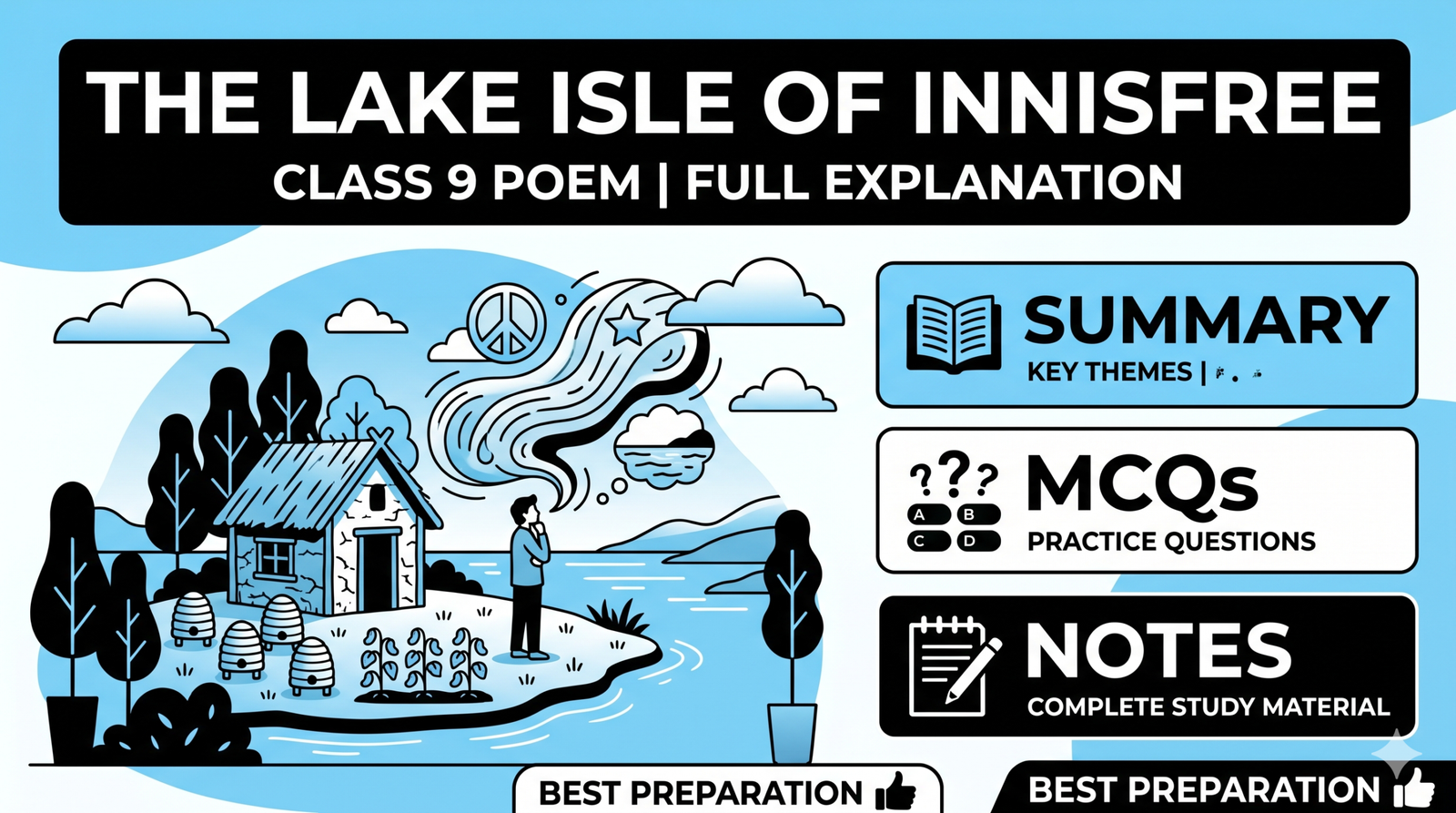
The Lake Isle of Innisfree Class 9: Full Notes, Poem & MCQs
Welcome to the complete study guide for Class 9 English Beehive chapter, “The Lake Isle of Innisfree”. Written by the renowned poet William Butler Yeats (W.B. Yeats), this lyric poem explores the universal human desire to escape the noisy, stressful city life and find peace in the lap of nature.
The Poem: “The Lake Isle of Innisfree”
And a small cabin build there, of clay and wattles made;
Nine bean-rows will I have there, a hive for the honey-bee,
And live alone in the bee-loud glade.
And I shall have some peace there, for peace comes dropping slow,
Dropping from the veils of the morning to where the cricket sings;
There midnight’s all a glimmer, and noon a purple glow,
And evening full of the linnet’s wings.
I will arise and go now, for always night and day
I hear lake water lapping with low sounds by the shore;
While I stand on the roadway, or on the pavements grey,
I hear it in the deep heart’s core.
Complete Summary of The Lake Isle of Innisfree
The poem is a beautiful expression of the poet’s deep longing for peace and tranquility, which he believes can only be found in the natural surroundings of Innisfree, an island in Ireland where he spent a lot of time as a boy.
Stanza 1: The Poet’s Plan
The poet expresses his strong determination to leave his current location (the noisy city) and go to the island of Innisfree. He plans to build a very simple life there. He will construct a small cabin made of clay and wattles (interwoven sticks). For his food, he will plant nine rows of beans and keep a beehive for fresh honey. He wishes to live all alone in the open space (“glade”) that will be filled with the loud, buzzing sound of the bees.
Stanza 2: The Experience of Peace
In the second stanza, the poet describes the kind of peace he will experience there. He says that peace in Innisfree does not come suddenly; it comes “dropping slow.” He feels peace descending from the misty mornings (“veils of the morning”) to the time when male crickets sing. He paints a magical picture of the island: the midnights are faintly bright (“glimmer”), the noons have a beautiful purplish light, and the evenings are filled with the fluttering wings of small brown birds called linnets.
Stanza 3: The Inner Calling
In the final stanza, the poet repeats his strong desire: “I will arise and go now.” He states his reason for this urgency. All the time, day and night, he can hear the gentle sound of the lake water hitting the shore of Innisfree. Even when he is standing on the busy roads or dull, “grey” pavements of the city (representing the lifeless urban environment), the sound of the lake water echoes deep inside his heart (“heart’s core”).
Important Word Meanings
| Word/Phrase | Meaning in English |
|---|---|
| Isle | An island or peninsula. |
| Wattles | Twisted sticks or twigs used for making fences or walls. |
| Glade | An open space in a forest. |
| Glimmer | A faint or weak light. |
| Linnet | A small brown and grey bird with a short beak. |
| Lapping | The gentle sound of water hitting the shore. |
| Heart’s core | The deepest part of the heart; the inner soul. |
| Pavements grey | Dull, concrete footpaths of the city (symbolizing a lack of nature). |