
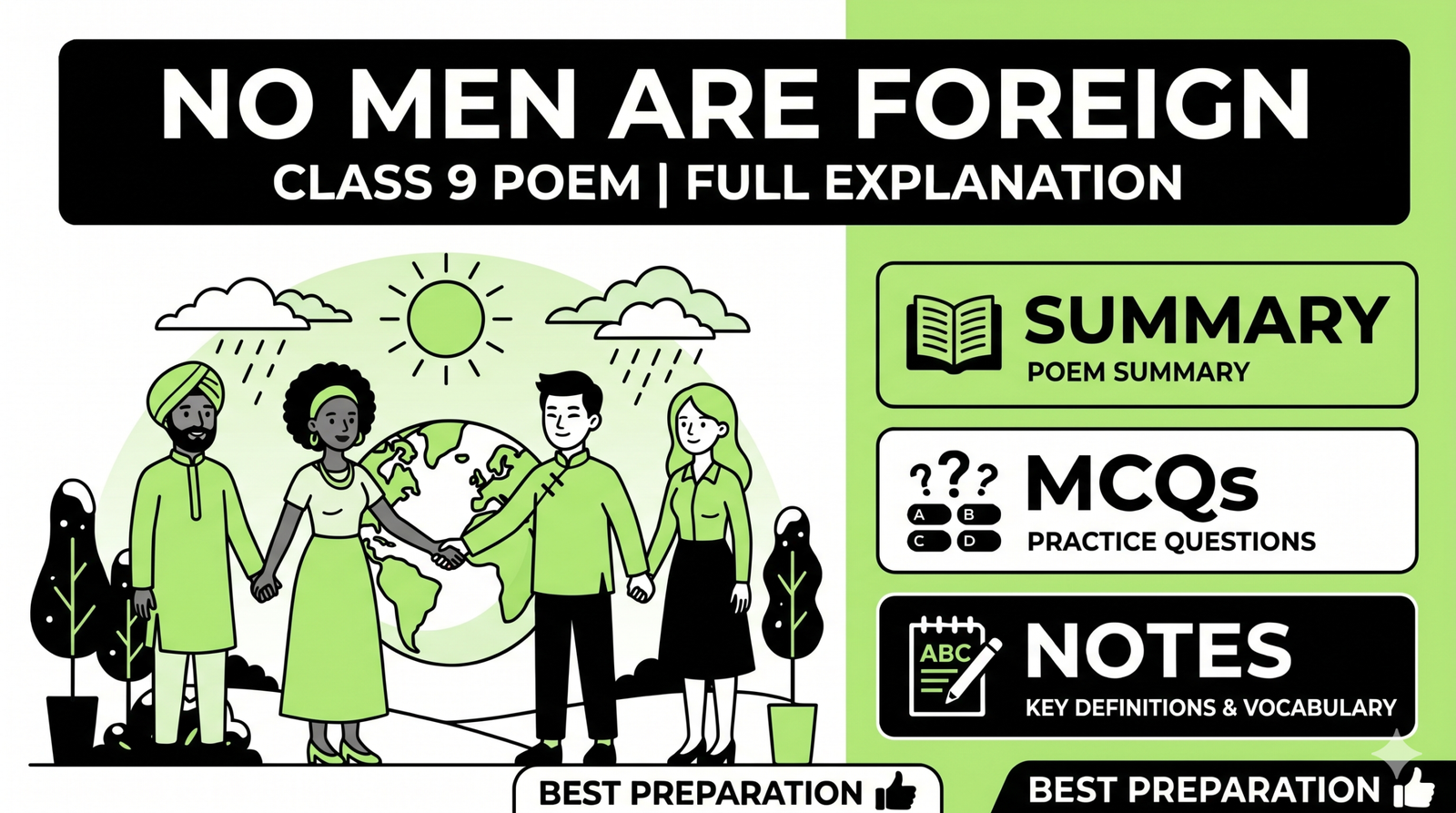
No Men Are Foreign Class 9: Full Notes, Poem & MCQs
Welcome to the complete study guide for Class 9 English Beehive poem, “No Men Are Foreign”. Written by James Kirkup, this beautiful and thought-provoking poem strongly advocates for universal brotherhood. It teaches us that national borders, different languages, and military uniforms are artificial boundaries, and beneath them, all humans are exactly the same.
The Poem: “No Men Are Foreign” by James Kirkup
Beneath all uniforms, a single body breathes
Like ours: the land our brothers walk upon
Is earth like this, in which we all shall lie.
They, too, aware of sun and air and water,
Are fed by peaceful harvests, by war’s long winter starv’d.
Their hands are ours, and in their lines we read
A labour not different from our own.
Remember they have eyes like ours that wake
Or sleep, and strength that can be won
By love. In every land is common life
That all can recognise and understand.
Let us remember, whenever we are told
To hate our brothers, it is ourselves
That we shall dispossess, betray, condemn.
Remember, we who take arms against each other
It is the human earth that we defile.
Our hells of fire and dust outrage the innocence
Of air that is everywhere our own,
Remember, no men are foreign, and no countries strange.
Complete Summary of No Men Are Foreign
The central theme of the poem is that all human beings are equal. God has made us all the same, and we should live in peace and harmony instead of fighting over borders and religions.
Stanza 1: Physical Similarity
The poet begins by reminding us that no human being is ‘strange’ or unfamiliar, and no country is ‘foreign’. Soldiers from different countries may wear different “uniforms,” but beneath those uniforms, the same human body breathes. All people walk upon the same Earth, and when we die, we will all be buried in this very same Earth.
Stanza 2: Shared Nature and Struggles
Just like us, people of other nations need the sun, air, and water to survive. During times of peace, they prosper and eat the food grown from “peaceful harvests.” However, during the harsh times of war (compared to a long, starving winter), they suffer and starve just as we would. If we look at their hands, we will see the lines of hard work (“labour”), which proves they work just as hard as we do to earn a living.
Stanza 3: Emotions and Love
The poet asks us to remember that our so-called “enemies” have eyes exactly like ours—eyes that wake up and go to sleep. They also possess physical strength, but that strength can be conquered not by force, but by love. Everywhere in the world, the journey of life is common. Everyone experiences the same emotions of joy and sorrow, which we all can easily recognize and understand.
Stanza 4: The Harm of Hatred
Whenever selfish leaders or warmongers tell us to hate people of other countries and fight against them, we should stop and think. By hating our “brothers” across the border, we are actually cheating, betraying, and condemning ourselves. Hatred destroys our own peace of mind.
Stanza 5: Defiling the Earth
Finally, the poet warns that when we take up weapons (“arms”) against each other and engage in war, we only pollute and dirty (“defile”) our shared Mother Earth. The fire, smoke, and dust of bombs and weapons destroy the purity (“innocence”) of the air that we all breathe. The poet concludes by repeating his opening thought: no men are foreign, and no countries are strange.
Important Word Meanings
| Word/Phrase | Meaning in English |
|---|---|
| Foreign | Belonging to a country other than one’s own. |
| Beneath | Under or below something. |
| Uniforms | Here, it refers to the different military dresses worn by soldiers of different countries. |
| Defile | To make something dirty, polluted, or impure. |
| Dispossess | To deprive someone of what they own (land, rights, etc.). |
| Condemn | To express strong disapproval of someone; to punish. |
| Outrage the innocence | To violate or destroy the purity and peace of the atmosphere. |