1. Introduction to Quality
Hello students! Welcome to the complete study notes for Class 7 English Chapter 5: “Quality” (JAC Board & NCERT). Written by the renowned author John Galsworthy, this story is a touching and emotional account of a true artist’s dedication to his work. It highlights the struggle of traditional craftsmen against modern, large-scale factories. The chapter beautifully explores the theme that true Quality Class 7 comes from passion, hard work, and a commitment that sometimes demands the ultimate sacrifice. Let’s delve into this inspiring yet tragic story.
2. Characters Detail
- Mr. Gessler (The Younger Brother): A dedicated German bootmaker living in London. He treats shoemaking as an art and never compromises on the quality of his boots, even if it means starving himself.
- The Elder Gessler Brother: Mr. Gessler’s older brother who shares the same passion for shoemaking. He tragically passes away due to the shock of losing one of their shops.
- The Narrator: A loyal customer who deeply admires the Gessler brothers’ craftsmanship. He tries to help them financially by ordering multiple pairs of boots.
3. Full Summary: Quality Class 7
The Master Bootmaker
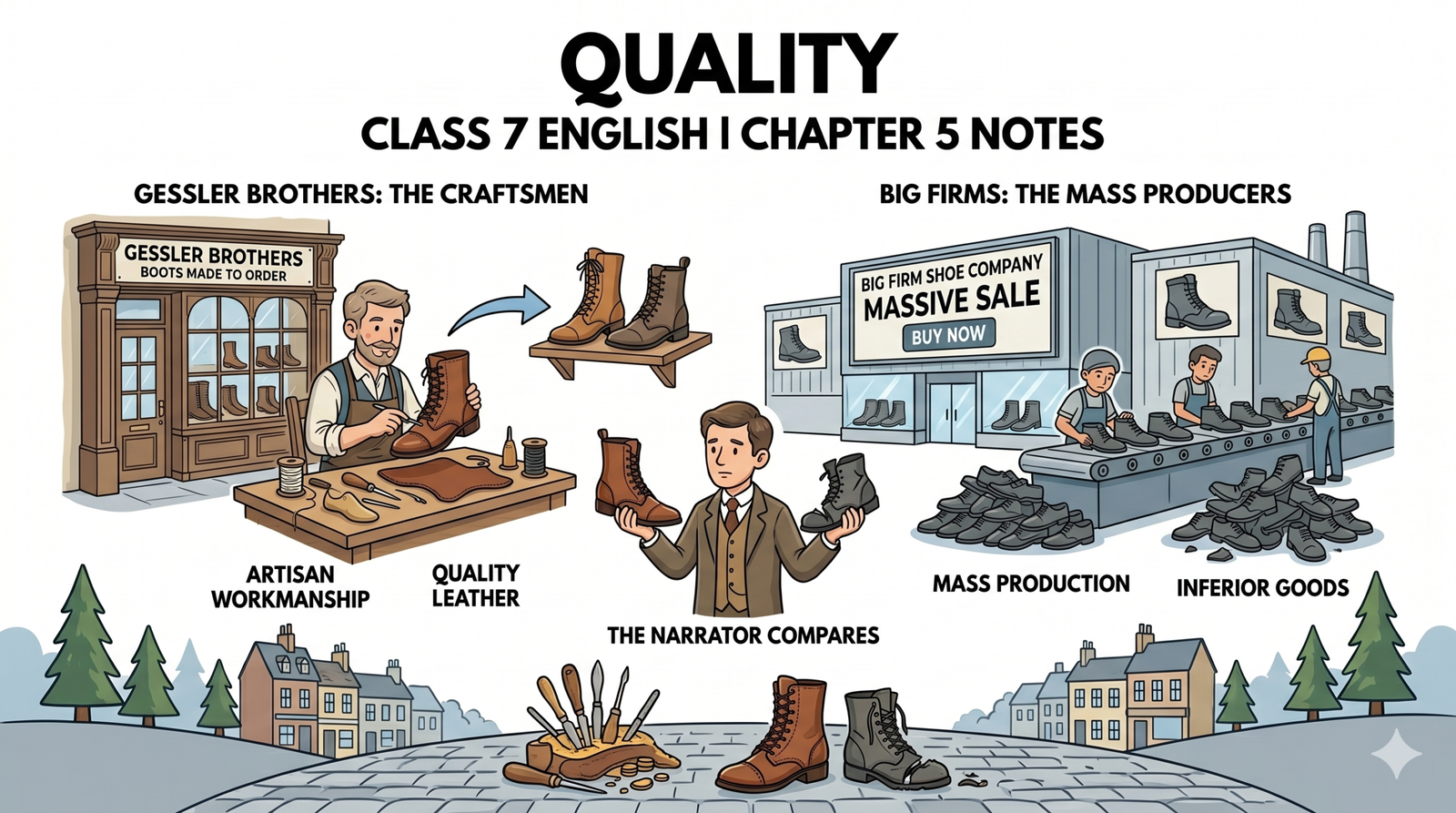
The narrator had known Mr. Gessler from his youth because Mr. Gessler made his father’s boots. The Gessler brothers lived in their shop in London. The shop had no big signs, just the name “Gessler Brothers.” Mr. Gessler only made boots on order, and the boots he made never failed to fit perfectly. For Mr. Gessler, making boots was not just a business; it was a sacred art.
The Creaking Boot Incident
The boots made by Mr. Gessler lasted so long that customers didn’t need to visit his shop very often. Once, the narrator complained that a pair of boots he bought had creaked. Mr. Gessler was shocked and hurt. He asked the narrator to bring the boots back, promising to either fix them or take them off the bill. This showed his extreme honesty and dedication to his craft.
The Threat of Big Firms
On another occasion, the narrator entered the shop wearing boots bought in an emergency from a large firm. Mr. Gessler immediately pointed out where the boot was hurting the narrator. For the first time, he spoke sadly about the hardships of his trade. He explained that large firms get business through advertisements, not by providing good work. Because of these big companies, traditional craftsmen like him were slowly losing all their customers and struggling to survive.
The Loss of the Elder Brother
A few years later, the narrator visited the shop again. He was shocked to learn that the elder Gessler brother had passed away. He died of shock and grief after they lost one part of their shop. Feeling immense pity for the struggling younger brother, the narrator ordered several pairs of boots, even though he didn’t need them immediately, just to provide some financial help.
The Tragic End of a True Artist
After being abroad for over a year, the narrator returned to London and visited the shop. He found that Mr. Gessler had aged terribly—he looked like a man of seventy-five. Once again, the narrator ordered many pairs of boots. A week later, he went to the shop to personally thank Mr. Gessler for the brilliant boots, but he found a young English face in the shop instead.
The young man informed the narrator that Mr. Gessler was dead. He had died of slow starvation. He spent all his money on buying the best quality leather and paying the shop’s rent. He never advertised, never hired anyone to help, and took a long time to make the perfect pair of boots. He forgot to eat, sacrificing his own life to maintain the uncompromising Quality of his boots.
4. Multiple Choice Questions (10 MCQs)
Q1. Who is the author of the story “Quality”?
(a) Ruskin Bond | (b) John Galsworthy | (c) Leo Tolstoy | (d) William Wordsworth
Answer: (b) John Galsworthy
Q2. What was the profession of the Gessler brothers?
(a) Tailors | (b) Carpenters | (c) Bootmakers | (d) Blacksmiths
Answer: (c) Bootmakers
Q3. Where was the Gessler brothers’ shop located?
(a) Paris | (b) Berlin | (c) London | (d) New York
Answer: (c) London
Q4. What did Mr. Gessler consider bootmaking to be?
(a) A burden | (b) A business | (c) An art | (d) A hobby
Answer: (c) An art
Q5. How did Mr. Gessler react when the narrator complained about a creaking boot?
(a) He got angry | (b) He was shocked and promised to fix or refund them | (c) He blamed the narrator | (d) He ignored him
Answer: (b) He was shocked and promised to fix or refund them
Q6. Whom did Mr. Gessler blame for the downfall of his business?
(a) The narrator | (b) His elder brother | (c) Big firms and advertisements | (d) The government
Answer: (c) Big firms and advertisements
Q7. Why did the elder Gessler brother die?
(a) Starvation | (b) Accident | (c) Shock and grief over losing part of their shop | (d) Old age
Answer: (c) Shock and grief over losing part of their shop
Q8. Why did the narrator order so many boots at once?
(a) He had a large family | (b) He was going on a long trip | (c) Out of pity to help Mr. Gessler financially | (d) To sell them at a profit
Answer: (c) Out of pity to help Mr. Gessler financially
Q9. How did the younger Mr. Gessler die?
(a) Of a heart attack | (b) Slow starvation | (c) In an accident | (d) He was murdered
Answer: (b) Slow starvation
Q10. Why did Mr. Gessler starve to death?
(a) He had no food in the city | (b) He spent all his money on rent and the best leather | (c) He was on a religious fast | (d) He forgot how to cook
Answer: (b) He spent all his money on rent and the best leather
5. Short Answer Questions (30-40 Words)
Q1. What was Mr. Gessler’s attitude towards his work?
Ans. Mr. Gessler considered bootmaking not just a trade, but a pure art. He was highly passionate, deeply committed, and never compromised on the quality of the leather or his craftsmanship.
Q2. What was Mr. Gessler’s complaint against “big firms”?
Ans. Mr. Gessler complained that big firms had no self-respect. They captured the market and took away customers not by producing good quality boots, but solely through flashy advertisements.
Q3. Why did the author order so many pairs of boots?
Ans. The author (narrator) ordered multiple pairs of boots because he felt deep pity and sympathy for Mr. Gessler’s struggling financial condition. He wanted to help him earn some money.
Q4. How did the author feel when he learned about Mr. Gessler’s death?
Ans. The author was deeply shocked and saddened. He had just received the best boots ever made by Mr. Gessler and went to thank him, only to find out that the master craftsman had starved to death.
Q5. Why did Mr. Gessler’s business fail despite making the best boots?
Ans. His business failed because he never advertised. He took a very long time to make a single pair of boots, and customers in the modern world lacked the patience to wait, preferring to buy readymade boots from large firms.
6. Long Answer Questions (60-80 Words)
Q1. Give a character sketch of Mr. Gessler.
Ans. Mr. Gessler was a poor German bootmaker living in London. He was a perfectionist and a true artist who dedicated his entire life to his craft. He was incredibly honest, hardworking, and never compromised on the quality of his work. Despite severe financial struggles and the threat of large firms, he refused to use cheap leather or rush his work. His tragic flaw was his inability to adapt to the modern, fast-paced commercial world, which eventually led to his death by starvation.
Q2. What is the significance of the title “Quality”?
Ans. The title “Quality” is highly appropriate and holds a dual meaning. Firstly, it refers to the supreme, unmatched quality of the boots made by the Gessler brothers, which lasted a very long time. Secondly, and more importantly, it reflects the high quality of Mr. Gessler’s character. His dedication, honesty, passion, and uncompromising commitment to his art represent the ultimate human “quality,” even though it cost him his life.
Q3. Who is really responsible for Mr. Gessler’s tragic death?
Ans. Mr. Gessler died of slow starvation because he spent all his earnings on paying rent and buying the finest leather. While his stubbornness to not change his ways contributed to his end, the real culprits were the “big firms” and industrialization. These large companies prioritized advertisements over craftsmanship, changing consumer habits. People started valuing quick delivery and brand names over true quality. Thus, Mr. Gessler became a tragic victim of a modernized, impatient, and commercialized world.