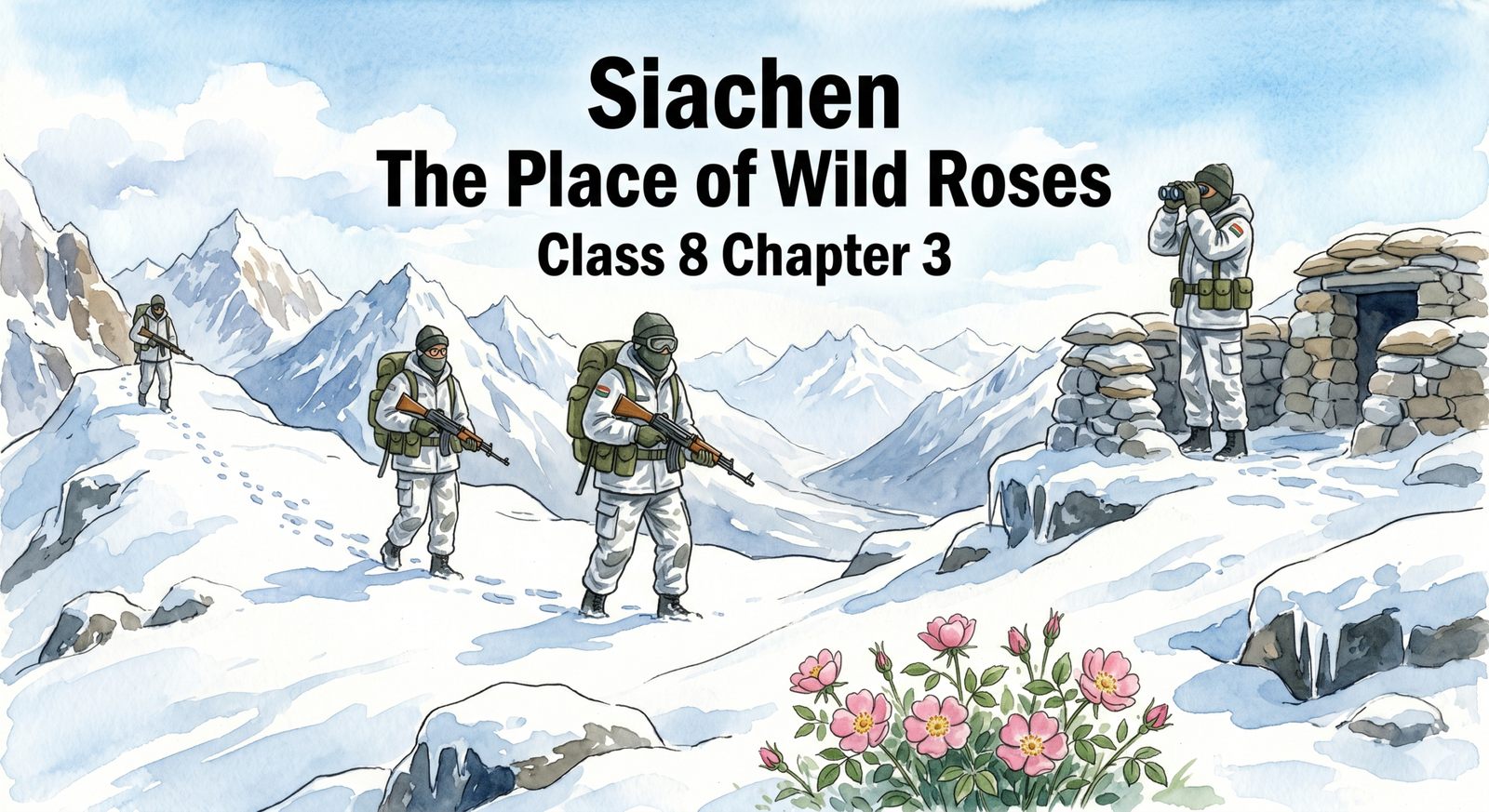
1. Chapter Introduction
Welcome to the best study material for Class 8 English. In this post, we will explore Siachen The Place of Wild Roses Class 8 notes and summary. This chapter is an informative essay that highlights the extreme conditions of the Siachen Glacier, which is known as the highest and coldest battlefield in the world. It describes the unparalleled bravery, immense struggles, and daily hardships faced by the Indian Army soldiers who guard the nation’s borders in sub-zero temperatures.
2. Key Information & Entities
- Siachen Glacier: Located in the Karakoram range of the Himalayas. It is the longest glacier in the Karakoram and second-longest in the world’s non-polar areas. Ironically, it is the highest battlefield on Earth.
- Meaning of Siachen: In the Balti language, “Sia” refers to the rose family plant, and “Chun” means any object found in abundance. Thus, Siachen means the “Place of Wild Roses”.
- The Indian Soldiers (Jawaans): The brave personnel of the Indian Armed Forces who survive at temperatures dipping to -40°C, risking avalanches, frostbite, and altitude sickness to protect the country.
3. Full Summary
Location and Significance
The Siachen Glacier is situated in the eastern Karakoram range in the Himalayas. The word ‘Siachen’ is derived from the Balti language where ‘Sia’ means a wild rose and ‘Chun’ means abundance. Despite its beautiful name, “The Place of Wild Roses”, it is the most hostile and unforgiving battlefield in the world. Both India and Pakistan maintain a permanent military presence here at heights of over 6,000 meters.
Operation Meghdoot
To secure the glacier, the Indian Army launched ‘Operation Meghdoot’ on April 13, 1984. Since then, Indian troops have maintained control over the entire Siachen Glacier. This operation showcased the extraordinary determination of the Indian forces to protect their land in the most inaccessible terrains.
Extreme Weather and Daily Life
The conditions in Siachen are deadly. The temperature can drop to -40°C or even lower. Soldiers face deadly avalanches, deep crevasses, and high-speed freezing winds. The extreme cold causes severe medical issues like frostbite, snow blindness, and pulmonary edema (fluid in the lungs due to low oxygen). Even simple tasks become monumental challenges. Soldiers have to melt ice over kerosene stoves just to get drinking water or to wash.
The Unsung Heroes
Surviving in Siachen requires special clothing and equipment. Soldiers wear layers of heavy, insulated clothing. Food items freeze solid like stones—an apple can become as hard as a cricket ball! Despite these life-threatening conditions and the fact that more soldiers die from the harsh weather and avalanches than from enemy bullets, the brave Indian soldiers stand tall. They endure unimaginable hardships with a smile, ensuring the safety of the nation.
4. Multiple Choice Questions (10 MCQs)
Q1. What does the word ‘Sia’ mean in the Balti language?
(a) Snow | (b) Rose family plant | (c) Mountain | (d) Water
Answer: (b) Rose family plant
Q2. Where is the Siachen Glacier located?
(a) Alps | (b) Andes | (c) Karakoram range | (d) Mount Everest
Answer: (c) Karakoram range
Q3. What is Siachen commonly known as?
(a) The highest battlefield in the world | (b) The longest river | (c) The largest desert | (d) The deepest ocean
Answer: (a) The highest battlefield in the world
Q4. When did the Indian Army launch Operation Meghdoot?
(a) 15 August 1947 | (b) 26 January 1950 | (c) 13 April 1984 | (d) 10 May 1999
Answer: (c) 13 April 1984
Q5. Which two countries have troops deployed in the Siachen region?
(a) India and China | (b) India and Pakistan | (c) India and Nepal | (d) Pakistan and China
Answer: (b) India and Pakistan
Q6. What happens to fresh food items like apples in Siachen?
(a) They melt | (b) They stay fresh for months | (c) They become as hard as stones | (d) They turn into juice
Answer: (c) They become as hard as stones
Q7. How do soldiers get drinking water in Siachen?
(a) Through pipelines | (b) By melting ice on stoves | (c) From rivers | (d) By collecting rain
Answer: (b) By melting ice on stoves
Q8. What does ‘Chun’ mean in the Balti language?
(a) Cold | (b) Ice | (c) Lack of | (d) Abundance
Answer: (d) Abundance
Q9. What is the lowest temperature generally recorded in Siachen?
(a) 0°C | (b) -10°C | (c) -40°C | (d) 10°C
Answer: (c) -40°C
Q10. What is the major cause of soldiers’ death in Siachen?
(a) Enemy bullets | (b) Wild animals | (c) Avalanches and extreme weather | (d) Lack of food
Answer: (c) Avalanches and extreme weather
5. Short Answer Questions (35 Words)
Q1. What is the meaning of ‘Siachen’?
Ans. In the Balti language, ‘Sia’ means a wild rose family plant and ‘Chun’ means abundance. Therefore, Siachen literally translates to “The Place of Wild Roses.”
Q2. Where is the Siachen Glacier located?
Ans. The Siachen Glacier is located in the eastern Karakoram range in the Himalayas. It is known as the highest and coldest battlefield in the world.
Q3. What was Operation Meghdoot?
Ans. Operation Meghdoot was a military operation launched by the Indian Army on April 13, 1984, to take control of the Siachen Glacier and protect it from foreign occupation.
Q4. How do soldiers manage their drinking water needs in Siachen?
Ans. Since everything is frozen in Siachen, soldiers cannot find liquid water. They have to constantly melt ice using kerosene stoves to get water for drinking and other basic needs.
6. Long Answer Questions (60-70 Words)
Q1. Describe the extreme weather conditions at the Siachen Glacier.
Ans. The weather in Siachen is incredibly harsh and deadly. The temperature can drop to -40°C or even below. The region faces high-speed, freezing winds and frequent, deadly avalanches. Due to the high altitude, the oxygen level is very low, making it difficult to breathe. Soldiers constantly face the risk of frostbite, snow blindness, and severe lung problems due to the freezing cold.
Q2. What difficulties do soldiers face regarding their food in Siachen?
Ans. Eating is a major challenge in Siachen. Due to sub-zero temperatures, fresh food items freeze solid. An apple or an orange becomes as hard as a stone and cannot be eaten normally. Even a chocolate bar becomes difficult to bite. Soldiers rely mostly on canned and specialized high-calorie foods, and they have to constantly use stoves to keep their food and tea from freezing.
Q3. Why is the Siachen Glacier called the highest battlefield in the world?
Ans. The Siachen Glacier is situated at an altitude of over 6,000 meters. Both India and Pakistan have deployed their military troops in this treacherous region to protect their borders. Soldiers are stationed in remote posts amidst snow and ice. Because armed forces are permanently fighting for control and survival at such extreme heights, it is termed the highest battlefield in the world.
Q4. Write a brief note on the bravery of the Indian soldiers at Siachen.
Ans. The Indian soldiers deployed in Siachen exhibit unparalleled bravery and resilience. They do not just fight enemy forces; they constantly battle nature’s fury. They survive avalanches, extreme frostbite, and a severe lack of oxygen. Despite the highest casualty rates being caused by the weather rather than bullets, these unsung heroes stand strong at their posts, protecting the nation with a smile and immense patriotism.